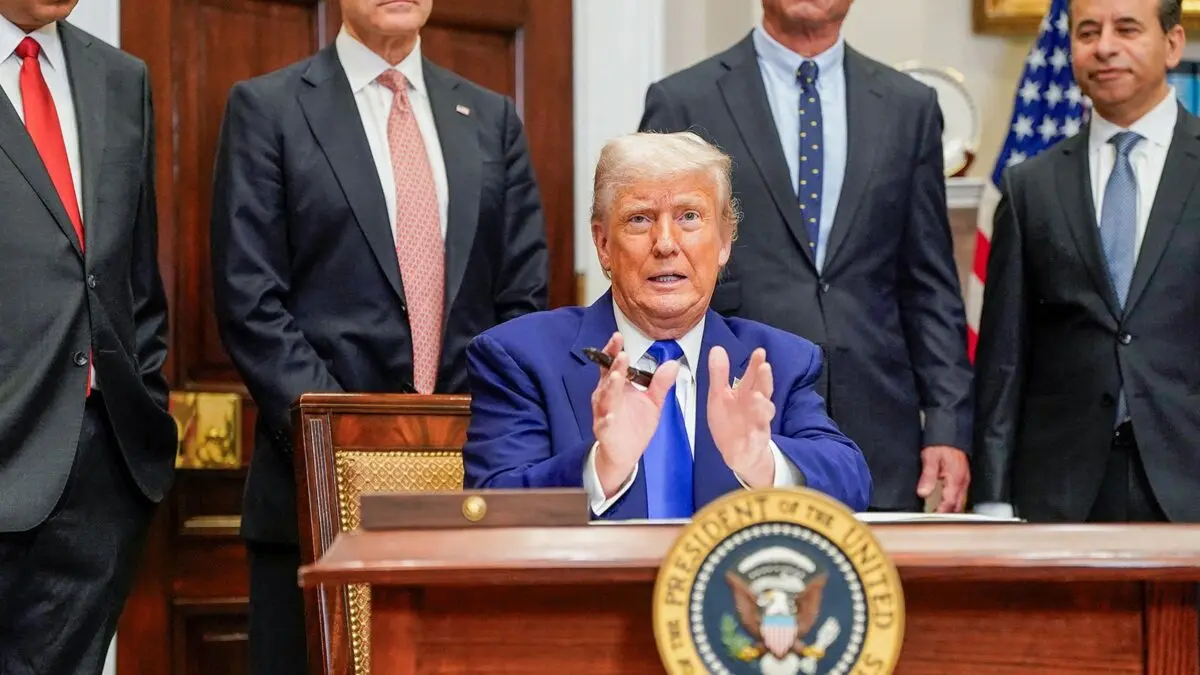
New Delhi: Even as US President Donald Trump on Thursday announced a 100% tariff on imported branded and patented pharmaceutical drugs, requiring companies to have US-based manufacturing plants to avoid the duty, this will cause less damaged to India’s $25-billion export machine than markets fear. The reason, they say, lies in the very structure of India’s drug exports—dominated not by the branded and patented medicines targeted by Washington, but by the generics that form the backbone of the country’s pharma trade with America
“I’m putting a 100% import tax on pharmaceutical drugs unless the companies are building plants right here in the United States,” Trump said on Truth Social. “Breaking ground, under construction, that’s the deal. No exceptions,” Trump had wrote on his social media handle.
India exported $13.1 billion worth of pharmaceuticals to the United States in 2024, accounting for just 5.3% of all US pharma imports but nearly a third of India’s overall pharma shipments, a Hindustan Times report cites. Of this, almost 78% was made up of low-cost generic medicines, data from Pharmexcil showed. These generics—critical for affordable healthcare in the US—do not fall under the tariff regime. “The near-term impact of the tariffs is likely to be limited, as India mainly exports generics. That being said, uncertainty still remains whether complex generics and biosimilars will come under the tariff embargo in the future,” Pankaj Pandey, head of research at ICICI Securities, told HT.
What’s the tariff plan?
The tariff plan, which takes effect on October 1, 2025, will slap a 100% duty on branded and patented medicines imported into the US. But there is a carve-out: companies that are already building or operating plants in America will not be subject to the new tax. “There will, therefore, be no tariff on these pharmaceutical products if construction has started,” Hindustan Times noted. For Indian firms, which have spent years building a presence in the US market, that exemption provides a crucial shield.
Sun Pharmaceutical Industries, India’s largest drugmaker, earned about 31% of its consolidated revenue—or $1.9 billion—from the US in FY25. It operates through its listed subsidiary Taro Pharmaceuticals and manufactures over-the-counter products via Ohm Laboratories in New Jersey.
Dr. Reddy’s Laboratories is even more dependent, with the American market contributing 45% of its revenue, or $1.73 billion. The Hyderabad-based company runs an active pharmaceutical ingredients plant in Middleburgh, New York, and until March this year had a facility in Shreveport, Louisiana, which it shut as part of restructuring. Even so, the company has signaled it is “open to expansion in the US … as a way to sidestep Trump tariffs,” Hindustan Times reported, citing The Hindu. Cipla, meanwhile, earned $934 million from its US operations—29% of its revenue—manufacturing through subsidiary InvaGen Pharmaceuticals in New York and Massachusetts, and focusing on inhalation generics, branded inhalers and some oncology products.
‘Tariffs not aimed at India’
Global strategists also agree that the Trump tariffs are not squarely aimed at India. “This is branded drugs—it doesn’t affect generics that China and India supplies,” Ken Peng, head of Asia Investment Strategy at Citi Wealth, was quoted as saying by Hindustan Times. “The regions that export the most branded, finished product to the US are Europe, Switzerland and maybe a little bit in Japan.” Indeed, Ireland alone accounts for 30% of US pharmaceutical imports, followed by Switzerland with 8.8%, while India’s 5.3% share is much smaller and largely generic in nature.
What happened to the stock market?
Still, the announcement rattled Dalal Street. Shares of Sun Pharma, Dr. Reddy’s and Cipla all slipped as investors feared a heavy blow to revenues from their most lucrative overseas market. Analysts, however, point out that the structure of India’s exports, coupled with the on-ground presence of its companies in the US, provides resilience. As Hindustan Times reported, India’s pharmaceutical industry has long been a critical supplier of affordable drugs worldwide, and its US-focused generics play a central role in reducing healthcare costs for American patients.
While generics are safe for now, there is unease over whether “complex generics”—such as inhalers and injectables—and biosimilars might be dragged under the tariff umbrella in the future. If that happens, India’s top companies could face a bigger challenge. For now, though, the consensus remains that Trump’s tariff bombshell will land hardest on Europe’s branded drug giants, leaving Indian pharma bruised on the markets but relatively shielded on the ground.
Know what will happen if tariffs are imposed on generic drugs
“We have been constantly advocating that generics should not be subjected to tariffs, as generics operate with rather than a margin. And if the tariff is imposed on generics, that will be passed to the patient, and it will increase the healthcare burden for the patient. So our advocacy, our efforts, our initiatives are to convey on a regular basis that generics should be free from tariffs. They play a vital role in access to medicines for critical diseases in the US, such as diabetes, cardiac oncology products, and gastrointestinal products. And they are serving important public health costs. So our submission will always be that tariffs should not be imposed on generics,” Sudarshan Jain, secretary general, Indian Pharmaceutical Alliance told ANI.
How can India turn this challenge into an opportunity?
AAP leader Raghav Chadha, who is also an MP, took to social media to explain how this can be turned into an opportunity. The leader had cautioned regarding such tariffs about seven months back in the Indian Parliament.
“India must turn this challenge into an opportunity by deepening alliances with other countries, co-developing medicines, sharing technology and creating pooled procurement deals. By leading in affordable healthcare, India can secure new markets while reinforcing its role as a trusted partner in public health,” the MP suggested.
Seven months ago in Parliament I had warned about this.
Today President Trump has imposed a 100% tariff on pharmaceuticals – a jolt for Indian drug makers who supply 40% of US Pharma imports.
India must turn this challenge into an opportunity by deepening alliances with other… pic.twitter.com/LJ7rVlX04y
— Raghav Chadha (@raghav_chadha) September 26, 2025