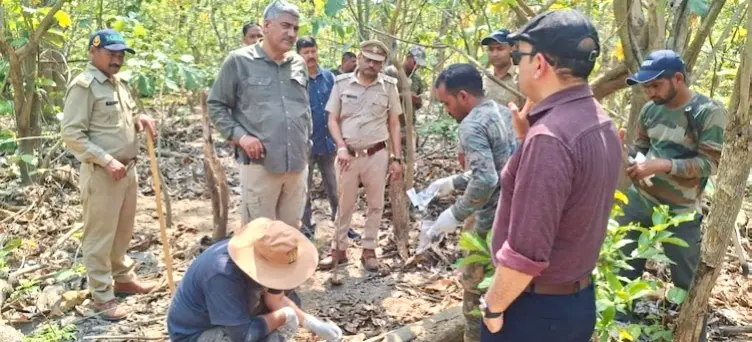
Haridwar: A horrifying wildlife crime, involving the poisoning of two tiger cubs and their subsequent mutilating has sent shockwaves through the Uttarakhand Forest Department.
The carcasses of the tiger siblings – a male and a female – were found in the Shyampur range of the Haridwar forest division. Poachers had chopped off their paws and were probably awaiting an opportunity to take away their skins and canines.
The killing of the two-year-old cubs has wiped out the entire lineage of the tiger family that once roamed the area. A search is now underway for their mother, who may have also consumed the poisoned meat that was offered as bait.
The carcass of the young male tiger was the first to be discovered during a routine tracking operation on Monday evening within the Sajanpur Beat of the Shyampur compartment.
Forest rangers were stunned to find that all four of the cub’s paws had been severed, though its skin and canines remained intact.
“The poachers probably planned to return to take the skin and canines,” Swapnil Anirudh, Divisional Forest Officer (DFO), Haridwar, has been cited by India Today as saying.
The carcass of the female cub was discovered subsequently after an intensive search. Her body was hidden inside a nearby seasonal drain. Her paws were missing as well.
A buffalo carcass, heavily laced with a lethal chemical poison, was found nearby. Both sub-adult tigers succumbed rapidly after consuming the tainted meat, forest officials suspect.
Officials have confirmed that these two cubs were the only offspring the tigress had in this specific litter, meaning her entire lineage from this cycle has been completely wiped out.
“During the search, we recovered the carcass of a buffalo, which was half-eaten,” DFO Anirudh explained. “Soon after, we discovered the carcass of the male tiger, followed by his sibling. The paws of both tigers had been severed.”
He considers this not just a simple act of retaliation, but a calculated, opportunistic poaching operation.
The mother tigress, who had originally hunted the buffalo, remains missing. A massive search operation to locate her is currently ongoing, and camera traps have been deployed across the zone.
“Fresh pugmarks have been discovered near the spot,” Anirudh confirmed. “The forest department remains hopeful as we have not yet discovered any other carcass.”
Four suspects belonging to a local Van Gujjar dera, an illegal settlement embedded inside the Shyampur range, barely one kilometer from the active crime scene by the forest officials.
An accused, identified as 50-year-old Alam (alias Ammi), has been arrested and remanded to judicial custody.
Three others, Amir Hamza (alias “Miyan”), Ashiq, and Juppi, are currently on the run, and multiple joint teams of forest personnel, police, STF and Wildlife Crime Board are actively conducting raids to apprehend them.
The buffalo used as the poisoned bait belonged to the prime suspect, Amir Hamza, who is a repeat offender.
“Hamza was caught in a 2017 poaching case where tiger and leopard bones were discovered in his possession,” DFO Anirudh said.
The incident has put the spotlight on the Van Gujjars inside the forests or along their peripheries.
Dr Koko Rose, field director of the Rajaji Tiger Reserve, noted that the Van Gujjars living in and on the peripheries of the reserve has long been under close surveillance.
“Some of the Van Gujjars were involved in past cases of poaching as well, so we are always suspicious of them and the forest department does keep a check on them. The challenge is that they know the terrain and the jungle incredibly well. Patrolling teams visit their deras on a regular basis to keep an eye on who is visiting them,” the field director said.
Incidentally, the Van Gujjars have been publicly projected as harmonious co-inhabitants and traditional guardians of the wilderness for decades.
This tragedy may reveal a deep, systemic shift where traditional forest dwellers are being systematically co-opted by organised international poaching syndicates.
“In the past, the Gujjar community was considered a friend of the forest,” renowned wildlife enthusiast A G Ansari noted.
“But this recent heinous act presents a significant shift. It cannot only be considered as a retaliatory killing of tigers. The fact that the carcasses were found with their limbs chopped off indicates they were planning to de-skin the animals, and the suspicion of illegal trade cannot be ruled out,” he said.
The incident is particularly alarming due to the critical geography of the crime scene.
The Shyampur range functions as an incredibly vital buffer zone located right next to the Chilla range of the Rajaji Tiger Reserve, which is currently home to 54 tigers as per the latest count.
“Shyampur Range is a very significant forest area in terms of tiger conservation as it borders the western side of the Rajaji reserve, and it also connects the Lansdowne Forest Division, which holds the prestigious Conservation Assured | Tiger Standards (CA|TS) status,” Ansari added.