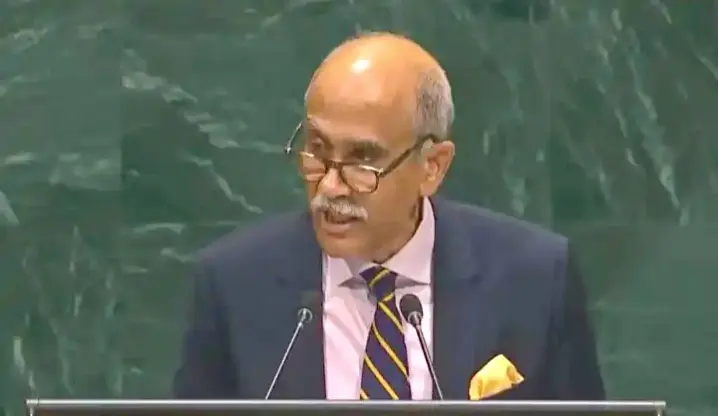
New York: Calling for meaningful reforms of the United Nations Security Council (UNSC), India has asserted that the global body’s structure cannot continue to be determined by the geopolitical realities of 1945, but reflect the contemporary world order.
While addressing the UN General Assembly (UNGA) on the question of equitable representation and increasing membership of the Security Council, India’s permanent representative to the UN, Ambassador Parvathaneni Harish, said its composition must evolve to remain relevant and legitimate, with expansion in both permanent and non-permanent categories.
“No war, especially one that took place over 80 years ago, should determine today’s state of the world. 1945 cannot be held as the sole reference point for today’s United Nations and today’s generation that is far removed from the time when this organisation was formed,” Harish said.
“We cannot reasonably drive into the future by constantly looking at the rearview mirror,” he added, as reported by ANI.
Harish, in his statement, highlighted the historical sacrifices made during the World Wars, including the contribution of Indian soldiers, while underscoring the need for a more representative Security Council.
“Around 2.5 million Indians took part in the war and around 90,000 of them died in military service. Over 4 million were killed in the infamous Bengal famine due to colonial war policies,” Harish said.
The existing global governance structure had failed to adequately recognise the experiences of countries that were not among the victors of the Second World War, he argued.
“An organisation crafted of the victors, for the victors and by the victors did not, obviously, care to include the concerns of the victims,” he said, adding that the Security Council must evolve to preserve its relevance.
Criticising the slow pace of Intergovernmental Negotiations (IGN) on Security Council reform, he noted that the process had continued for more than a decade and a half without a negotiating text, a clear timeline or a defined outcome.
“That is not negotiation; it is merely perpetuation of status quo,” he said.
The Indian envoy called for accelerated progress, urging the co-chairs of the negotiations to move from the existing Elements Paper to a negotiating text that captures the positions of member states and reflects support for expanding both categories of membership.
Asia-Pacific, Africa and Latin America remain inadequately represented in the Council, India stressed. Harish pointed out that the Asia-Pacific region accounts for more than 60 per cent of the world’s population but has only one permanent member, alongside limited elected representation.
“A reform that expands only the non-permanent category leaves the central imbalance untouched and further entrenches the status quo,” he said, reiterating India’s position that genuine reform requires expansion in both categories.
Harish said India’s position remained unchanged on the issue of veto powers, asserting that if the veto continues to exist, it must be available to all permanent members, both existing and new, to prevent institutionalising inequality.
He further called for greater transparency and accountability in the Council’s working methods, including improved representation for troop and police contributing countries, regular review of mandates and greater openness in decision-making.
Delays in reform were undermining the UN’s credibility, he warned, saying that the organisation must respond more effectively to conflicts and contemporary security challenges.
“The citizens of today want to look ahead to what the future has in store for them and not at the distant past. They want equality, rights, fraternity of international cooperation in its truest sense,” he said.
Reaffirming India’s commitment to multilateral cooperation, Harish said New Delhi would continue engaging constructively with member states to advance meaningful Security Council reform.
“We hope the 81st session will mark the point at which this process finally acquires a text, a timeline and a destination,” he said.