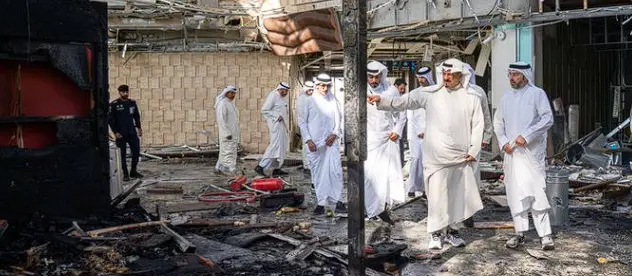
Washington/Dubai: The US government plans to redirect Iranian assets to Gulf states for rebuilding and repairs of damage caused by Iran, a source familiar with the matter said on June 6, as Tehran launched additional drone attacks following strikes against Kuwait and Bahrain, Reuters reported.
Treasury Secretary Scott Bessent has ordered specialists to calculate the cost of damage Gulf allies have already suffered from Iranian attacks. The source indicated the US may also deploy Iranian assets to cover repairs from any future destruction. Details on which assets the Treasury is reviewing remain unclear, and the wording suggests the plan could extend beyond frozen holdings.
This potential asset seizure risks further straining a fragile US-Iran ceasefire that was already shaken this weekend by reciprocal military strikes. Diplomatic efforts have ground to a halt.
Iranian state media said Pakistani Interior Minister Mohsin Naqvi landed in Tehran on June 6 to meet Iranian officials, including Foreign Minister Abbas Araghchi. According to ISNA, Naqvi stated he was bringing a “special letter” from Pakistan’s army chief and prime minister addressed to Iran’s Khamenei.
Just one day prior, Mohsen Rezaei, an adviser to Iran’s supreme leader, stated on CNN that any peace agreement depends on Washington releasing “US$24 billion (S$31 billion)” in Iranian assets the United States has
frozen.
In the early hours of June 6, US forces targeted Iranian coastal radar installations at Goruk and Qeshm Island in the Strait of Hormuz after intercepting drones that Central Command deemed dangerous to maritime shipping. The US military later confirmed it shot down two additional Iranian attack drones threatening vessels in the strait.
Iran’s Revolutionary Guard claimed it struck US military bases in Kuwait and Bahrain with ballistic missiles. Kuwaiti forces reported intercepting seven missiles that flew over residential neighborhoods, causing property damage but no injuries. Bahrain triggered emergency sirens and ordered residents to shelter. Both nations condemned Iran’s attacks. While Iran asserted it successfully hit US bases in both countries, the US military stated six missiles were intercepted and a seventh missed its target.
Meanwhile, indirect talks between Washington and Tehran have focused on an interim agreement to pause the three-month conflict, postponing contentious issues like Iran’s nuclear programme for later discussions. Tehran seeks access to billions in oil revenues, sanctions relief on crude exports, removal of a US port blockade, and bargaining power over the Strait of Hormuz, which Iran has effectively sealed despite handling roughly one-fifth of global oil traffic before the war.
President Trump told NBC that Iran’s missile and drone manufacturing capacity has been largely destroyed, though Tehran retains roughly one-fifth of its missile inventory. “They have some missiles, they have some drones. I would say percentage wise, maybe 21 per cent to 22 per cent of their missiles. It’s a lot of missiles, but it’s not what it was when we first attacked,” Trump said on NBC News’ Meet The Press, per excerpts released June 5.
The war has spiked oil prices and disrupted supply chains for humanitarian aid. In Lebanon, an Israeli strike killed two Lebanese army officers and a soldier; Israel is investigating. Iran demands a Lebanon ceasefire as a precondition for any deal with Washington.