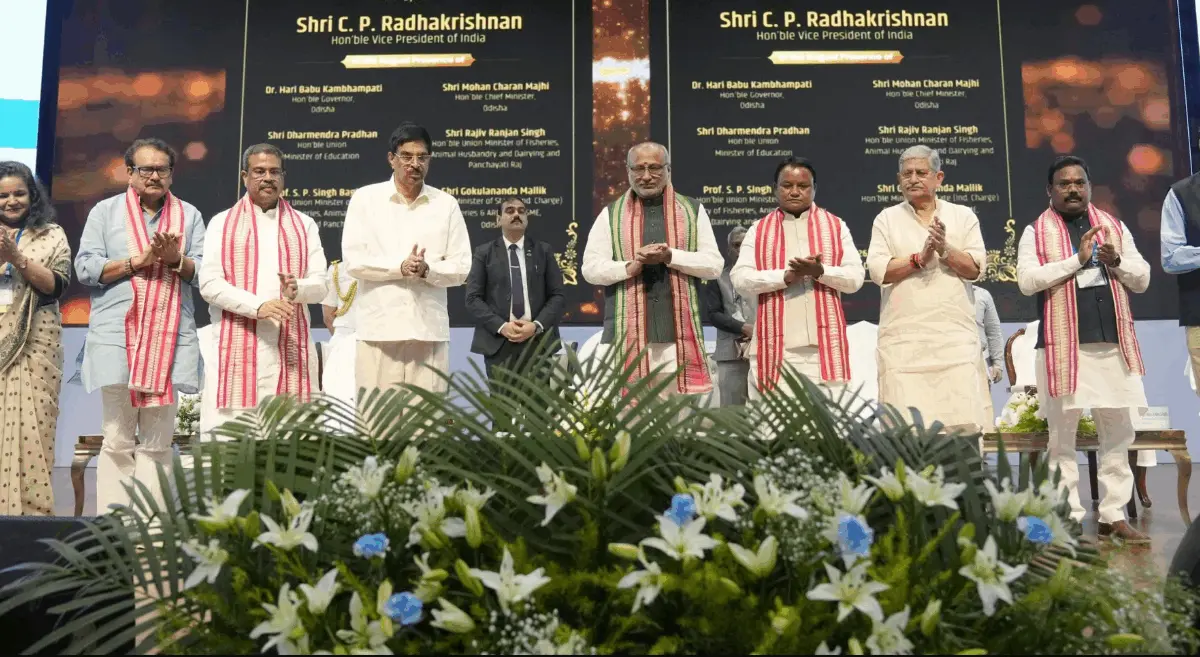
Bhubaneswar: Vice President C P Radhakrishnan on Thursday launched the national programme for issuing Letters of Authorisation (LoAs) for sustainable harvesting of fisheries in the High Seas, signifying a major step towards expanding India’s deep-sea fishing sector.
On the occasion, the Vice President also unveiled the Odisha Deep Sea Fishing Mission Document and handed over Letters of Authorisation to ten Fish Farmer Producer Organisations (FPPOs) and fishermen from different parts of the country.
Odisha Deep Sea Fishing Mission is a visionary initiative to transform the State into a leading deep-sea fishing and marine export hub of Eastern India, said Radhakrishnan.
Addressing the gathering at the event held in Bhubaneswar, Radhakrishnan said the initiative opens a new chapter in India’s maritime development by enabling fishermen to sustainably utilise the country’s vast marine resources within the Exclusive Economic Zone (EEZ) and the High Seas.
He said the programme reflects the joint commitment of the Union Government, state governments and fishing communities to promote growth, sustainability and prosperity in the fisheries sector.
The Vice President noted that India has a coastline of more than 11,000 kilometres and an Exclusive Economic Zone covering nearly 24 lakh square kilometres. Despite possessing rich marine resources, much of the potential remains untapped as fishing activities have largely been confined to coastal waters.
The new framework, he said, would encourage Indian fishermen to venture into deeper waters to sustainably harvest high-value species such as tuna.
Highlighting the growth of the fisheries sector, the Vice President sai
d India is now the world’s second-largest fish producer, contributing around 8 per cent of global fish production. The sector supports the livelihoods of nearly three crore fishermen and fish farmers, while seafood exports exceeded Rs 73,000 crore in the last financial year.
He expressed confidence that the High Seas fishing initiative would further boost seafood exports while creating employment opportunities in harvesting, fish processing, cold chain infrastructure, transportation, packaging, logistics and export services
Radhakrishnan said the new authorisation framework gives priority to fisheries cooperatives, Fish Farmer Producer Organisations and Indian fishermen for the issuance of LoAs. He described it as an important step towards empowering coastal communities and strengthening their participation in the country’s blue economy.
Underlining the need for sustainable fishing practices, the Vice President said economic growth must go hand in hand with the conservation of marine resources. He highlighted the importance of digital authorisation systems, vessel tracking, international certification and strict compliance with measures to curb illegal, unreported and unregulated fishing.
Odisha Governor Hari Babu Kambhampati, Chief Minister Mohan Charan Majhi, Union Minister Dharmendra Pradhan, and other dignitaries joined the ceremony at the Odisha University of Agriculture and Technology (OUAT). The event witnessed participation from fishermen and Fisheries Producer Organisations (FFPOs) across states.
The Vice President distributed LoAs to fishermen, enabling them to legally operate deep-sea fishing vessels up to 370 kilometres offshore. He emphasised that the mission aligns with Odisha Vision 2036 and Viksit Bharat 2047, aiming to strengthen India’s Blue Economy.
The mission includes deployment of modernised deep-sea fishing vessels, advanced technology integration, and development of marine hubs at Paradip, Dhamra, and Gopalpur. Officials highlighted that these hubs will boost coastal livelihoods and ensure sustainable utilisation of marine resources.
The Chief Minister described the initiative as a transformative step for Odisha’s fishing community. The mission will empower fishermen with modern skills, improve incomes, and secure long-term growth in fisheries, he said.