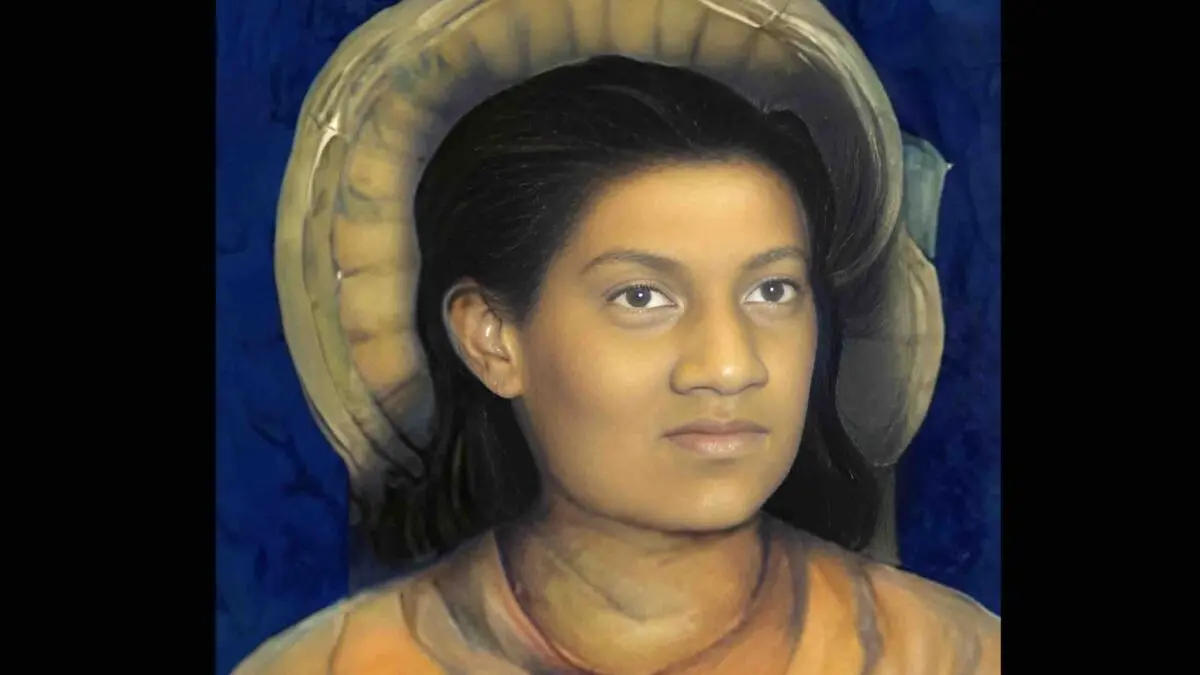
Bhima Bhoi (1850–1895), a saint-poet, mystic, and social reformer from Odisha, is one of the most remarkable figures in Indian literary and spiritual history.
Born into a marginalized Kondh (Khond) tribal family in the Rairakhol region (likely Jatasingha village in Sonepur district, though nearly half a dozen villages in the Rairakhol-Birmaharajpur area claim to be his birthplace), he rose from abject poverty and social exclusion. As a member of an “untouchable” Adivasi community, he gave voice to those long silenced by caste hierarchies and Brahmanical dominance.
Bhima Bhoi’s emergence in the Odia literary scene introduced a distinctly tribal worldview rooted in indigenous, egalitarian sensibilities that was unprecedented in a tradition previously dominated by caste-based Hindu expressions. Until his arrival, much of Odia poetry reflected the worldview of upper-caste Hindu society (though an alternative stream of rebellious Odia saint-poets did exist), often framed within Vedic, Puranic, or devotional norms that reinforced social hierarchies.
Bhima Bhoi disrupted this pattern by infusing his work with a subaltern, tribal perspective that emphasised universal humanity, rejected ritualism and idolatry, and expressed profound empathy for the suffering of all beings. His poetry does not merely adapt Hindu reformist ideas; it reimagines spirituality through an autochthonous lens, drawing from tribal experiences of nature, community, and direct communion with the divine, unmediated by priests or caste barriers.
As a devoted disciple of Mahima Gosain (the founder of Mahima Dharma, also known as Satya Mahima Dharma), Bhima Bhoi became the movement’s foremost propagator. Mahima Dharma, a monotheistic, nirguna bhakti tradition, rejected idol worship, caste discrimination, and Vedic authority in favour of devotion to a formless, indescribable supreme being (Alekha or Sunya Purusha—the void or ineffable absolute). Illiterate yet divinely inspired (legend holds that his guru blessed him with poetic vision), he composed orally in colloquial Odia infused with Sambalpuri folk elements. His rhythmic, lyrical, “spoken-sung” verses were transcribed by disciples and spread through bhajans, making them accessible t
o the masses, especially tribals and other marginalized groups.
Simply labelling his poetry as “rebellious” or an “autochthonous Hindu reformist idea” risks oversimplifying its depth. While Mahima Dharma shares some traits with other 19th-century Indian reform movements like Brahmo Samaj or Arya Samaj, it remains distinctly indigenous and non-derivative, rooted in Odisha’s tribal and bhakti soil, largely free from external colonial or pan-Indian influences.
Bhima Bhoi’s role transcends that of a poet; he was a social change-maker who challenged socio-economic injustice, religious bigotry, and caste oppression. His famous assertion — “Mo jeevana pachhe narke padithau, jagata uddhara heu” (“Let my life rot in hell if necessary, but let the world be redeemed”) — captures his radical ethic of self-sacrifice for universal liberation.
A key yet less-discussed work, Nirveda Sadhana (also spelled Nirbeda Sadhana), exemplifies this tribal-alternative narrative. Presented as a dialogue between the enlightened guru (Nirakar or Mahima Swami) and a disciple, it expounds the essence of Mahima Dharma: the path of detachment (nivrtti), renunciation of Vedic rituals and external symbols (tilak, flowers, sacred threads), and rejection of blind adherence to scriptures. True realization comes through inner devotion (nirveda sadhana), an austere, heartfelt practice independent of the Vedas, focused on complete surrender to Alekha.
The work rejects Brahmanical knowledge hierarchies, instead prioritizing ethical living, compassion, and direct spiritual experience, echoing tribal values of communal harmony, simplicity, and alignment with the natural/divine order over ritualistic formalism.
Bhima Bhoi’s conception of the “human” is profoundly tribal: inclusive, non-hierarchical, and grounded in lived suffering rather than abstract metaphysics. His poetry critiques caste as a barrier to divine access, promotes gender inclusion (by initiating women into the faith), and envisions a society of one God, one humanity, and one religion. Yet scholars often fail to read him through this tribal lens, reducing him instead to a bhakti reformer or mystic, overlooking how his indigenous worldview reshapes Indian spirituality “from below.”
In an era dominated by caste narratives, Bhima Bhoi remains the voice of the voiceless: a Kondh tribal whose poetry wields rebellion as compassion and reform as redemption. His legacy endures in the living communities of Mahima Dharma and in the ongoing quest for equality, demanding deeper historical and subaltern analysis to fully appreciate his transformative power.