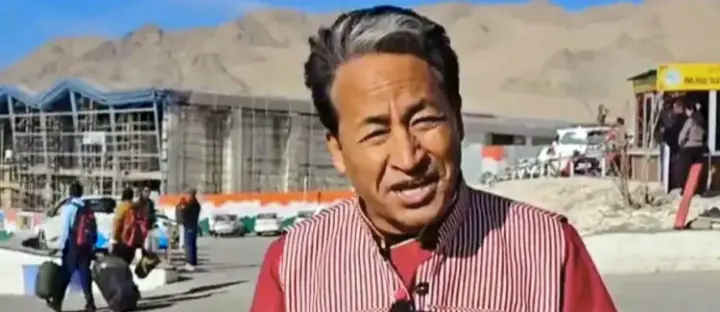
Leh: Activist Sonam Wangchuk has warned that Ladakh could witness a “very large-scale agitation” if the Centre fails to make concrete progress on the region’s long-pending demands after the talks scheduled to be held next week.
Wangchuk, who is associated with the Leh Apex Body (LAB), said on Friday that the group would be left with little choice but to intensify its movement if Ladakh continued to face what he described as “stepmotherly treatment”, particularly in matters concerning its people and sensitive border areas.
He issued the warning ahead of a crucial meeting to be held between an LAB sub-committee and officials of the Ministry of Home Affairs (MHA) on September 9, as reported by The Times of India. The outcome of the talks would determine the next course of action, he indicated.
“If there is no concrete progress after September 9, we will be compelled to launch a very large-scale agitation,” Wangchuk said, warning.
The LAB’s proposed foot march (padyatra) from Kargil to Leh, beginning September 10, has now been postponed in view of the scheduled talks with the Centre.
The organisation has indicated that the march could be revived if the September 9 discussions fail to produce a satisfactory outcome, Wangchuk said.
The LAB has also called for wider support for Ladakh’s political rights, environmental concerns and the interests of people living along the strategically important border region.
September is being observed by the organisation as “Martyrs’ Month” to remember those who were killed, injured or jailed during the violence that erupted in the Union Territory in September 2025.
Ladakh is demanding stronger political representation and constitutional safeguards for the Union Territory.
The LAB and the Kargil Democratic Alliance (KDA) have been seeking an elected legislative structure for Ladakh with meaningful powers over legislation, administration and finances. They have also pushed for constitutional protection for the region, including safeguards similar to those available under the Sixth Schedule or through provisions such as Article 371.
They have also been demanding the withdrawal of cases linked to the September 2025 violence, compensation for those affected and the publication of the inquiry commission’s report into the clashes.
There has been a prolonged political campaign since Ladakh was separated from Jammu and Kashmir and made a Union Territory in 2019.
The LAB and KDA have repeatedly engaged with the Centre since then, seeking greater political autonomy, protection of Ladakh’s fragile environment and safeguards for its land, culture and employment opportunities.
While previous rounds of discussions, including talks held in May 2026, have resulted in some areas of understanding and draft proposals, major differences remain, according to Wangchuk and the two regional bodies.
The groups have also expressed concern over what they describe as a trust deficit between Ladakh’s representatives and the Centre.
The activist, who has previously undertaken hunger strikes and participated in peaceful demonstrations over Ladakh’s demands, has continued to advocate dialogue while warning that patience among protesters is wearing thin.
It now remains to be seen whether the September 9 meeting can lead to substantive progress on Ladakh’s demands – or whether the stalled dialogue will give way to another major round of agitation.