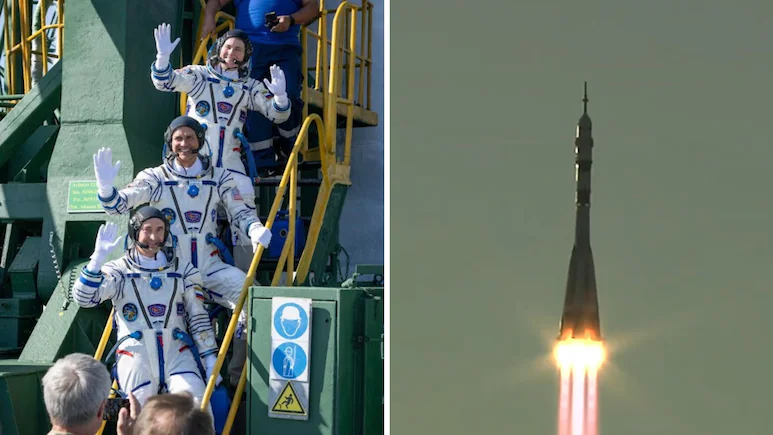
New Delhi: Anil Menon, a NASA astronaut of Indian origin, launched into space along with Russian cosmonauts Pyotr Dubrov and Anna Kikina on board Russia’s Soyuz MS-29 spacecraft.
The trio blasted off for the International Space Station (ISS) from Baikonur Cosmodrome in Kazakhstan.
This is the second mission for Dubrov and Kikina, and the maiden space odyssey for Menon.
They are expected to spend eight months at ISS, conducting scientific research and technology demonstrations before returning to Earth early next year.
The Soyuz MS-29 lifted off at 8.17 pm on Tuesday, and is expected to dock at the orbital laboratory in a little over three hours.
LAUNCH! Epic drone view! https://t.co/a8skYWYlEx pic.twitter.com/Zt14Kz0pk2
— NSF – NASASpaceflight.com (@NASASpaceflight) July 14, 2026
The 49-year-old Menon, born to an Indian father and a Ukrainian mother in Minneapolis (US), is an emergency medicine physician and a US Space Force colonel.
Menon, who has degrees in neurobiology, mechanical engineering and medicine under his belt, served on the frontlines in Afghanistan during US Air Force’s Operation Enduring Freedom. He also worked for the Himalayan Rescue Association, especially looking after climbers on Mount Everest.
He spent a year in India as a Rotary Ambassadorial Scholar to study and support polio vaccination initiatives.
Having begun his career at NASA as flight surgeon in 2014, he worked with astronauts living and working on the ISS. He joined SpaceX in 2018, and started the medical programme. He helped prepare for SpaceX’s first human space flights, working closely in the development of Starship.
In December 2021, Menon was selected as a NASA astronaut.
His wife Anna Wilhelm is also an astronaut, having travelled to space in September 2024 in a private spaceflight operated by SpaceX.
Goals for Menon and 2 other astronauts
Menon and his fellow-astronauts’ stay in microgravity is expected to provide valuable data on how extended spaceflight affects the human body. It will be crucial for NASA and its international partners as they prepare for missions to the Moon and Mars.
An important investigation for the team will be AI-assisted ultrasound scanning, which could eventually become an essential tool for diagnosing medical conditions during deep-space missions where communication delays make real-time guidance impossible.
Menon will also participate in experiments for manufacturing high-quality semiconductors in microgravity. According to scientists, the weightless environment of space may help in production of more uniform and defect-free semiconductor materials.
There will be several studies to investigate how prolonged exposure to weightlessness alters blood flow, cardiovascular function and overall health.
Another experiment will be to explore bioprinting in space, where researchers hope microgravity can improve the fabrication of complex biological tissues.