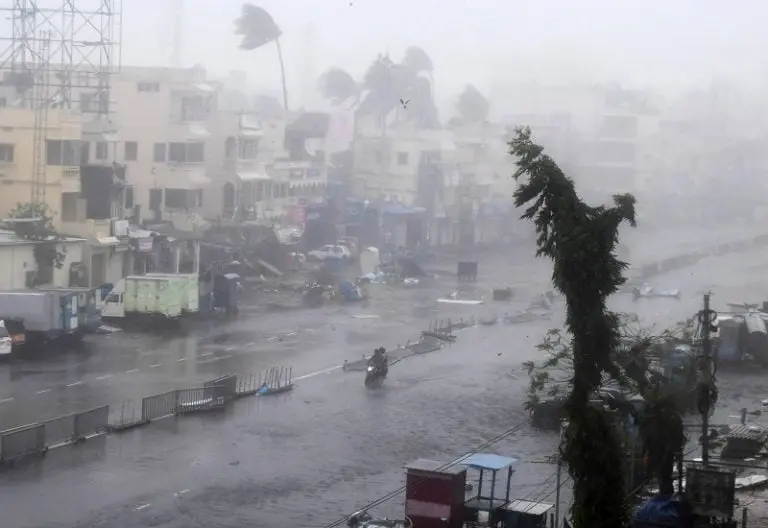
Bhubaneswar: Odisha has been spared major structural damage or loss of life after Cyclone Akvan made landfall near Gopalpur on Friday morning, though heavy rainfall continues to lash several parts of the state.
According to the India Meteorological Department (IMD), the landfall process began around 8 am and concluded by 11:20 am. The cyclonic storm crossed the south Odisha and north Andhra Pradesh coasts near Gopalpur, packing wind speeds of 70–80 kmph, with gusts reaching up to 90 kmph. Subsequently, the weather system weakened into a deep depression over south coastal Odisha with sustained winds of 55–65 kmph and gusts up to 75 kmph. The system is likely to move north-northeastwards and weaken further into a depression over the next six hours, eventually degenerating into a well-marked low-pressure area.
Heavy rainfall continued across southern Odisha, with Ganjam district recording the highest precipitation. In the 24 hours ending at 8:30 am on Friday, Patrapur recorded 209 mm of rainfall, followed by Hinjili (207 mm), Chikiti (199 mm), Gopalpur (190 mm), and Chhatrapur (139 mm). “Southern Odisha is now receiving heavy rain and the northern part would also get heavy downpour later,” IMD Director General Mrutunjay Mohapatra stated, adding that overall rainfall intensity is expected to subside starting Saturday.
Echoing the same, Revenue and Disaster Management Minister Suresh Pujari said that the next 24 hours will be crucial for Odisha, and the situation is expected to gradually return to normal thereafter.
Cyclones Making Landfall Outside Odisha
Odisha, however, has frequently borne the brunt of major storms in recent years that made landfall elsewhere along the eastern coastline. Even without crossing the state directly, the associated winds, heavy rain, and outer bands of these systems have repeatedly impacted several districts.
Notably, Akvan follows two other 2026 cyclones—Arnab and Murasu—both of which made landfall in Andhra Pradesh yet triggered significant wind and rain across Odisha. At least 10 persons died in a landslide in in Gidipabali village in Ganjam district, while hundreds of villages were inundated as heavy rainfall triggered by Arnab caused extensive flooding in the state’s southern part.
Over the past decade, several other severe storms that made landfall in neighbouring states and countries have similarly disrupted the state. These include Cyclone Hudhud in 2014 (landfall at Visakhapatnam, Andhra Pradesh, with 170–180 km/h winds), Cyclone Titli in 2018 (near Palasa, Andhra Pradesh, at 140–150 km/h), Cyclone Bulbul in 2019 (along the West Bengal–Bangladesh coast at 110–120 km/h), and Cyclone Amphan in 2020 (at Sundarbans in West Bengal with wind speeds of 155–165 km/h).
Around 3,343,966 people were impacted across 15 districts, with southern districts like Koraput, Rayagada, Gajapati, and Malkangiri, reportedly experiencing wind speed of 80-100 kmph. Strong winds and heavy rains uprooted thousands of trees, damaged roads, and knocked down electric poles, disrupting power and communications. Three persons lost their lives due to the cyclone. Bansadhara also witnessed flash floods affecting the downstream areas of Gajapati and Rayagada districts.
Over 8,000 trees were uprooted, rivers swelled, and more than 50 people lost their lives, 39 deaths were reported from Gajapati district alone with 15 of them were killed in a landslide in Baraghara village, while 57 lakh people were affected in the very severe cyclonic storm Titli and subsequent flooding in the state.
Heavy rain and high-velocity winds triggered by Cyclone Bulbul killed two people and wreaked havoc in most parts of coastal Odisha. Cyclone Amphan affected over 44.45 lakh people in 9833 villages and 22 urban bodies in Odisha with no confirmed cases of human casualty.