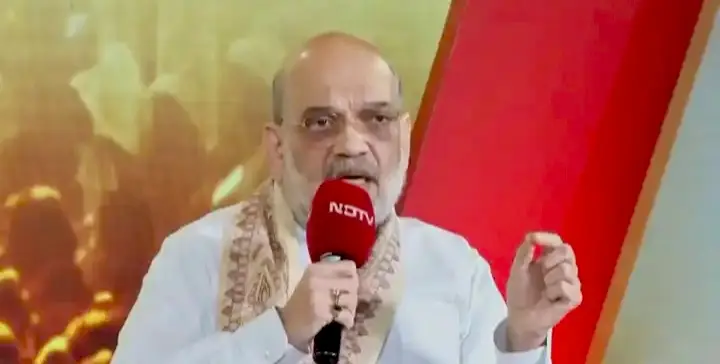
Patna: India has launched a major offensive against narcotics and will destroy drug cartels operating in the country by 2029, Union Home minister Amit Shah told NDTV in an interview.
The fight against drugs has been going on for the past four years with “very good” planning, he said. This is part of the Nasha Mukt Bharat Abhiyan launched in 2022.
“It has been going on from the district level to the state level, right up to the Indian government, and the plan has been very successful,” Shah said when asked if the government would fight drug cartels with the same intensity it has worked to eliminate Maoists.
“We have broken the record of arresting drug traffickers and drug dealers in the last three years,” he said.
“Now, the time has come to destroy the cartels and not just the drug trade at the lower level. This will ensure that network is destroyed forever. I have complete faith that in the next four years, all the state governments and the Centre will destroy the drug cartels, whether it is at the district level, state level or national level,” Shah said.
According to him, arrangements have been made to tackle the trade in drugs through all three routes.
“One route is seaborne. The second one is through Pakistan and the third through Myanmar. We have made thorough arrangements to stop all three routes,” the home minister said.
According to the Narcotics Control Bureau (NCB), 1,483 kg of cocaine was seized by enforcement agencies in 2024. This was about 78 times higher than what was seized in 2020 and about five times higher than the 2023 figure.
Other drugs that saw a “sharp” increase included mephedrone (also known as 4-MMC or Meow Meow), a much-abused party drug. Enforcement agencies seized 3,359 kg of this drug from across the country in 2024 as compared to just 275 kgs in 2020, the NCB report states.
One can look at this in two ways. Either proliferation has gone up or crackdown on the trade has intensified. Shah said it is the latter.
The NCB has also expressed concern about the increase in the number of drug-laden drones from Pakistan over the last four years. These drones enter Punjab from across the Indo-Pakistan Border. Many of the consignments are meant for terrorists of outfits like the Babbar Khalsa International or BKI.
“The use of drones for cross-border smuggling of narcotics has emerged as a significant threat to India’s internal security, particularly along the Pakistan border in Punjab. This evolving modus operandi has replaced traditional smuggling methods and poses a complex challenge for law enforcement and border security agencies,” the report said.
The number of such seizures in 2024 “rose manifold” to 179 as compared to just three cases in 2021. The recovered drug consignments largely included heroin and opium, the report said. The total drug recovery was about 236 kgs.
The ‘Death Crescent’ (comprising the countries of Iran, Afghanistan and Pakistan) remains the “primary” source of heroin, ATS and hashish enters the country through the western coast while the ‘Death Triangle’ (Myanmar, Laos and Thailand) serves as the “main supplier” of synthetic drugs, particularly methamphetamine. This is smuggled through the eastern land border of the country or the eastern coast. the report said.
Taking drugs through injections was a “rising concern” as in 2024 the agencies seized over 2.75 lakh units (injections) valued at Rs 4.54 crore with states like Punjab and Maharashtra witnessing “high volumes” of the seizure, it further said.