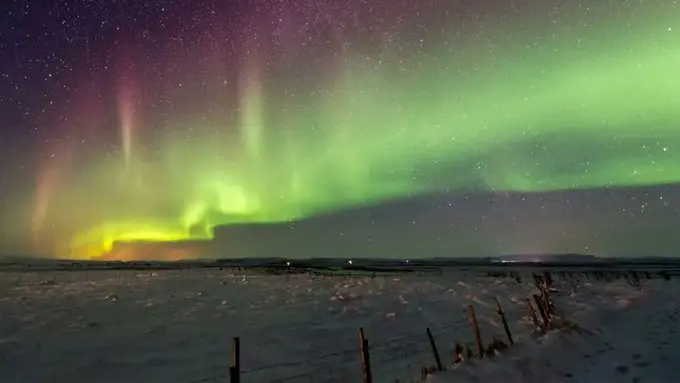
New Delhi: As a powerful solar storm is expected to reach Earth on June 8, skywatchers are hoping to see the northern lights in India. This storm has raised the possibility of rare auroral activity and even potential sightings of the northern lights in parts of India, according to space weather forecasts and reports.
Why rare auroras may be visible in India?
A strong geomagnetic disturbance triggered by a coronal mass ejection (CME) from the Sun is forecast to interact with Earth’s magnetic field on June 8, 2026. Space weather agencies, including the US National Oceanic and Atmospheric Administration (NOAA), have issued a geomagnetic storm watch for the period, classifying it as a potentially strong event, reported India Today.
The incoming solar material is expected to disturb Earth’s magnetosphere, which can lead to increased auroral activity—commonly known as the northern and southern lights.
One of the most visible consequences of a geomagnetic storm is the appearance of auroras, commonly known as the Northern Ligh
ts and Southern Lights.
According to reports, the latest CME originated from active solar region 4461 and contained a dense core filament, a structure rich in plasma and magnetic energy. Space weather observers believe this feature could strengthen the storm’s impact when it reaches Earth, reported Moneycontrol.
What makes this event significant?
Auroras are usually confined to polar regions such as Scandinavia, Canada, or Alaska. However, during strong geomagnetic storms, the auroral oval expands and can shift toward lower latitudes.
Experts suggest that under favourable conditions, faint auroral glows could be visible from parts of northern India, particularly in high-altitude Himalayan regions with clear skies.
Possible impact on technology
While the phenomenon is visually spectacular, solar storms can also affect modern technology. Potential effects include:
Temporary disruption in satellite communications
Minor disturbances in GPS accuracy
Radio signal interference at high frequencies
Increased load on power grid systems in extreme cases
Scientists and space agencies continue to monitor the situation closely to assess intensity and duration.
What skywatchers should expect?
If conditions remain stable and skies are clear, the best chance of viewing auroral activity would be during nighttime hours on June 8–9. However, visibility in India remains uncertain and highly dependent on the storm’s final strength and local atmospheric conditions.
Even if auroras are not visible, the event remains scientifically significant for studying solar–Earth interactions and space weather behavior.