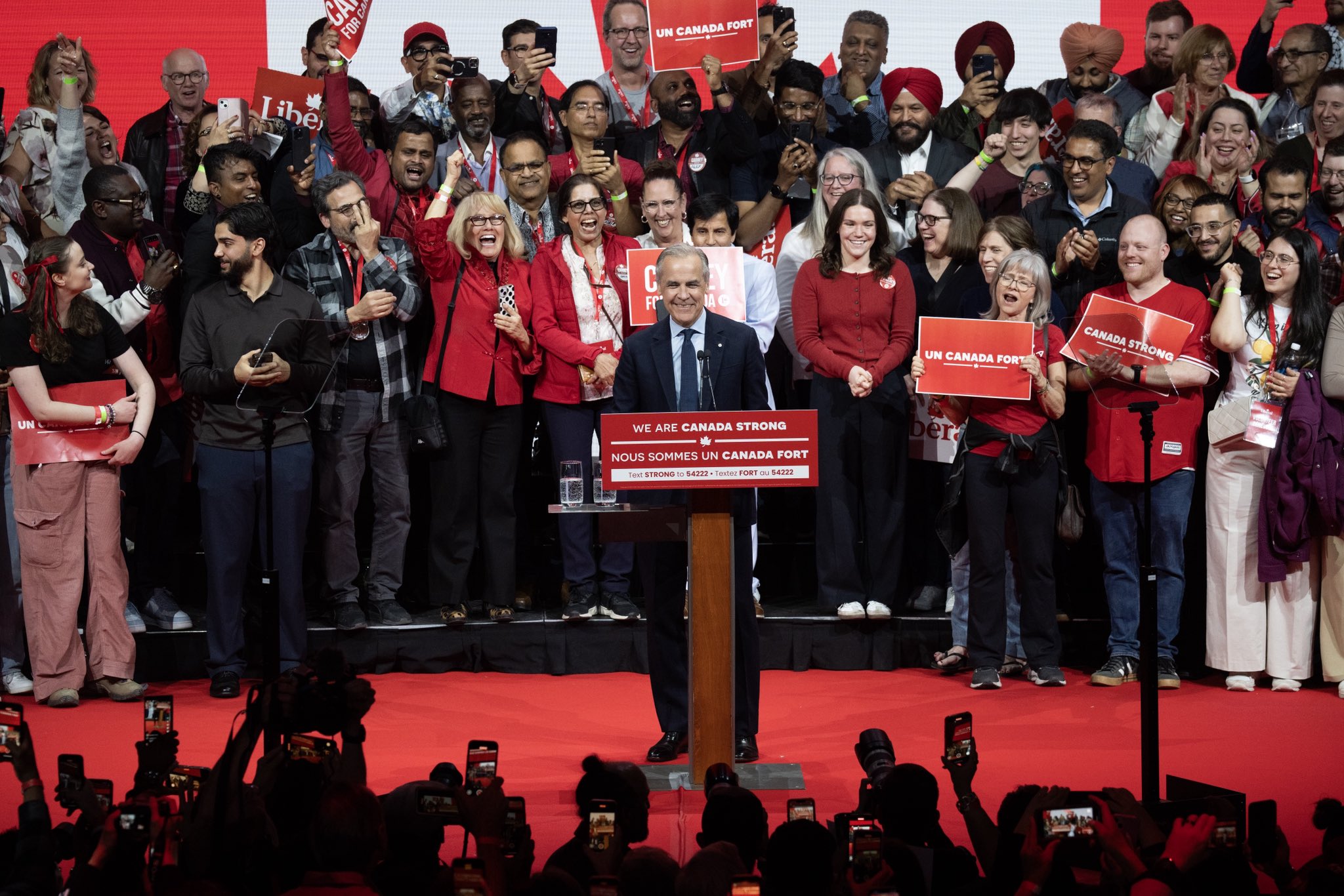
Toronto/New Delhi: A month back, Canadian Prime Minister Mark Carney took time off his busy campaign schedule to join the Hindu community in celebrating Ram Navami. This was a kind of an indication that Carney’s hopes to mend fences with India after the bilateral ties nosedived under Justin Trudeau.
And now as Carney is back as Prime Minister of Canada, scripting a dramatic reversal in fortunes for the Liberals, bilateral ties with India may improve after Trudeau’s tumultuous regime.
The Liberal Party, led by new Prime Minister Mark Carney, is projected to form a minority government, defeating the Conservative Party, led by Pierre Poilievre. This comes at a time when Canada is dogged by Trump’s tariff policies. A party needs 172 votes in the House of Commons to form the government. Carney, 60, has never held elected office and only replaced Justin Trudeau as prime minister last month.
Thank you, Canada.
Our strength lies in our resolve to work together. United, we will build Canada strong. pic.twitter.com/uN6h4LUAEP
— Mark Carney (@MarkJCarney) April 29, 2025
For “Canadian PM” Mark Carney, PM Modi’s Greetings And A Message Of Hope
Prime Minister Narendra Modi congratulated Carney, indicating a step towards improving the bilateral tie. “Congratulations @MarkJCarney on your election as the Prime Minister of Canada and to the Liberal Party on their victory. India and Canada are bound by shared democratic values, a steadfast commitment to the rule of law, and vibrant people-to-people ties. I look forward to working with you to strengthen our partnership and unlock greater opportunities for our people,” he wrote on X.
Congratulations @MarkJCarney on your election as the Prime Minister of Canada and to the Liberal Party on their victory. India and Canada are bound by shared democratic values, a steadfast commitment to the rule of law, and vibrant people-to-people ties. I look forward to working…
— Narendra Modi (@narendramodi) April 29, 2025
Pro-Khalistan voice gets defeated
In a major political shake-up, Canada’s New Democratic Party (NDP) leader and pro-Khalistan voice, Jagmeet Singh, suffered a stinging defeat in the 2025 Canadian federal election. Singh failed to retain his Burnaby Central seat in British Columbia, losing to Liberal Party candidate Wade Chang.
The election results have triggered a significant power shift, with Singh’s NDP, once a kingmaker in Canadian politics, now relegated to fourth place. The party’s dismal performance led to Jagmeet Singh resigning as party leader, marking the end of a controversial chapter in Canada’s political narrative.

Diplomatic Thaw: Good News for India
Singh’s defeat is being seen as positive news in New Delhi. His consistent support for pro-Khalistan elements and repeated unsubstantiated allegations against India — particularly in the aftermath of Khalistani terrorist Hardeep Nijjar’s assassination in 2023 — had worsened already strained India-Canada relations.
Throughout 2023 and 2024, Singh amplified claims — first made by then-Prime Minister Justin Trudeau — of Indian government involvement in Nijjar’s killing. India strongly refuted these baseless accusations, consistently demanding evidence, which Canada failed to provide.
Vindication for India After 2025 Commission Report
India’s firm stance was vindicated in January 2025 when a Canadian commission report found “no definitive link” between a foreign government and Nijjar’s death. The report exposed the hollowness of Trudeau and Singh’s claims, effectively discrediting their anti-India rhetoric.
New Leadership, New Hope
With Mark Carney’s Liberal Party returning to power, Ottawa is expected to pivot towards stabilising ties with New Delhi. Carney’s leadership — unburdened by Trudeau’s baggage and Singh’s provocations — offers a fresh window to rebuild trust, enhance bilateral trade, and resume diplomatic engagement.
Canada’s Khalistan Lobby Loses a Voice
Jagmeet Singh’s political fall marks a setback for pro-Khalistan voices in Canada’s mainstream politics. India has long maintained that sections of Canada’s political establishment, including Singh, gave space to separatist rhetoric for vote-bank politics.
His ouster signals a potential weakening of the Khalistan lobby’s influence in Canadian policymaking.
What Lies Ahead
As Singh exits the political spotlight, India and Canada have an opportunity to reset relations, moving past a phase of distrust and public sparring. Analysts believe Prime Minister Modi and Mark Carney could initiate a new diplomatic chapter, focusing on trade, diaspora ties, and regional security cooperation.