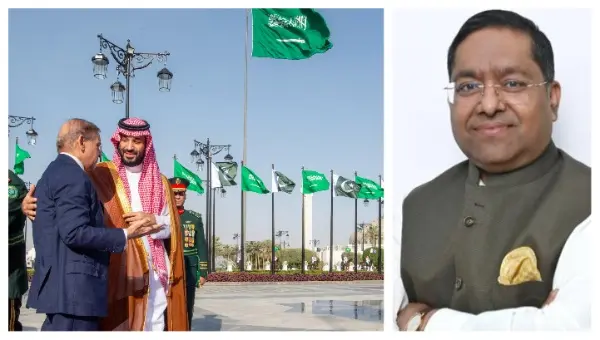
New Delhi: Saudi Arabia and Pakistan have signed a Strategic Mutual Defence Agreement, pledging that any aggression against one country will be considered an aggression against both.
The agreement, which did not name any country in particular, was signed after Pakistan Prime Minister Shehbaz Sharif met Saudi Crown Prince Mohammed Bin Salman during a state visit to Riyadh on Wednesday. “Building on a partnership extending nearly eight decades, and grounded in bonds of brotherhood, Islamic solidarity and shared strategic interests, the two sides signed the Strategic Mutual Defence Agreement,” a joint statement said.
The senior Saudi official, requesting anonymity, said that the agreement is a culmination of years of discussions. “This is not a response to specific countries or specific events but an institutionalisation of longstanding and deep cooperation between our two countries,” the official was quoted as saying by Reuters.
This pact assumes significance against the backdrop of Israeli strike in neighbouring Qatari capital Doha last week, which undermined US’ credibility as a longstanding security guarantor of the Gulf states. The unprecedented attack in Doha is said to have had the tacit approval of Donald Trump.
Pact’s Implications & India’s Response
The brief armed conflict between India and Pakistan in May this year has added further complexity to the pact’s implications. With Operation Sindoor in abeyance, will another conflict between the two neighbours see Royal Saudi Air Force helping Islamabad with its F-15s and Eurofighter Typhoons?
While analysts have called the pact between Saudi Arabia and Pakistan nothing but posturing, India, in a measured response, said that it will “study the implications” of this development for its “national security as well as for regional and global stability”, and is committed to “protecting India’s national interests”.
“We have seen reports of the signing of a strategic mutual defence pact between Saudi Arabia and Pakistan. The Government was aware that this development, which formalises a long-standing arrangement between the two countries, had been under consideration,” MEA spokesperson Randhir Jaiswal added, addressing a weekly media briefing in Delhi.
The senior Saudi official also acknowledged the need to balance relations with India, also a nuclear power. “Our relationship with India is more robust than it has ever been. We will continue to grow this relationship and seek to contribute to regional peace whichever way we can.”
The ties between India and Saudi Arabia have strengthened over the past two decades. Diplomatic relations were established in 1947, and strategic partnerships were formalised through landmark agreements such as the Delhi Declaration (2006) and the Riyadh Declaration (2010). During Prime Minister Narendra Modi’s visit to Riyadh in April 2025, several agreements were signed in areas like energy, space, health, sports, postal services, and plans for two oil refineries in India.
According to the Embassy of India in Riyadh, bilateral trade reached USD 41.88 billion in FY2024-25, with Indian exports of USD 11.76 billion and imports of USD 30.12 billion.