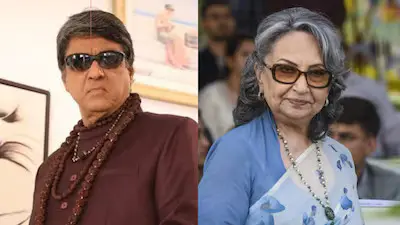
Mumbai: Veteran actor Mukesh Khanna has reacted to Sharmila Tagore’s recent remarks on Vande Mataram, criticising her views and referring to her marriage to former cricketer Mansoor Ali Khan Pataudi.
Khanna questioned Tagore’s reported stance on the national song and referred to the name Ayesha Begum, which she adopted after her marriage.
Speaking to The Free Press Journal, Mukesh Khanna was asked about Sharmila Tagore’s reported suggestion that only the opening stanzas of Vande Mataram should be sung, keeping India’s religious diversity and the sentiments of different communities in mind.
Khanna disagreed with the view and, in his response, referred to Tagore’s Bengali background, her marriage into the Pataudi family and her association with Hindu cultural traditions.
“She is speaking according to her own understanding. I don’t know why she said it. Maybe while explaining her point of view, she ended up saying that people from other religions may not understand or accept it,” he said.
The actor also addressed Sharmila Tagore as “Ayesha Begum” while referring to her marriage into the Pataudi family.
“Did you realise only after marriage that Islam also exists? When you became a Begum, did you then realise that Muslims follow a different faith? You became Ayesha Begum for marriage, but today you are speaking as Ayesha Begum. I’m surprised that after living your whole life with Hinduism, you have suddenly become concerned about other religions,” Mukesh said.
He also referred to Sharmila’s Bengali roots, noting that she had grown up with traditions such as Kali Puja.
“You grew up in Bengal, where Kali Puja is celebrated on such a large scale. You have grown up with Bengali culture and Bengali films. Why is it only now that you feel that people from another religion may not accept this?” he asked.
Mukesh claimed that concerns raised by some sections of the Muslim community have historically gone beyond references to Hindu deities in the song’s later verses.
“Their objection did not begin today. The argument has been that they bow only before Khuda and therefore would not bow before anyone else,” he claimed.
Mukesh maintained that respecting the country does not necessarily mean physically bowing before an image or symbol.
He said those who do not wish to bow should not be forced to do so, but questioned whether that objection should extend to singing Vande Mataram itself.
“We bow before Bharat Mata. If someone does not want to bow, fine, we are not forcing them to bow. But then saying that Vande Mataram itself should not be sung is something I do not understand,” he said.
The actor concluded by alleging that political parties were using the controversy for electoral gains instead of maintaining a consistent stance on the issue.
“You are not following a principle, you are following appeasement. You are trying to show Muslims that you are still with them so that they vote for you. That is the whole problem,” Mukesh said.