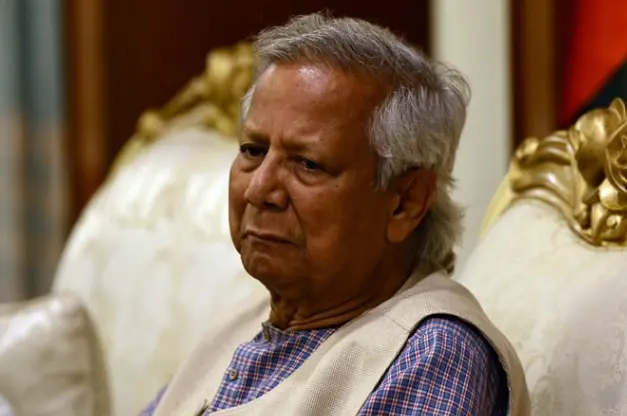
Dhaka: Bangladesh’s former interim government chief Muhammad Yunus on Monday demanded an immediate halt to assaults on Grameen Bank outlets, alleging that close to 100 branches of the microfinance institution had been struck by petrol-bomb attacks since the beginning of November, PTI reported.
In a statement, Yunus, who is founder of Grameen Bank, said its offices were coming under attack almost daily and claimed that the apparent coordination behind the violence pointed to instructions originating from “someone at a higher level.”
“Looking at the pattern of the attacks, it appears that someone at a higher level is directing the perpetrators to carry out such attacks,” he said, in what was widely read as a reference to the disbanded Awami League and its leader, former prime minister Sheikh Hasina, who is living in exile in India.
Yunus stated that nearly 100 Grameen Bank branches nationwide had been hit with petrol bombs since the start of the month. Media accounts similarly placed the number of branches damaged by fire or vandalism at 97 since early November.
Calls For Accountability
The former chief adviser pressed authorities to identify those behind the attacks and ensure they face legal consequences. He also urged Bangladeshis who recognise the bank’s importance to publicly oppose the violence, while appealing to supporters abroad to use their influence to dissuade those organising or carrying out the assaults.
His remarks came five days after suspected Awami League backers torched his family home in Chattogram, a major port city in southeastern Bangladesh, on Wednesday.
Yunus continues to be protected by the military-run elite Special Security Force (SSF) under an executive order issued by the interim government before it handed over power following the February 12 elections. That protection is set to lapse on February 17, 2027.
Unrest Deepens
The attacks have unfolded against a backdrop of intensifying political friction in Bangladesh. The Awami League has largely remained sidelined since Hasina’s government was removed in a student-led uprising on August 5, 2024.
Hasina escaped to India after her administration collapsed following a harsh crackdown on demonstrators. Yunus, then 86, subsequently led the interim government; his administration later disbanded the Awami League and pursued legal action against its senior leaders, including Hasina, who was convicted in absentia by a special tribunal and sentenced to death for crimes against humanity connected to the crackdown.
The current wave of violence has overlapped with Hasina’s repeated declarations that she intends to return to Bangladesh, notwithstanding the death sentence. Earlier this month, the 79-year-old pledged to return “at any cost,” sharpening tensions ahead of a proposed December homecoming.
Hasina has also sent two letters through a British legal firm to Bangladesh’s High Commission in New Delhi over the past fortnight, requesting a passport and the restoration of her National Identity Card (NID) to enable her return. Dhaka has turned down both requests.
Official statements and media reporting indicate that the latest unrest has left four people dead. At least four police facilities and 28 police vehicles have been set on fire, while another 83 vehicles — including buses — were torched across the country.
Security Response
The most severe disturbances have occurred in southwestern Gopalganj, Hasina’s home district and an Awami League stronghold, where two police stations were burned.
In response, the government has deployed hundreds of Border Guard Bangladesh (BGB) personnel to help contain the violence. Police said they arrested 528 people nationwide between November 1 and 17 for alleged participation in activities connected with political instability.
Security has also been reinforced along Bangladesh’s frontier with India.
Both the Yunus-led interim administration and the elected government now led by Prime Minister Tarique Rahman have pressed India to extradite Hasina. Dhaka, however, has refused to provide her with travel documents for a voluntary return.
New Delhi has confirmed receipt of Bangladesh’s extradition requests but has not disclosed whether it will transfer her, saying the issue is being considered through established procedures.
Prime Minister Rahman last week alleged that the Awami League was plotting to destabilise Bangladesh to satisfy its “masters across the border,” as the party called a nationwide shutdown that sparked violence in several areas.
He also instructed BNP lawmakers to return promptly to their constituencies and maintain a visible street presence with local party workers, rather than depending exclusively on the government and administrative machinery to counter the Awami League.
Meanwhile, Jamaat-e-Islami, the principal opposition party, began a 40-day nationwide protest campaign on Saturday, timed to coincide with Hasina’s anticipated return in December.
“We will resist fascists with the people,” Jamaat Secretary General Mia Mohammad Porwar declared at a rally launching the programme, in an apparent reference to the Awami League.
Yunus Demands End To Attacks On Grameen Bank Branches Amid Bangladesh Unrest