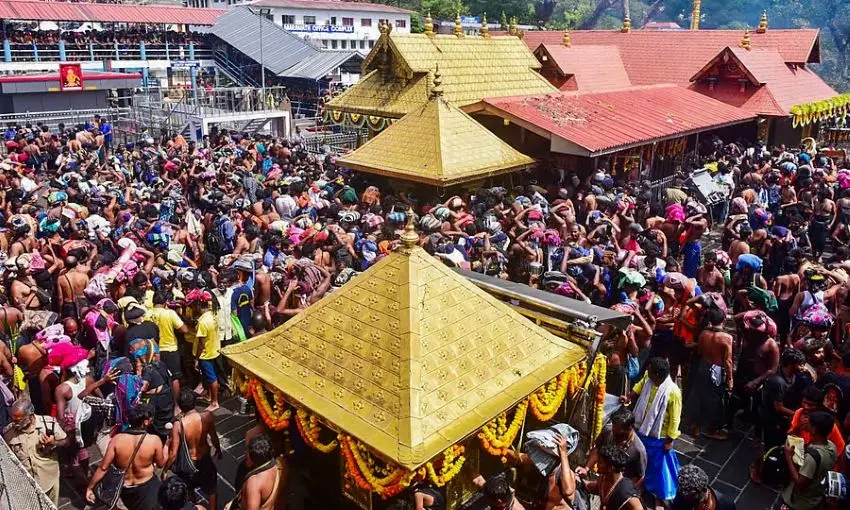
New Delhi: The Supreme Court reserved its verdict in the Sabarimala reference matter on Thursday.
A nine-judge Constitution Bench of the Supreme Court, headed by Chief Justice of India (CJI) Surya Kant, heard the matter over 16 days. The Sabarimala reference matter refers to a set of broader constitutional questions stemming from review petitions following the top court’s historic 2018 verdict, allowing women of all ages to enter Sabarimala temple in Keralam.
That judgment, delivered nearly eight years ago, struck down a decades-old practice which barred women of menstruating age from entering the popular hill shrine.
While hearing review petitions against the verdict in November 2019, the Supreme Court referred a set of larger constitutional questions to a bigger bench for examination.
On Thursday, the nine-judge bench heard arguments on the interplay between Articles 25 and 26 of the Constitution, reported Livelaw.in.
The hearing got underway with rejoinder submissions by senior advocate Mukul Rohatgi, who referred to religious practices in the Parsi community. A Parsi woman is among those before the court, having challenged her excommunication after marrying a Hindu man.
Rohatgi argued that excommunication practice is no longer common in the Parsi community, Bar and Bench reported.
“In the last seventy-five years, there has in fact been no excommunication at all. It is not as though there exists some arbitrary or diabolical authority constantly threatening that ‘I will excommunicate this person’ or ‘I will excommunicate that person.’ Nothing of that sort has happened for decades,” Rohatgi said.
Senior advocate Gopal Subramanium said there is a constitutional distinction between a religion and a religious denomination.
“The two expressions carry distinct constitutional meanings… The nature of individual freedom under Article 25(1) is not altogether the same as denominational freedom under Article 26,” Subramanium submitted.
Senior advocate Rakesh Dwivedi objected to describing Hinduism merely as a “way of life.”
“Hinduism is also a religious philosophy. It is also a deeply evolved social structure. It concerns how human beings relate to the creator, how existence itself is understood. It encompasses questions about the meaning of human life and existence in this world… I would respectfully hope that Your Lordships do not reduce Hinduism merely to a way of life,” he said.
Earlier this month, the Supreme Court had questioned the very foundation of the public interest litigation (PIL) that led to the landmark 2018.