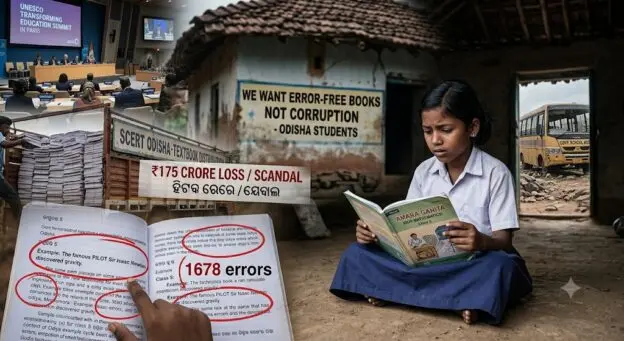
The opening remarks at UNESCO’s Transforming Education Summit +4 (TES+4) in Paris last Friday got off to a less-than-promising start. Nearly an hour behind schedule, delegates passed the time chatting animatedly about France’s FIFA World Cup victory from the night before. But once the speeches began, attention quickly shifted to a much steeper uphill climb—one the world is in serious danger of failing: Sustainable Development Goal 4, which aims to ensure inclusive, equitable, and quality education for all by 2030.
TES+4 was designed to take stock of progress since the initial New York summit in 2022, which sought to reinvent learning frameworks in the wake of the COVID-19 pandemic. “Four years on, the world has changed dramatically,” UNESCO Director-General Khaled El-Enany remarked, gesturing toward a dark red backdrop featuring images of children writing on a blackboard. Unfortunately, that change has not been for the better. The macro-statistics presented were sobering: global international aid to education is projected to shrink by up to 30% by 2027, and 113 nations currently spend more on servicing national debt than on educating their children. For a fleeting moment, the high-level policy talk blurred a stark human reality—the millions of children whose future depends entirely on whether a state’s financial architecture can hold under pressure.
Representing India at this global forum, the national delegation presented a narrative of aggressive, ambitious structural overhauls. They highlighted the sweeping reforms under the National Education Policy (NEP) and pointed to a milestone domestic commitment: a record-high central education budget allocation of ₹1,39,289 crore for the 2026–27 fiscal year. The government’s core argument is structurally compelling. To modernise a system serving over 250 million students, a country must centralise its resources, invest heavily in scalable digital infrastructure, and focus on large-scale, measurable outlays. On paper, it is a vision of progress. Yet, as the global community debated these grand blueprints in Paris, the mind naturally wanders to the ground reality back home. If global summits provide the architectural plans, what does the actual building look like to the ordinary citizen?
To understand this contrast, one need only look at the capital city of New Delhi, where the humid air at Jantar Mantar has been thick with a very different kind of educational discourse. For weeks, a youth-led movement calling itself the “Cockroach Janata Party” has staged satirical protests alongside hunger strikes led by prominent activists. The catalyst for their anger was a series of highly publicised national competitive examination paper leaks, including the NEET-UG breakdown, which threw the lives of over two million young aspirants into absolute chaos.
The administration’s defence is that these cracks are legacy vulnerabilities being aggressively corrected through centralised testing mechanisms and strict new legal penalties for malpractice. The philosophical intent is to create a pure meritocracy through uniform, ironclad control. However, when a young student from a lower-income family spends years studying in a cramped, rented room—skipping meals to afford private coaching fees—only to find their exam cancelled on the day of the test, the issue shifts from administrative efficiency to basic trust. If a system struggles to secure the sanctity of a single printed questionnaire, how effectively can it guarantee the socioeconomic mobility of an entire generation?
This question of administrative intent versus human impact becomes even more visible when examining how public money is spent on the ground. While the ₹1.39 lakh crore budget allocation sounds monumental, parliamenta
ry standing committee reports reveal a persistent bottleneck in “ground utilisation.” Year after year, the Department of School Education struggles with back-loaded spending, often utilising less than 60% of its assigned funds during the first three quarters of the fiscal year, leading to a frantic, inefficient rush to deploy capital in the final three months.
Instead of funding the slow, difficult work of upgrading neighbourhood schools, policy has shifted toward “school rationalization”—a strategy that has seen nearly 94,000 government schools closed or merged across India over the last few years. The number of government schools nation-wide in 2024-25 (10.13 lakh) fell by 8% compared to the figure in 2014-15 (11.07 lakh) as reported by the Indian Express in their article “Private over Government Schools, failing enrolment and dropout rates: Where India’s school education system stands”. The economic logic is clear: low-enrolment schools are inefficient and expensive to staff. By merging them into larger, well-equipped regional “hubs,” the state argues it can provide superior laboratories, libraries, and specialised teachers.
But what happens to the children when the neighbourhood school disappears? A comparative analysis of post-merger dropout rates reveals a troubling trend. While primary school enrolment remains statistically stable, secondary school dropout rates have spiked to 11.5% in heavily rationalised districts, with a disproportionate impact on young girls. For a family living in a remote village, a newly introduced three-kilometre walk across isolated terrain to reach a consolidated “hub” is not an administrative optimisation—it is a safety risk that often brings a girl’s education to an abrupt end. Are we inadvertently balancing our fiscal spread sheets by shutting the schoolhouse door on our most vulnerable communities?
This friction between high-level policy and local execution becomes acute when looking at Odisha. The state has earned praise for its visible investments in school modernisation, funding smart classrooms and e-libraries through its flagship transformation initiatives. Yet, institutional funding means little without rigorous systemic integrity. Just recently, the state’s Crime Branch arrested a senior bureaucrat and former director of the State Council of Educational Research and Training (SCERT) regarding a massive textbook scandal. The investigation revealed that an irregular publication process led to the printing of millions of elementary textbooks riddled with 1,678 flagrant factual and grammatical errors—including a bizarre passage describing Sir Isaac Newton as a “famous pilot.” The blunder resulted in a ₹175 crore loss to the public exchequer and left over five million children with compromised learning materials.
The state’s swift legal action and subsequent arrests demonstrate an active accountability mechanism. It proves that the government will not tolerate overt administrative negligence. Yet, the deeper, more unsettling question remains: how does an education system with multiple layers of institutional oversight allow millions of error-ridden books to be printed and distributed in the first place? When public funds are lost to systemic corruption, the damage cannot be calculated solely in rupees. The true deficit is borne by the primary student sitting under a dim village light bulb, trying to build a future out of a broken lesson plan.
Historically, societies have measured educational success by its physical inputs: budgets passed, infrastructure built, and institutional targets achieved. Philosophically, however, education is not a matter of logistics; it is an intimate, sacred contract between a generation and its government.
When international summits like TES+4 track global commitments, they look at sweeping policy metrics. But the distance between a high-level declaration signed in a Parisian hall and an error-free textbook delivered to a tribal village in Odisha remains vast. If our public investments continue to rise alongside deep systemic vulnerabilities, we are forced to reflect on the true nature of our progress. Are we building an educational apparatus that is structurally flawless on paper, yet increasingly fragile for the very children it is meant to protect?
(Views expressed by the columnist are personal and do not necessarily reflect the opinion or policy of the news portal)