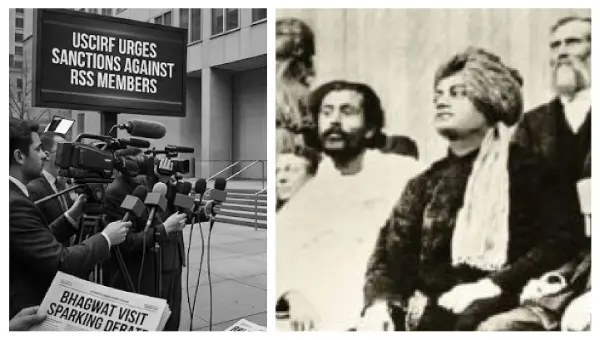
In 1893, an Indian monk travelled to Chicago to speak about a civilisation and its faith to a world that knew little about either. At the Parliament of the World’s Religions, Swami Vivekananda presented Hinduism in a language of religious pluralism and interfaith dialogue; the Parliament itself describes his appearance as the moment Hinduism was introduced to the world stage.
He arrived not as a representative of a government, a political party or an ideological organisation, but as a monk carrying an idea — that religions could coexist, that different paths could lead towards truth, and that faith could be a bridge between human beings rather than a wall separating them. His famous opening, “Sisters and Brothers of America”, has survived not merely because it was eloquent, but because it captured something larger about the encounter: an Indian religious voice was asking the world to listen, not to a political claim, but to a philosophy of human fraternity.
Now move the clock forward 133 years. Another Hindu Nationalist organisation’s chief is preparing to visit America. This time, however, the headline in all newspapers is strikingly different: “Ahead of Bhagwat’s visit, US religious body seeks sanctions.”
The United States Commission on International Religious Freedom has called for sanctions against RSS members and urged the American government to deny high-level meetings and diplomatic courtesies to its leaders.
The contrast between Chicago and New York is difficult to ignore. In 1893, an Indian monk stood before an American audience and spoke about the possibility of religions meeting one another. In 2026, an Indian ideological organisation is being discussed in the language of religious freedom, political influence and sanctions. Vivekananda went to America to explain India to the West.
Today, India is increasingly having to explain itself to the West. The question is not whether Vivekananda was right and Bhagwat is wrong, nor whether the American religious-freedom body is entirely right or entirely wrong. The more interesting question is what happened in the 133 years between those two moments. How did religion, which once sought to answer questions of meaning, morality and the relationship between human beings, become so closely intertwined with questions of identity, political power and ideological allegiance?
Perhaps the difference is not really between two religious leaders at all. It is between two ways in which religion has come to be presented to the world. Vivekananda’s Hinduism was confident enough to engage with other faiths without appearing threatened by their existence. It did not need the disappearance of difference to establish its own legitimacy. Contemporary religious identity, by contrast, often appears through the politics of belonging: who is one of us, who is not, whose faith is under threat, whose history has been wronged and whose identity must be defended. The distinction is subtle but profound. Religion can be a way of asking how we ought to live, or it can become a way of establishing who we are. Once religion becomes inseparable from identity, and identity becomes inseparable from political power, criticism of a religious organisation can easily begin to appear as criticism of the community, the civilisation or even the nation itself.
And that brings us to the second, perhaps more curious, part of this story. Mohan Bhagwat is not a Union minister, an ambassador or a constitutional office-holder. The RSS is not a department of the Government of India. His visit to America is not, on the face of it, a state visit. Yet when USCIRF criticised the RSS and sought sanctions against its members, the Indian government responded sharply, dismissing the American body as biased and lacking credibility. The government can certainly argue that an American body making allegations about religious freedom in India and recommending punitive action against an Indian organisation has crossed from commenting on a private visit into commenting on India’s domestic affairs. There is therefore a legitimate diplomatic interest in responding. But the episode still leaves behind a question that deserves to be asked without either accusation or allegiance: when does defending India become defending an organisation? At what point does an ideological organisation become so closely associated with the idea of India that an attack upon it is treated as an attack upon the country itself? And when the state steps forward to answer criticism of an organisation that is not formally part of the state, what does that tell us about the boundaries between government, ideology, religion and civil society?
Perhaps this is why the distance between Chicago and New York deserves our attention. It is not simply the distance between two cities or two religious figures. It is the distance travelled by our own understanding of religion. We should not romanticise 1893; India of Vivekananda’s time was deeply unequal, divided and burdened by its own contradictions. Nor should we assume that everything about the present is a decline. But something in that Chicago encounter remains worth remembering. An Indian monk went to America to speak about his faith without needing to turn another faith into an enemy. He carried India’s spiritual traditions into a conversation with the world, and the conversation itself became the point. Today, a visit by the head of India’s most influential ideological organisation is surrounded by questions of sanctions, religious freedom and political legitimacy, while India’s government finds itself responding to the criticism.
Perhaps the real story, then, is not Vivekananda versus Bhagwat, nor India versus America. It is the space that has opened between the two. What happened to the idea of religion in that space? When did faith become so inseparable from identity and identity from power? And when did we become so accustomed to defending what belongs to us that we forgot that the oldest purpose of religion may have been to make us look beyond ourselves? Perhaps the journey from Chicago to New York is ultimately a journey each of us might quietly ask ourselves.
(Views expressed by the columnist are personal and do not necessarily reflect the opinion or policy of the news portal)