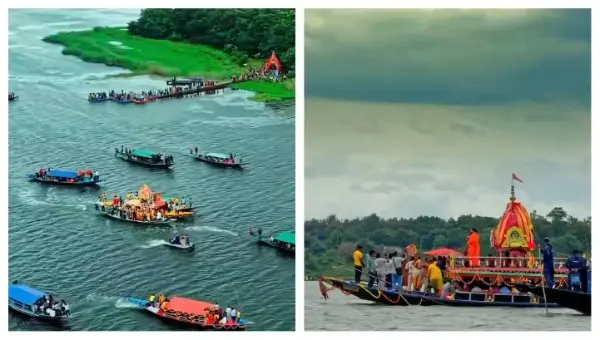
Bhubaneswar: While the majestic grand chariots roll on the Grand Road in Puri, a uniquely captivating and centuries-old tradition unfolds simultaneously on the tranquil, azure backwaters of Chilika Lake in Odisha. At the historic island shrine of Kankan Sikhari, located near Nairi village in Odisha’s Khordha district, thousands of eager pilgrims gather annually to witness an extraordinary water-borne Rath Yatra.
This rare aquatic celebration, which mirrors the sacred timing and core rituals of the main festival in Puri, carries deep historic and spiritual significance.
According to historical chronicles like the Madala Panji, the deities—Lord Jagannath, Lord Balabhadra, and Devi Subhadra—were secretly smuggled out of Shree Jagannath Temple in 1731 to protect them from the invading forces of Mughal Subedar Taqi Khan. The isolated, nature-shielded island of Kankan Sikhari served as their secret refuge for over four months. The islet, around 85km from Bhubaneswar, is accessible only by boat from Nairi.During this exile, servitors carefully sustained daily rituals, reportedly feeding the deities local spine gourds (kankada) due to a scarcity of regular vegetables, which ultimately gave the hilltop island its distinct name. The modern water-based festival serves as a living commemoration of this remarkable chapter in Odisha’s spiritual resilience.
To faithfully recreate the Rath Yatra tradition on water, organisers securely lash together three large traditional boats. These interconnected vessels are elaborately decorated to construct three floating representations of the iconic chariots: Nandighosha for Lord Jagannath, Taladhwaja for Lord Balabhadra, and Darpadalana for Devi Subhadra. Following the ceremonial Pahandi rituals, the deities are formally enthroned upon this unique aquatic chariot.
Once the procession commences from the Yamuna Ghat in Nairi village, the vast brackish lagoon of Chilika effectively transforms into the ceremonial Bada Danda (Grand Road). Unlike the land-based festival where massive ropes are pulled by physical force, the floating chariot glides across the water on a 1.5-km circuit around Kankan Sikhari creek. Devotees firmly believe that it is the pure current of faith and devotion, rather than physical strength, that carries the Lord forward on this sacred voyage.
The entire atmosphere across the waters reverberates with an intense spiritual energy as the sounds of conch shells, traditional bells, cymbals, mridangas, and devotional hymns echo from the shores and accompanying boats. Deafening chants of ‘Jai Jagannath’ and ‘Haribol’, along with traditional ululations from women, fill the air. Even persistent monsoonal rains fail to dampen the spirits of the pilgrims; during recent celebrations, devotees noted with awe that downpours miraculously ceased the moment the Pahandi rituals began.
To facilitate the massive influx of pilgrims trying to reach the island shrine, the Kalijai Motor Boat Association and local trusts collaborate to provide free ferry services across the 500-meter stretch of water. Heavy police deployment and administrative measures are also put in place to manage the massive crowds safely.
The revival of this water-based pilgrimage received a major spiritual boost in March 2015, when the Shree Jagannath Temple Administration in Puri officially donated an authentic wooden wheel from Lord Jagannath’s actual Nandighosha chariot to the island. This sacred relic is now permanently enshrined and worshipped at Kankan Sikhari.
Reflecting on the deeper theology of the ritual, Sushant Kumar Sahu, the manager of the shrine and head of the local trust, shared an ancient legend regarding the Lord’s historic journeys. He explained that in ancient times, six distinct chariots were required for the deities to travel from the main Jagannath Temple to the Mausi Maa Temple because the river Malini intersected the path. The Lord would take a transitional boat ride across the river before boarding three waiting chariots on the opposite bank. Sahu noted that perhaps the Lord is fulfilling that historic desire for a water journey right here at the island of Kankan Sikhari. He added that because they enshrine and worship a dismantled wheel from the Lord’s actual Puri chariot, rolling a conventional chariot on land is impossible on the rugged terrain, making the water-based Rath Yatra the perfect, divinely ordained solution.
This rare fusion of maritime heritage and deep-seated devotion continues to stand as one of Odisha’s most breathtaking and unique cultural spectacles.