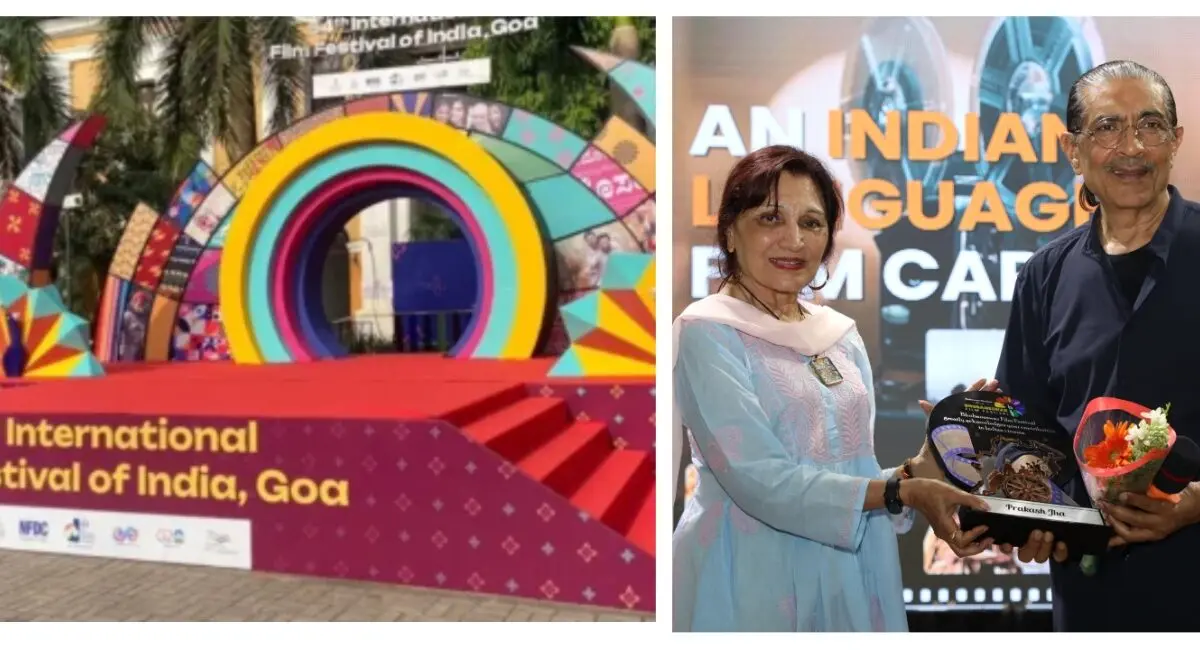
The excitement in the seminar hall was palpable. The 56th IFFI (International Film Festival of India) had just been inaugurated and all of us, the mid-career professionals who happened to be for a training in Goa, were busy discussing how to catch up on the award-winning movies to be showcased. Come November, the city of Panaji was bedecked in multi-colour hues and local elements of art and culture with an impressive lineup of tinsel celebrities from all over the world. Since 2004, cinema through IFFI has provided a new identity to Goa that was merely a tourist hotspot. Such is the power and attraction of a film festival.
Small City Blues
I largely grew up in small cities in Odisha till I ventured out of the state for my higher studies in Pune and professional career in New Delhi. In these small or tier 2 cities access to cinema was through cinema halls that were restricted to viewing Bollywood films alone. Without a film society or a film festival, our celluloid world was limited to either a Hrithik Roshan or an SRK. As enthusiasts, we were aware of contemporary cinema both in India and overseas but never got a chance to watch them. Moreover, we grew up at a time that didn’t have an Amazon, a Netflix or a Jio Hotstar.
I was lucky that my higher studies took me to Pune; the film hub – not only in terms of film training but for its cosmopolitan and culturally diverse crowd that helped fulfill my strong desire to watch and discuss cinema beyond just the run of the mill. I realized that big cities played a crucial role in shaping my film aesthetics and it is through the multi-genre cinema, I could see the world and rediscovered India. I often ask myself what would have happened to my cinematic hunger and education had I continued to stay in smaller cities? The answer is simple; in times of easy and unhindered consumption of global cultural products if people in small towns can’t automatically move to bigger places to watch them, cinema can always come them. But the question is, how?
Who can understand the critical importance of a film festival more than a kid like me who grew up in a tier two city? A film festival, as the name denotes, is a festive confluence of cinema and its critical players that provides access to independent and acclaimed movies normally not available for viewing. But is film festivals limited to film viewing alone? In my strong personal opinion, film festivals are launchpads for new generation filmmakers whose works get validated across a diverse audience, culture and taste.
Being an ardent votary of small city magic, I was wondering if a constituency of creative minds can be built to promote cinema in small cities in India. It was during this creative quest I was exposed to a similar small city initiative called the Bhubaneswar Film Festival (BFF) in June 2025. Apart from watching a host of language films, what struck me most in BFF is its focus on creating a platform for skill growth for the younger generation who chose filmmaking as a viable career option. The carefully created space for an interface between ‘experience’ and the ‘beginner’ was the hallmark of the BFF, especially at a time when the millennials and the Gen Z are increasingly getting reoriented towards vernacular language and culture.
Film festivals: Unique space to promote cultural diversity
Film festivals as carriers of cultural diversity are limitedly accepted. This could be due to two reasons, One, is the fact that unlike dance or music festivals that have received government patronage and publicity, film festivals have been difficult to curate by both public and private organizations as they don’t typically focus on just one region’s art and culture. Cinema being a composite art form, its festivals require the conglomeration of various fields and skills involved in the craft of filmmaking. There are artistes, technicians and directors whose domain of work while interlinked, varies from each other.
Secondly, film festivals also give a chance to deep dive into one’s own culture. The regional industries today are undergoing a resurgence with some brilliant films coming from different quarters of the country. Odia film industry, for instance, has catapulted from being a loss-making one to an industry that has started to experiment and commercially succeed in filming diverse themes. Therefore, language film festivals not only raise the cinematic temperature within a given geography, it significantly contributes to reviving a largely dormant film culture to cause growth of filmmaking within the region.
Of late, the film distribution network along with the digital world and the social media have narrowed the gap between tier 1 and tier 2 cities when it comes to a Kantara (Kannada, 2022) vis a vis Dhurandhar (Hindi, 2025). But what if I were a film lover in a Raipur, a Ranchi or a Bhubaneshwar wishing to see “Boong”, the BAFTA winner this year? It is this gap that annual or bi-annual film festivals seek to bridge.
Why government should prioritise small cities
Film festivals are a weaver of Indian cultural self. Cinema not only binds India it creatively represents its cultural diversity. Therefore, cinema can do wonders in making India’s cultural pluralism reach the remotest parts and creating the imagination of ‘many in one’. The national and state governments, today, focus on skilling the younger generation in the hitherto unexplored areas of technical aspects of film craft. Therefore, it creates a unique opportunity for the National Film Development Corporation (NFDC) to take language cinema to the entire country through promoting film festivals in smaller cities. Since the focus of the government has been consistently on the “Orange Economy”, a well curated and marketed film festival will do wonders to boost this economy by promoting young filmmakers.
……………………………………………………………………..
The author is from the Indian Revenue Service (Income Tax), currently posted in Delhi. Views expressed are purely personal.