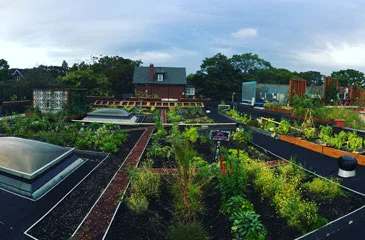
Cities worldwide are experiencing an increase in artificial surfaces like tarmac and concrete, while green space is declining. As a result, urban temperatures can rise up to 8°C than in rural areas, significantly increasing heat exposure.
Extreme heat is known to cause thermal stress, psychological distress and physical illness. Although green space has been shown to reduce these effects, expanding traditional parks and vegetation in crowded cities is challenging due to a lack of available land. Vertical and rooftop greening offers a promising alternative, but it has not been widely evaluated. Specific evidence on their physiological and psychological benefits has been limited.
Recent technological advances have made it possible to move beyond self-reported wellbeing to record objective physiological responses. By using heart rate data and EEG patterns, this study delivers a more robust and holistic understanding of how green infrastructure affects health and how it can be designed and implemented effectively.
Researchers installed three types of green infrastructure on a rooftop in South Korea’s Seoul — a live plant green roof, a live plant green wall and an artificial plant green wall. Participants were university students aged 19-34, all native Korean speakers.
Over 11 days, each participant experienced five conditions — viewing a bare wall front-on, viewing a live green wall front-on, sitting with their back to a live green wall, viewing an artificial green wall front-on and sitting in front of the green roof.
Results showed that every green infrastructure setting significantly reduced heat stress, measured and compared with the bare wall. The largest reduction occurred in front of the live green wall, followed by the artificial green wall and then the live green roof. Participants’ perceptions of thermal comfort aligned closely with these objective measurements, indicating that the cooling effect of greenery is both physically real and psychologically noticeable.
The plant species used for the green walls released more water vapour during the daytime than the species used on the roof, giving the walls an advantage in reducing daytime heat stress. Surprisingly, the green wall made of artificial plants also had a measurable cooling effect, likely due to the thermal properties of its structural materials.
Importantly, the study found that visual exposure to greenery played a more powerful role in delivering psychological benefits than the physical cooling itself. This included artificial greenery, indicating that even where live plants cannot be installed, well-designed artificial green infrastructure may still deliver meaningful mental health improvements.
By integrating environmental measurements, physiological data and psychological surveys, the study provides a useful assessment of how rooftop and vertical greenery support human health in hot urban environments. It confirms that green walls and roofs offer multiple, interacting benefits reducing heat stress, improving mood, lowering heart rate and positively influencing brain activity.
The findings strengthen the case for expanding such green infrastructure, especially in cities where land is scarce. The researchers also call for further research on how green roofs and walls perform in different climates, with varied vegetation, soil conditions and spatial configurations.
Bhubaneswar has already shown records melting in heatwave, and we are all dreaming of AC as a solution. As if someone can sell ideas of putting an AC umbrella over Bhubaneswar, but we hardly recognised there’s something that can make our neighbourhood feel way cooler with trees and water bodies.
But in order to believe Bhubaneswar can turn its smoke chimney into cool waves, it has to accept that it heats up faster than surrounding areas due to the urban heat island effect, where concrete and asphalt trap heat, pushing temperatures higher and making heatwaves more dangerous.
Trees are one of the simplest and most effective solutions, because they cool our streets by at least 5°C; A mature tree can absorb over 22 kg of CO2 per year on average. Together they make cities healthier and more liveable, and ensure no net loss of green urban space and tree cover by 2040, and a steady increase in their total area from 2040.
Bhubaneswar and its vibrant communities must take up restoration plan on a war footing by showing how they will deliver on the targets. Bhubaneswar will also be required to monitor and report on their progress, and must produce regular technical reports on progress towards the targets, and in turn, will report to the communities.
As we observe World Nature Conservation Day, the choice before Bhubaneswar is — either buy that cooling umbrella or cool it using tools of Nature.