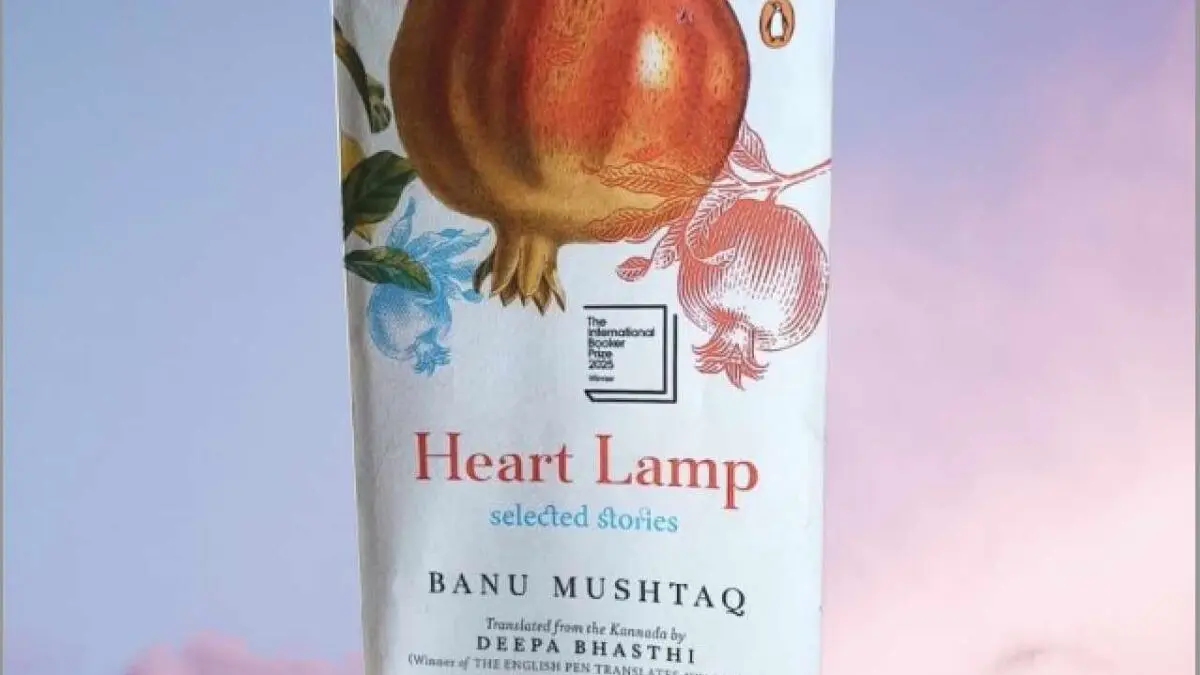
Heart Lamp is a heart-warming collection that delights in the same measure that it educates. The book grips you from the opening sentence and keeps you under its spell through all of its 214 pages that serve a delectable fare of twelve women-centric stories. There needs to be an added qualification, though: the characters are defined by their exclusively Muslim identity. Yet neither the politics of Banu Mushtaq nor her culture is exclusionary.
The opening sentence maps an alienated cityscape, mirroring the city’s concrete jungle and speed and congestion in its complex construction of clauses and pauses. In Kannada the writing must be breathtaking; in Deepa Bhasthi’s English translation it is certainly exquisite. When the language of a work, be it the original or the translation, works as lucidly and persuasively as it does here, it is a sign of one thing and one thing only: that the experience comes from some place real.
The stories in Heart Lamp are born of experiences and events in the daily lives of Muslim women from the south Indian state that is Mushtaq’s home. From every story emanates the anguished cry of a helpless woman, crushed under the triple yoke of religion, gender and class. The stories expose the injustice of a religious and cultural ethos that is skewed against women from the start.
Take Nikkah, for instance. It is such a blissful and cherished thing for a woman, a sacred bond that bestows on a woman the status of an ‘ardhangini.’ But what does one make of this sentence in the opening story “Stone Slabs for Shaista Mahal”? ‘Suppose there comes a situation where the husband’s body is full of sores, with pus and blood oozing out from them, it is said that even if the wife uses her tongue to lick these wounds clean, she will still not be able to completely repay the debt she owes to him’ (p. 8) This does not describe a better half for sure, because there is talk of debt being repaid through a lifetime of servitude. As if this was not enough, she can be stripped of even the barest existence, as is shown to be happening in story after story, with her husband’s uttering of ‘talaq’ three times. It goes without saying that such a skewed gender relation is disastrous for poorer women. They are doubly oppressed, by their men folk as well as by the upper class women they are obliged to serve. “The Shroud” is a powerful story that highlights the second kind of oppression. Getting a shroud from Mecca for her maid was not among her mistress’s priorities, but the maid had bet her life on it.
With delicate irony Mushtaq shows that a ‘mahal’ of love can only house the corpse of the lover, as with the historic Taj Mahal. It is not in Islam alone that the dice is loaded against the woman; in the Bible we learn of the first woman Eve being m
ade of Adam’s rib, and thus being forever condemned to a second sex status. And in the Ramayana there is a tale about a wife performing odd jobs for some prostitutes so she can in return beg them to spend a night of passion with her leper husband, an act that is touted as a virtue. So these stories draw attention to the inherent injustice of a patriarchal culture, be it under Islam or any other religion, which has valorized men and enslaved women.
The stories overtly portray the plight of Muslim women, but the underlying aim is always to question uneven gender relations in Indian society. And when money, materialism and consumerism are brought into the equation the gender gulf widens many times over, with devastating consequences for the woman. This is movingly brought out in the story “High-Heeled Shoe”: “Material things had become priceless, and human beings worthless… Aha! The golden deer is more than roaming about, it is making everyone mad too. It has brought everyone under its spell. The tale of its magnetism – no one could grasp it in their hands – this was the grand mark of civilisation’ (p. 123).
This indeed is the beauty of Mushtau’s world. Highly localized tales of Muslim women suffering at the hands of their self-centred husbands, becoming child-producing machines and forming sisterhood with other suffering women as the only possible resistance against oblivion – the titular story offers a particularly moving instance of the mother-daughter bond – metamorphose into allegories of woman’s fate in a male-centred world. Only a critical insider such as Mushtaq can reveal the chilling truth about that fate.
Another striking thing about Mushtaq’s writing is the inclusivity of her cultural references, a phenomenon which strikes at the roots of the divisive politics that is the order of the day in India. Let me explain. When Heart Lamp won the International Booker Prize earlier this year and was frenziedly discussed in the press and social media, some samples from the book were routinely highlighted as evidence of Mushtaq’s feminist perspective. Among them were the last two lines of the last story “Be a Woman Once, Oh Lord!”: ‘Come to earth as a woman, Prabhu. Be a woman once, Oh Lord!’ (P. 208)
To me, unacquainted with the book then, the word ‘Prabhu’ seemed an outrage, an attempt by the translator to foist a Hindu identity on an Islamic entity – Allah. Now that I have read the book I have a feeling that Mushtaq may have engineered such a border-crossing herself. This is part of a textual pattern which illuminates the crises and flash points in the lives of her Muslim characters through allusions to Ram and Lakshman, Kumbhakarna, Manthare, Shakuni, not to mention the Hindu poetical works, Ramayan and Mahabharat. By this she is trying to achieve a cultural syncretism that works against the current politics of polarization. The translation reflects the same joyful syncretism in its diction by seamlessly blending Urdu, Persian, Kannada with English.
Heart Lamp touches the heart with its heart-breaking tales of loss of identity and its hard-won recovery.
(The writer is a critic and translator. He taught English at Utkal University)