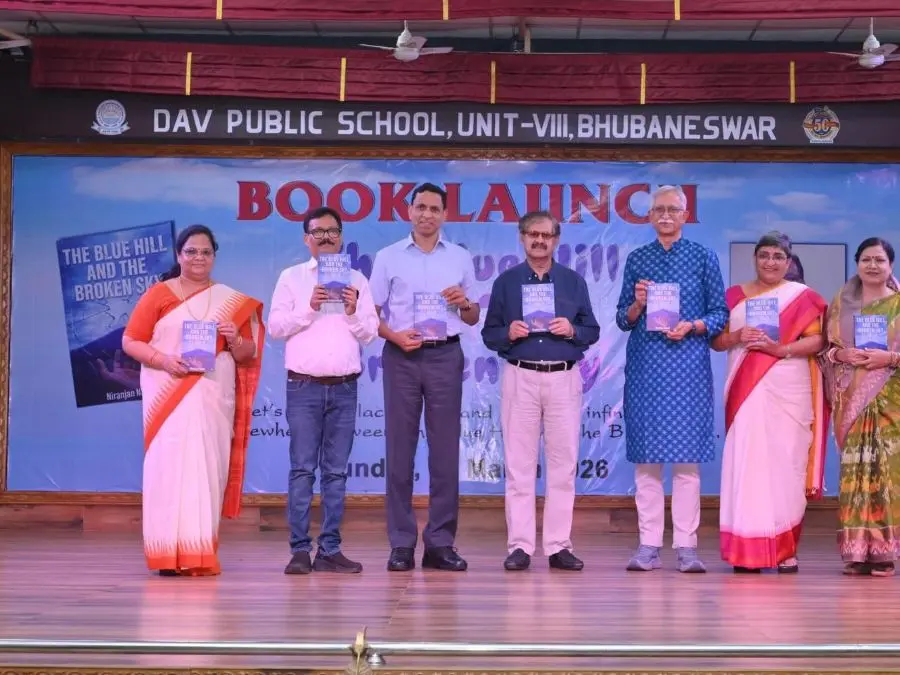
Two years after his debut novel ‘The Other Side of the Rainbow’ was published, Niranjan Nayak recently brought out his second novel, ‘The Blue Hill and the Broken Sky’.
He is just not accelerating on the creative high road, he is also adding to the repertoire of Odia-English fiction, that didn’t exist before. This is the life of a teacher of literature, more specifically the life of an English teacher.
Some of the well-known names in the Odia-English fiction canon such as Biyotkesh Tripathy’s ‘Baba Bugi’ and ‘The Vagrant’, and Dharanidhar Sahu’s ‘The House of Serpents’ and ‘The Prince in Disguise’ dwell on the intricacies of desire and the philosophical aspects of reality and illusion. Aswini Mishra’s ‘Feet in the Valley’ is a fine novel, but it has the world of officialdom as its happy hunting ground.
Likewise, Sachi Jena’s ‘A Tale of Two Families’, another fine novel, and a multi-family saga like ‘A Suitable Boy’, but in miniature, has the world of business as its subject matter. If the college or the university campus as a dynamic hub of human interactions has not been explored in Odia-English fiction previously, it is probably because of a belief in its inherent dullness.
Nayak’s two novels are set to change that perception. Both his novels are anchored in the educational space. What is more, Nayak traces back deadlocks and impasses in fully-formed personalities to early encounter that happened in their young adult days of youthful passion, rebellion and frustration.
‘The Other Side of the Rainbow’ is a case in point. Upon publication, Nayak’s first novel immediately stood out for its landmark setting of Ravenshaw College. But it aimed much higher than what the term ‘Campus Novel’ denotes by probing the thought processes of its three main characters — Rajiv, Arun and Saswati.
In ‘The Blue Hill and the Broken Sky. the threesome of Ravenshaw College, namely Arun, Rajiv and Saswati, have mutated into the threesome of Utkal University — Aman, Bijan and Meghna. Utkal University is, however, not the dominant presence in the novel, as Ravenshaw was in the earlier one. That honour belongs to a series of places far from the claustrophobic urban spaces and known landmarks of Odisha.
One such space, resplendent against the blue hills and a majestic sky, stands out. It is Darjeeling, a veritable Forest of Arden where fantasies may become reality and life-changing experi
ences may happen. This is what has happened with a young man and a young woman whose chance meeting on a bus leads to a passionate encounter in a small place in Assam, where the young man is an English teacher. It has the hallmark of a one-night stand. But the novelist shapes this sensational incident into a profound moment of impact. The young man on the bus is no other than Aman, who is on a revitalising trip to Darjeeling. The woman is Tulika. Their relationship forms the core of the novel.
But Aman’s backstory is the key to how the plot turns. He has left Odisha and taken up a teaching job at a college in Assam’s Dhubri. His taking off for Assam, besides being triggered by the job scarcity in Odisha in the 1980s and 90s, has a troubling personal aspect as well. This is his failure to turn his budding romance with Meghna, his classmate, into a fulfilling relationship, though both of them desire it. More importantly, this failure is rooted in his complex and troubled identity. We learn at a crucial point in the unfolding of this relationship who Aman is and why his alliance with Meghna is doomed. The surname ‘Akhtar’, which dropped like a bombshell on us early in the novel, tells it all. To get the full shock of the disclosure, I would urge all to read the novel before reading the blurb.
After the one-night stand between Aman and Tulika, the novel changes gear and goes right into the heart of inter-faith, inter-community bonding, a theme that has been sounded early on in the novel. The backstory of Tulika, preceding their night of passion, is crucial to this exploration. If Tulika is willing to show the ‘awful daring of a moment’s surrender’ to Aman despite knowing his Muslim identity, then that is a sign of how deep her attraction for Aman is. But that she does not insist on a commitment from Aman is because of her full sympathy for her father’s hostility to Muslims. She is deeply aware that her father’s anger is a product not of whipped-up communal hysteria of politicians, but of a genuine post-partition trauma that he as a Hindu suffered in the hands of communal-minded mobs.
Is Aman capable of redemption? The answer is in the affirmative. Aman realises that suffering is not just a test of character but a pathway to finding a common humanity that religion has occluded: “When the common humanity comes under one umbrella, their gods become one and so do their religions” (P. 217).
How is Aman to make reparations, especially in his present context when he has returned to Odisha? The answer lies in the novel’s suspenseful last part and the mind-blowing ending. So the reader had better gird up her loins and be ready to fly into the mystical heart of ‘The Blue Hill and the Broken Sky.’ She will be the richer for it.
(Niranjan Nayak, The Blue Hill and the Broken Sky. Notion Press, 2026, Pp. 223.)