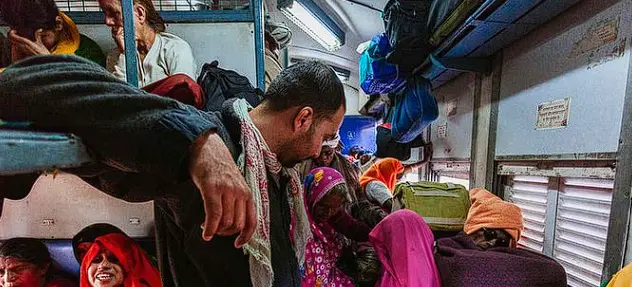
Kolkata: The Calcutta High Court has sharply criticised a practice in which some travelling ticket examiners (TTEs) allot vacant berths for money, likening the trade to selling “vegetables in a market”, and asked general managers of all railway zones to impose the maximum penalties available against such conduct. The bench said the misconduct played a role in a robbery that ended in the death of a passenger who had been drugged, PTI reported.
The court was dealing with a 2009 incident on the Teesta Torsa Express. Two men travelling from New Jalpaiguri to Sealdah with unreserved tickets secured berths after paying a TTE, the bench noted. They were later dosed by two criminals and robbed; one of the victims, who had underlying health issues, died from the sedative administered to him.
Court Directs Railways To Act
“This court is constrained to refer a copy of the judgment to the general manager of the Eastern Railway and other railways (zones) in the country to ensure the maximum available penalties for TTEs who sell empty berths in trains like vegetables in a market,” the division bench, led by Justice Rajasekhar Mantha, said.
The bench, which also included Justice Biswaroop Choudhury, stressed that such behaviour has led to serious consequences beyond theft. “There are several cases galore not reported that have, in fact, resulted in very serious medical consequences for victims of petty theft,” the court observed. “The origin of such crimes is in the hands of the TTEs,” it added.
Police Lapses Criticised
The court also faulted the police for
shortcomings in the probe and prosecution. It said police must take “more sincere, diligent and devoted steps to conduct investigations so that the life and liberty of travelling passengers are more secure in the Indian Railways”.
At trial, two accused — Aloke Ghosh and Gopal Mistry — were convicted and given life sentences on murder charges (Section 302) and seven-year terms for causing hurt by poison and intoxicating drugs (Section 328) of the IPC, in addition to convictions for theft and attempted murder as to the surviving victim; the sentences were ordered to run concurrently.
Appeals Partly Allowed
On appeal, the division bench found that the evidence did not sustain several of the charges and held that the appellants could at best be convicted under Section 328 for seven years. It therefore partially allowed their appeals, noting that the other charges “are clearly not proved”.
The court said Ghosh and Mistry are currently out on bail after having served 10 and 16 years respectively, and directed that they be released on execution of a bond to the satisfaction of the trial court, to remain in force for six months.
Forensic Lapses Highlighted
The bench criticised the investigating officer for failing to obtain a forensic science laboratory (FSL) report on the victim’s viscera, observing there was no evidence the viscera had been sent to the FSL. “The lapse on the part of the investigating officer is rather inexcusable,” the court said.
TTE Negligence Blamed
The court described serious dereliction by the TTE who allotted berths to the two passengers without prior reservation and noted similar lapses by TTEs on duty on the train’s run to Sealdah. “TTEs often allot berths at the earnest request of passengers who willingly pay money therefor,” the bench observed, and held that these failures by railway staff were primarily responsible for the crime.
According to the judgment, Arun Chakraborty and Sunil Kumar Das boarded the Teesta Torsa Express in February 2009 on unreserved tickets, obtained berths after bribing a TTE, were drugged and robbed of their belongings. Chakraborty survived after nine days in hospital, while Das succumbed.