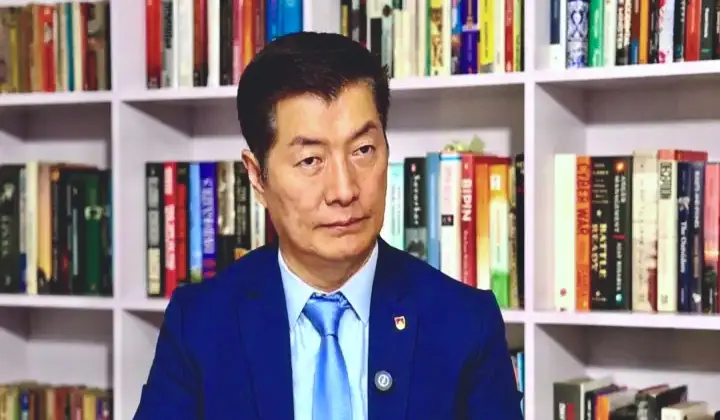
New Delhi: China could use a ‘puppet’ Dalai Lama to take over the Siachen Glacier, Galwan, Arunachal Pradesh and Sikkim, Lobsang Sangay, the former Sikyong (political leader) of the Central Tibetan Administration, said on Wednesday, urging India to be on alert.
There could be Chinese interference in the Dalai Lama’s succession, he warned,, while speaking to ANI.
Though the succession of the Dalai Lama is not complicated, as it will be facilitated by the Ganden Phodrang and recognised by Dalai Lamas for centuries, he was wary of Beijing’s intervention in the matter.
His observations came after the 14th Dalai Lama, in his book Voice for the Voiceless, announced that his successor will be born in a free world outside of China.
“The issue of the next Dalai Lama is also a major point of conflict. His Holiness recently celebrated his 90th birthday and is very healthy; we pray he lives for over 100 years. For people of faith, the succession is not complicated. There will be one Dalai Lama facilitated by the Ganden Phodrang, which is His Holiness’s office and trust. This office has facilitated the recognition of Dalai Lamas for centuries,” Sangay said.
The 15th Dalai Lama will be accepted by all, Tibetans and Buddhists globally, from the Himalayas to Europe and America, he said.
“His Holiness has made it clear in his book, Voice for the Voiceless, that he will be born in a free world outside of China. A spiritual teacher needs freedom to practice, which China does not provide. This 15th Dalai Lama will be accepted by Tibetans and Buddhists globally, from the Himalayas to Europe and America,” he said.
“The Chinese government, an atheist party, wants to control this process by appointing a ‘fake’ puppet Dalai Lama to use for political purposes. India must be on alert regarding this. A puppet Dalai Lama would be used to claim regions like the Siachen Glacier, Galwan, Arunachal Pradesh, and Sikkim. The world must decide: do they want the authentic leader authorised by the Dalai Lama’s office, or a Chinese puppet who will create disturbances throughout the Himalayan region? As a matter of faith, the choice is clear. The other will simply be a political official, much like the current Panchen Lama appointed by Beijing, whom even Chinese Buddhists do not follow as a spiritual leader,” Sangay said.
Tibet, being an independent country, deserves independence and self-determination, he further said.
“Historically, Tibet was an independent country. Under international law, we deserve independence and self-determination. However, the government-in-exile’s policy is the “Middle Way Approach.” His Holiness the Dalai Lama chose this for philosophical, personal, and political reasons. As Buddhists, we seek a middle ground through dialogue. Politically, it is difficult for countries like India or America to support full in
dependence because they have treaties with China respecting its sovereignty. The Middle Way is a compromise: if China stops the repression and discrimination of Tibetans, we will seek genuine autonomy within China rather than total separation,” the former Sikyong said.
China is an expansionist empire, while Tibet believes in solving the stalemate through the middle ground, he observed.
“Unfortunately, the Chinese government does not reciprocate. They are in the habit of taking, not giving. They took Tibet, Uyghur regions, Mongolia, and Hong Kong; now they want Taiwan. They also claim parts of India, including the Galwan Valley and Arunachal Pradesh, as well as parts of Nepal and Bhutan. China is an expansionist empire. While we offer a “give and take” middle ground, they continue to take. Despite this stalemate, our policy remains focused on addressing the issue of Tibet through non-violent dialogue,” he said.
The government-in-exile has been doing a very good job in the education field, he noted.
“The Tibetan government-in-exile has been doing a very good job in this regard. We run our own schools, from kindergarten all the way through high school and even at the college level. Recently, the Indian government handed over all the Tibetan schools they previously subsidised for us to run ourselves. Today, about 90 per cent of the teachers and staff members are Tibetan. We are doing quite well with the populations in India, Nepal, and Bhutan,” he said.
Although the Indian government is cooperative, there are different types of challenges faced by their educational institutions in the West, Sangay said.
“In the West, however, there is a bit of a challenge due to the different education systems in European countries, America, and Canada. Despite this, the younger generation is becoming more aware and paying more attention. We offer many summer programs that bring them to India, and weekend programs that teach Tibetan language, culture, and values,” he said.
Compared to other exiled communities, the Tibetan government-in-exile is the most efficient, he said.
“If you compare us to other exiled communities, the Tibetan government-in-exile is the most efficient. There are roughly 35 million political refugees in the world, including millions of Venezuelans, Iranians, and Afghans. Based on the research for my upcoming book, I can say there is no other government-in-exile like ours. We run our own schools, hospitals, banks, and international offices. I often give workshops to other communities because of how well-structured we are,” the former democratically elected political head said.
There was a new group of Tibetans who felt a bit of an identity crisis, but are now becoming more aware, he added.
“That said, some members of the younger generation do feel lost or confused. I recently held an event in Bengaluru where I was asked about identity. Many young people wonder, ‘Am I Indian, American, European, or Tibetan?’ I tell them they should not have an identity crisis. I was born in India and am proud of it; India has done more for Tibetans than any other country. However, I was born Tibetan, I will die Tibetan, and while I live, I will work for Tibet. Most Indians want us to remain Tibetan and fight for our cause — that is why we were given refuge here. Similarly, those in Europe and America should realise that their true identity is Tibetan. Many who feel Americanized or European eventually “come back home” to their roots,” Sangay said.