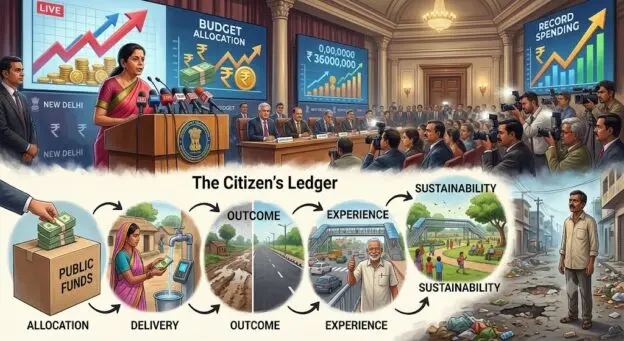
Every year, finance ministries across India unveil record budget outlays, heralded by massive media announcements, escalating target sheets, and swelling beneficiary databases yet, for the ordinary taxpayer, these fiscal declarations consistently miss a simpler, more fundamental question: what actually changed in my daily life?
Recent developments across the nation — ranging from Odisha’s decision to commission independent field audits through premier institutions like IIT Bhubaneswar and IIM Sambalpur, to the Economic Advisory Council to the Prime Minister’s evaluation of direct cash transfers to women, and a nationwide study detailing “Gram Sabha participation fatigue” — reflect a growing structural recognition that administrative accountability cannot end with mere expenditure. When citizens disengage from local democratic consultations or face persistent urban friction, they are signalling a deep mismatch between public input and experienced reality. The next frontier of governance requires an objective, baseline framework to measure whether public spending produces outcomes that citizens can physically verify.
To move beyond political rhetoric, public policy must be evaluated through a systematic lens rather than isolated news events. This framework, which we define as The Citizen’s Ledger, moves the focus of governance from measuring administrative inputs to auditing citizen-centric results. Every public programme should be subjected to five consecutive tests.
First is Allocation: how much public money was actually spent? Second is Delivery: did the allocated resource physically reach the intended citizen? Third is Outcome: did the target system or environment actually improve?Fourth is Experience: would the individual beneficiary voluntarily state that this intervention genuinely made their life better? Finally, fifth is Sustainability: will the structural benefit remain viable after government spending halts?
By separating the mere flow of capital from the physical transformation of an environment, this ledger forces a shift from ideological debates to evidence-based assessments.
Supporters of the current input-centric system frequently argue that massive public allocations and rapid financial outlays are necessary prerequisites for building capacity in a developing nation. From this perspective, high-volume budgets and expanding enrolment data represent essential administrative milestones that accelerate decision-making and overcome deep historical infrastructure deficits. While these initial outlays are undoubtedly critical, judging success purely by the quantum of money spent creates a major systemic blind spot. It allows administrative machineries to claim total policy success based entirely on a balanced balance sheet, even if a newly laid road degrades within a single monsoon or a subsidised utility grid fails to deliver basic comfort during localized emergencies. When the metrics of success remain locked inside bureaucratic ledgers, the public is forced to carry the financial risk without a guarantee of qualitative return.
This measurement gap has direct consequences for civic behaviour and public trust. When communities observe a persistent gap between multi-crore project announcements and the daily reality of their neighbourhoods, institutional fatigue inevitably sets in. The widespread decline in local assembly participation highlights that citizens withdraw from civic systems when they realize that repeated consultations yield no tangible change in public safety, mobility, or ease of dealing with the state.
This deficit cannot be fixed with larger financial inputs or broader welfare enrolment lists. True progress requires a governance mind-set that actively looks beyond the initial distribution of resources to measure the long-term utility of the assets created. Ultimately, public spending should not be evaluated by the comfort of the administrative process, but by the tangible, lasting improvement it brings to the shared public square.
As India navigates increasingly complex developmental goals, the core question for the future of public administration must pivot from how much wealth was distributed, to a more demanding question: how do we know it actually worked?