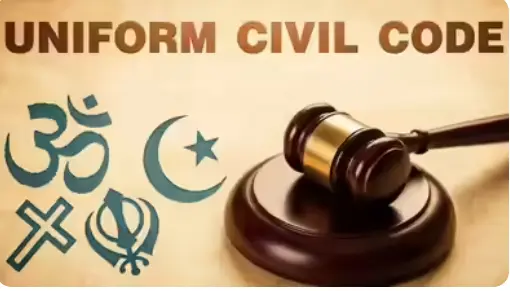
Before asking whether India needs a Uniform Civil Code, perhaps the ordinary citizen should ask a much simpler question: what will it change in my life? Will I have a better marriage, a more secure inheritance, a faster court, greater protection of property, greater equality for women, or simply a better quality of life because of it? Or are we witnessing something larger than a legal reform — another step in the political project of Hindu consolidation associated with the BJP and the Sangh?
The question acquires an unusual significance in Odisha because of something Union Home Minister Amit Shah said in May this year. Addressing a tribal gathering in New Delhi, Shah assured tribal communities that no provision of the UCC would apply to them and that their rights, customs and traditions would not be disturbed. He pointed specifically to the provisions made in Uttarakhand and Gujarat to keep tribal communities outside the UCC. And now, in September 2026, Shah has said that he is confident that all 21 BJP-NDA-ruled states will introduce the UCC before the 2029 Lok Sabha elections. The political ambition is therefore unmistakable. But so is the paradox: India is being asked to move towards a Uniform Civil Code while simultaneously being told that a substantial section of its citizens must remain outside that uniformity because their customs and traditions are different.
For Odisha, this is hardly a minor qualification. According to the latest Census figures officially available, Odisha had 95.9 lakh Scheduled Tribe people in 2011, constituting 22.85 per cent of the state’s population. The Union government was still citing precisely this figure in Parliament in February 2026. There is no published 2026 Census figure that can responsibly be presented as a new demographic reality. Odisha has 62 recognised tribal communities and 13 Particularly Vulnerable Tribal Groups, giving it the distinction of having the largest variety of tribal communities among Indian states. The Kondhs, Santals, Saoras, Gonds, Juangs, Bhuiyans, Gadabas, Bondas, Didayis, Dongria Kondhs and others are not merely names in a government schedule. They have different languages, kinship systems, rituals, festivals, relationships with land and forests, and customary ways of organising family and community life. Nearly one in every four people in Odisha therefore belongs to a community whose social and cultural history cannot simply be treated as a footnote to a national debate about uniformity.
Take the Bonda community of southern Odisha. Traditional Bonda marriage provides a striking example of why the word uniform deserves closer examination. Ethnographic accounts describe customary marriage arrangements involving family negotiation and a traditional bride-price known as ginning or gining. Recent documentation of Bonda customary practice records the traditional contribution to the bride’s family in the form of cattle and cereals. Such practices have evolved within a very different social and cultural setting from the statutory personal laws that govern most Indians. The point is not that every traditional practice should automatically be preserved. Customs too can require reform where they violate dignity, consent or equality. The question is whether equality before the law necessarily requires identical social customs. If the objective is to protect the individual, perhaps the law should begin with the rights of the individual rather than with the assumption that cultural difference itself is a problem.
This is where Odisha’s own civilisational experience becomes relevant. A 2013 paper by Dr Archana Kanungo in Odisha Review, tellingly titled “Unity in Diversity: The Uniqueness of Jagannath Culture of Odisha,” describes Jagannath culture precisely through the coexistence of cultural variety and unity. That is an idea Odisha has lived rather than merely theorised. Jagannath is profoundly rooted in Odisha and yet is imagined as the Lord of the Universe. The larger Odia experience has similarly been one of preserving distinctiveness without treating distinctiveness as separation. The movement for a separate Odisha was an assertion of Odia nationalism — a demand that language, culture and historical identity deserved political recognition. Yet becoming Odisha did not mean withdrawing from India. We became a linguistic state and remained part of the Indian nation. We preserved Odia while accepting India; we retained our cultural memory without rejecting a larger national identity. Perhaps that is one lesson Odisha can contribute to the UCC debate: a people can be different without being disloyal; unique without being divided; proudly Odia and completely Indian at the same time.
The argument that uniformity does not necessarily produce unity is not new, and it is important to acknowledge that. In a 2003 Times of India leader titled “Civil Disservice: Uniformity Threatens Unity and Reform,” writer and Kashmir scholar Balraj Puri argued that the emphasis on uniformity could actually obstruct both reform and national unity. His argument was that linguistic, religious and caste diversities could coexist with national unity, and that reform within personal laws should not automatically become a battle over community identity. Twenty years later, the same question remains remarkably alive: is the problem that citizens are governed by different personal laws, or is the problem that some of those laws may fail the tests of equality, dignity and individual freedom?
Pratap Bhanu Mehta made a related argument in The Indian Express in 2023, though from a somewhat different direction. He wrote that the purpose of a UCC ought to be the creation of a just society based on freedom, equality and individual dignity, and warned that the project should not become hostage to majoritarianism. That distinction is important. One can believe that personal laws need reform without automatically believing that cultural uniformity is the objective. The real test, Mehta suggested, is what the law actually does for individuals. Does it expand freedom and equality? Does it protect women and children? Does it improve individual dignity? Those questions are more consequential than simply asking whether every community is following exactly the same rules.
Odisha has already demonstrated that there is no single Odia position on the UCC. On June 30, 2023, thousands of Santali people gathered in Keonjhar in opposition to the proposed UCC, raising concerns about the effect of uniform civil laws on tribal customs and identity. The protest was a reminder that for communities whose customary systems remain part of everyday social life, “uniformity” is not an abstract constitutional phrase. It can mean changes to how families marry, inherit, organise relationships and understand community authority.
A few weeks later, another part of Odisha’s society expressed a very different concern. On July 12, 2023, The Times of India reported that Maulana S.N. Barquee, general secretary of Jamiat Ulama-eOdisha, urged more members of the community to submit their opinions to the Law Commission against the UCC before the consultation deadline. His argument was that religious freedom should be protected and that the move should be stopped in the interests of national unity and integrity. So Odisha’s response has not been a simple “yes” or “no”. There has been tribal opposition, minority opposition, and also support from sections of Odisha’s intellectual community.
On August 11, 2026, the Cuttack-based Thinkers’ Club devoted its 159th webinar to the Uniform Civil Code. Presided over by former senior bureaucrat Vivek Pattanaik, the discussion featured retired Utkal University political science professor Surjya Narayan Mishra as chief speaker and senior advocate Sourjya Sunder Das among the participants. The forum broadly supported the idea of a UCC and recommended sending a memorandum to the Prime Minister and Odisha Chief Minister. The significance is not simply that an intellectual forum supported the UCC. It is that Odisha is debating the issue from several directions, and therefore the State should not assume that there is one “Odia” answer.
There is, however, another question that deserves to be asked before the political timetable becomes confused with a constitutional obligation. Are BJP-ruled states actually constitutionally required to implement the UCC? Article 44 says that “the State shall endeavour” to secure a Uniform Civil Code throughout India. It is a Directive Principle, not an enforceable Fundamental Right, and the Constitution does not prescribe a deadline by which every state must enact an identical code. Matters relating to marriage, divorce, succession and other personal-law subjects fall within areas in which both Parliament and states can legislate. Therefore, Shah’s 2029 target is a political commitment of the BJP-NDA governments, not a constitutional deadline imposed upon every state.
And this brings us back to the word that sits at the centre of the entire debate: uniform. If tribal communities must be excluded because their customs are different, if customary systems continue to exist, and if the Constitution itself recognises India’s extraordinary diversity, perhaps the more fundamental question is whether national unity actually requires citizens to become uniform in their social and cultural lives. Odisha’s own experience suggests otherwise. We did not have to become less Odia to become Indian. We did not have to surrender our language to prove our nationalism. Why, then, should national unity necessarily require every community to become socially identical?
And so, the citizen’s question remains. What exactly will the Uniform Civil Code do for me? How will it elevate the quality of life of the ordinary Odia — the farmer, the worker, the small businessman, the young couple, the widow, the tribal family, the middle-class household struggling with property and inheritance, or the woman seeking justice? If those benefits can be clearly demonstrated, then the case for reform deserves serious consideration. But if the immediate gains to citizens are difficult to identify, should we instead understand the UCC as part of a much larger political project of Hindu consolidation by the BJP and the Sangh?
Because ultimately, a democracy cannot measure a law merely by the scale of the political project behind it. It has to measure the law by what the citizen receives from it. The next question, therefore, is perhaps the most uncomfortable one: what is the democratic Return On Investment of the Uniform Civil Code?