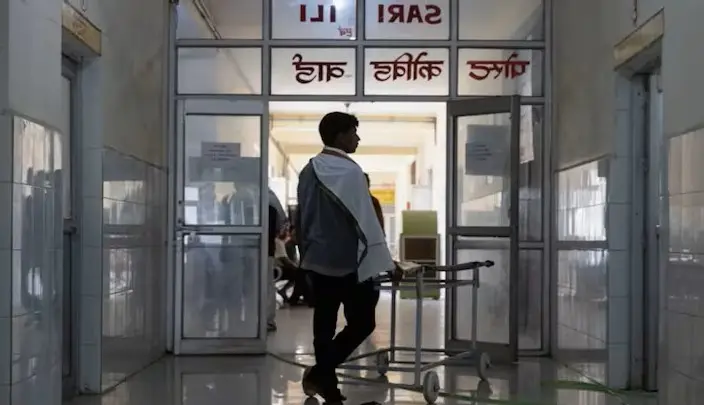
The family was waiting for good news. My niece had been admitted to a private hospital in Bhubaneswar for the delivery of her first child, and there was the usual mixture of excitement, anxiety and anticipation that surrounds the arrival of a baby. We were waiting for the nurse to break the news and we could be assured that Tamanah (my niece) and the baby were fine. But the happiness of that moment was soon accompanied by another anxiety — the hospital bill.
Questions began to arise about the charges, the procedures and the expenses appearing on the bill. What should have remained a family’s memory of the arrival of a new life, became, at least for some time, a conversation about money, bills and what had actually been done. It made me think about something more fundamental than one hospital or one bill. Why has healthcare become so expensive that a family can be overwhelmed by the cost at precisely the moment when it is least capable of thinking about money?
We have become accustomed to explaining the cost of healthcare by pointing to the years of medical education, the cost of establishing hospitals, sophisticated equipment, specialist doctors, nurses, technology, imported machines and the enormous infrastructure required to keep a modern hospital running. There is truth in all of this.
A good hospital does require substantial investment. Industry research cited in a SEBI-hosted report puts the capital cost of a tertiary or quaternary hospital in a Tier-I city at more than Rs 1 crore per bed, excluding land, with land and building accounting for around 55-60 per cent of capital expenditure and equipment around 25-30 per cent. When Apollo opened its 350-bed Bhubaneswar hospital in 2010, The Times of India reported an investment of Rs 120 crore in the facility. In 2024, The New Indian Express reported that Manipal Hospitals planned to invest around Rs 100 crore in revamping its Bhubaneswar facility and developing a dedicated oncology unit. These are substantial amounts of money, but they also make one wonder whether we have stopped at the explanation and forgotten to ask the next question: how much does healthcare actually need to cost?
The patient is often presented with the acquisition price of sophisticated technology as though that entire price belongs to the individual procedure. But capital equipment is an investment, used thousands of times over many years. Once its cost is spread across its useful life and utilisation, what is the actual cost attributable to a single patient?
The machine serves thousands of patients. Its cost is recovered over time. The same logic applies to hospital buildings, operating theatres and other major infrastructure. The real question is therefore not whether these investments cost money, but how those costs are calculated, over what period they are recovered and what constitutes a reasonable return.
The same question can be asked about medical education. In August 2025, the Odisha government revised the annual MBBS fee at Hi-Tech Medical College & Hospital, Bhubaneswar, from Rs 6.5 lakh to Rs 11.56 lakh — a rise of nearly 78 per cent, effective from the 2025-26 academic session. A doctor spends years acquiring knowledge and skills, and there is no argument against rewarding that expertise properly. But why must the cost of producing a doctor be so high in the first place? If society needs doctors, should their education be treated primarily as a private investment to be recovered through future earnings, or as an essential social investment like the education of teachers, engineers or public servants?
The National Medical Commission has itself moved towards greater transparency in medical-college fees, requiring private and deemed institutions to disclose their fee structures in detail. Perhaps we should therefore question not only what a doctor earns, but the system that makes becoming a doctor so expensive that the economics of recovering that investment inevitably become part of the healthcare system.
There is another difference between healthcare and almost every other market. A person buying a car can compare five models. Someone buying a television can compare prices online. A traveller can compare hotels before booking. A patient cannot compare five hospitals when a child needs an ICU, when a mother has cancer, when a family’s sole earning member has suffered a cardiac emergency or when a newborn needs intensive care.
The patient does not enter the market as a rational consumer with time, information and the ability to walk away. The patient enters frightened, often exhausted and frequently without understanding the medical terminology being used. A family may not know whether a particular test was necessary, whether another test could have provided the same information, what an implant actually costs, how much a procedure normally costs or what portion of the final bill represents the doctor’s professional fee, equipment, consumables, nursing, infrastructure or the hospital’s return on investment. It is perhaps one of the few markets in which the customer is least capable of questioning the product while having the greatest emotional reason to buy it.
That is where the look in people’s eyes inside hospitals becomes difficult to ignore. It is not simply fear of disease. It is the fear of not knowing. A family may be prepared to spend whatever is necessary to save someone they love, but that willingness should not be mistaken for an informed acceptance of every charge. The helplessness of a patient is precisely why transparency matters. A person who does not understand medicine should at least be able to understand the bill.
The problem becomes even more complicated when the patient arrives with a government health card. Odisha’s BSKY system brought millions of people into private hospitals under publicly financed healthcare, and the state has repeatedly had to intervene over complaints involving beneficiaries. In 2022, the government directed private hospitals to ensure BSKY beneficiaries were not harassed after complaints that patients were being denied treatment.
In 2023, a private hospital was de-empanelled after alleged BSKY irregularities involving fake documents and bills. More recently, in June 2026, the State Health Assurance Society warned empanelled hospitals not to charge beneficiaries for covered pre-hospitalization and post-hospitalisation services after reports of money being collected for diagnostic tests and other services. These actions do not mean that private hospitals as a whole are dishonest. They do, however, tell us that the government itself recognises the possibility of misuse within a system in which public money is spent on private healthcare institutions.
Perhaps the answer lies in something more basic than whether private hospitals should make profits. They should be able to recover their investments, pay their doctors and employees, maintain equipment and continue to provide advanced care. But somewhere between the actual cost of providing healthcare and the final price presented to the patient lies a space that the ordinary citizen cannot see. How much is genuine cost? How much is depreciation? How much is a reasonable return on investment? How much is inefficiency? How much is commercial margin? And how much, if any, is simply the price that can be extracted because the person standing at the billing counter has no choice?
When my niece’s first child finally arrived, none of us was thinking about capital expenditure, equipment depreciation or hospital margins. We were thinking about the little life that had just entered our family. We named her Aakriti. Her arrival should have remained a memory of a family becoming larger, of a new life taking shape. Yet the experience left behind a question that is perhaps larger than one hospital or one bill: when a family walks into a hospital carrying hope, fear and love, and not the bargaining power of an ordinary consumer, should the price of that vulnerability be part of the price of healthcare?
(Part I of a two-part examination of private healthcare vis-vis public sector, its economics and the vulnerability of the Citizen)