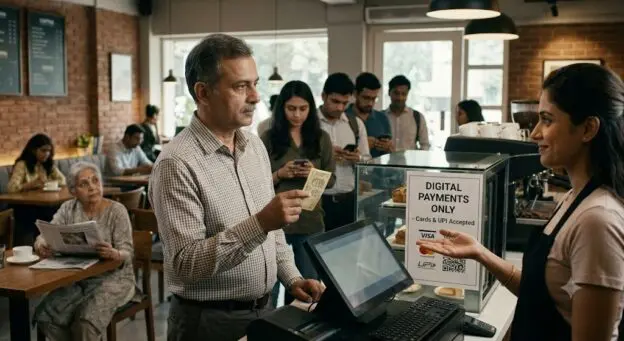
A few days ago, while ordering coffee at a well-known café, I reached into my wallet and placed a currency note on the counter. The cashier smiled, pointed towards a neatly printed notice, and politely informed me that the establishment accepted only digital payments. Cards and UPI were welcome; cash was not. The transaction lasted less than a minute. The question it raised has stayed with me much longer.
The issue was never the coffee, nor was it an objection to digital payments. Few would deny that digital transactions have made life easier. They are faster, easier to audit and, in many situations, more secure than cash. The café was merely exercising a business decision that thousands of establishments now make every day.
Yet one thought lingered. When did carrying legal tender issued by the Reserve Bank of India cease to be enough? More importantly, when did convenience begin to replace choice? The distinction may appear trivial. It is anything but.
Democracies are accustomed to celebrating grand freedoms. We speak of the freedom to vote, the freedom of speech, the freedom of religion and the freedom to pursue one’s profession. These are rightly regarded as the pillars of constitutional democracy. But there exists another freedom, quieter and less celebrated, that shapes our lives far more frequently: the freedom to choose between alternatives in ordinary moments.
We exercise that freedom dozens of times each day without noticing it. We choose how to pay, how to travel, how to communicate, where to shop and which services to use. These decisions seem too mundane to attract philosophical attention. Yet they form the texture of everyday liberty. Perhaps this is why their gradual disappearance often goes unnoticed.
Modern societies are understandably obsessed with efficiency. Governments seek administrative simplicity. Businesses seek operational efficiency. Citizens themselves demand faster services, shorter queues and frictionless transactions. Technology has enabled much of this transformation. Digital payments, electronic toll collection, online public services and automated customer support have all emerged from a legitimate desire to make systems work better.
None of this is inherently problematic.
Indeed, one could argue that a nation aspiring for economic growth has little choice but to embrace such technologies. Efficiency is not the enemy of democracy. Quite often, it strengthens it. The question, however, is whether efficiency always expands freedom—or whether, on occasion, it quietly narrows it.
That distinction deserves greater public attention than it currently receives.
Consider how technological transitions are usually described. They are presented as additions to our lives. We are told that digital payments supplement cash, online services supplement physical offices and automated systems supplement human interaction. Initially, that is often true. Over time, however, the relationship changes. Cash counters disappear. Human operators become inaccessible. Public services assume universal internet access. Toll plazas begin to expect electronic tags. What began as an additional option gradually became the only practical one.
At what point does an option cease to be optional? The question is not rhetorical. It lies at the heart of how citizens experience freedom in everyday life. A democracy does not merely protect spectacular rights. It also preserves ordinary alternatives.
Technology itself is not the issue. Few people would voluntarily abandon instant payments, online banking or digital commerce. Nor should they. Progress has transformed healthcare, education, commerce and communication in ways that would have seemed unimaginable only a generation ago.
The real question is different.
Does progress increase the number of meaningful choices available to citizens, or does it simply replace one system with another while describing the transition as inevitable? These are not identical outcomes. The first enlarges freedom. The second reorganises it.
History offers an interesting perspective on this distinction. During periods of financial disruption, economists have often observed that resilience emerges not from uniformity but from diversity. Healthy ecosystems depend upon biodiversity. Competitive markets discourage monopolies. Democratic institutions distribute authority across multiple centres of power precisely because concentration creates vulnerability.
Why should everyday civic life be governed by a different principle?
When every payment moves through the same technological architecture, every grievance passes through the same automated process and every public service increasingly assumes a single mode of access, efficiency undoubtedly improves. Yet the system also becomes more dependent upon uniform behaviour. Perhaps this is the paradox of modern governance. The more efficiently institutions organise society, the more important it becomes to ask whether citizens retain the freedom to organise their own lives differently.
This is not an argument against digitisation. It is an argument against mistaking standardisation for progress. The two are related, but they are not synonymous. Progress enlarges human possibility. Standardisation often reduces variation. Sometimes these objectives coincide. Sometimes they do not. The challenge for public policy is recognising the difference.
Curiously, public debate rarely examines this question. We enthusiastically discuss artificial intelligence, digital infrastructure, financial inclusion and economic growth. These are important conversations. Yet we devote remarkably little attention to a simpler question: what choices are quietly disappearing as new systems emerge?
Perhaps this silence exists because each individual change appears insignificant. A café refusing cash is hardly a constitutional crisis. An automated customer service number is merely an inconvenience. A mandatory digital platform may even appear perfectly rational. Viewed individually, none of these developments seems worthy of alarm. Viewed together, however, they reveal a broader pattern.
Alternatives seldom disappear dramatically. They fade through neglect, convenience and gradual irrelevance until one day they no longer feel like alternatives at all.
It is tempting to dismiss such concerns as resistance to change. That would be a mistake. Every generation has witnessed technological transformations that improved human life. The question has never been whether societies should modernise. They should. The question is whether modernisation continues to respect the citizen’s capacity to choose.
Perhaps the health of a democracy is measured not only by the elections it conducts or the technologies it adopts, but also by the number of meaningful choices it leaves untouched. Because freedom rarely disappears in a single dramatic moment. More often, it retreats quietly, disguised as convenience, justified in the language of efficiency, and accepted because each individual compromise appears too small to matter. Until, one ordinary afternoon, standing at the counter of a coffee shop, a citizen discovers that what has vanished is not cash. It is the habit of asking whether there ought to have been another choice.
(Views expressed by the columnist are personal and do not necessarily reflect the opinion or policy of the news portal)