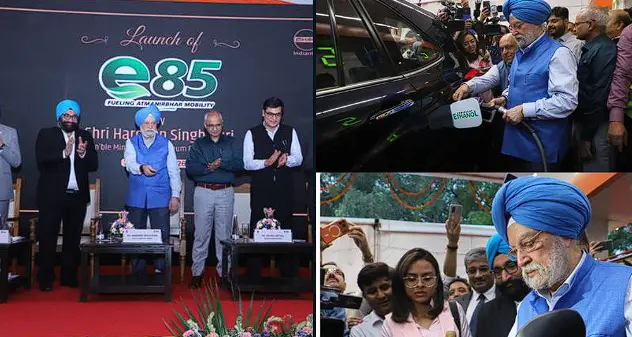
New Delhi: India’s ethanol push reached a new milestone with the arrival of E85 in Delhi. Union Petroleum and Natural Gas Minister Hardeep Singh Puri opened the capital’s first E85 pump at Indian Oil’s Pusa Road station, making high-ethanol fuel commercially available in the city.
What is E85?
E85 is a fuel made mostly from ethanol — up to 85% — with about 15% petrol, compared with E20’s 20% ethanol and 80% petrol. Using more ethanol cuts petrol use, lowers reliance on imported oil, and supports domestic ethanol production from crops like sugarcane and maize, as reported by Auto Punditz.
Why ₹82.12 Price Matters
Delhi’s E85 sells at ₹82.12/litre — roughly ₹20 less than E20. That prompts the key question: will drivers save on running costs? Ethanol has less energy per litre, so vehicles on E85 typically burn more fuel for the same distance. Still, a large enough per‑litre discount can make E85 cheaper per kilometre
, and the government seems to be using price to nudge people toward flex‑fuel vehicles.
However, it must be noted that E85 is not suitable for unmodified petrol cars. Only flex-fuel vehicles — which include altered engines, fuel systems, sensors and calibrations to handle varying ethanol ratios — can safely run on E85. Using it in standard petrol vehicles can cause performance problems and long-term damage.
Which Vehicles Will Use E85?
India’s flex-fuel market is nascent but growing. The Maruti Suzuki WagonR Flex Fuel stands out as the first passenger car engineered for high-ethanol use. In motorcycles, Hero MotoCorp offers flex-fuel variants of the Splendor+ and HF Deluxe, and Suzuki has shown the Gixxer SF FFV. These moves bring flex technology closer to mainstream commuter mobility.
Rollout Plan
According to reports, the Pusa Road station is just the start. The government aims for 50–100 E85 pumps across Delhi-NCR and the Mumbai-Pune-Nagpur corridor initially, scaling to about 500 outlets by end-2026 and roughly 5,000 by end-2027. Coordinated growth of pumps and compatible vehicles is essential for the ecosystem to take off.
Why India Is Pushing Ethanol
Ethanol blending into petrol helps India cut oil imports and reduces its exposure to global price swings and currency risk. It also creates extra income for farmers and distilleries by boosting demand for crops such as sugarcane and maize. After achieving nationwide E20 ahead of schedule, the government’s move to introduce E85 signals a clear push toward higher ethanol blends.