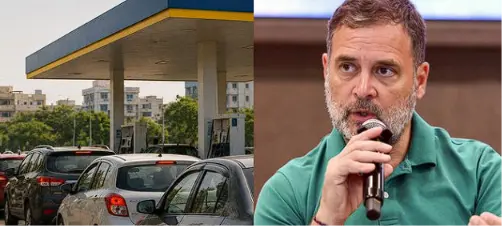
New Delhi: Congress leader Rahul Gandhi on Saturday launched a sharp attack on the Modi Government over ethanol blending in petrol, alleging that motorists were being shortchanged through fuel containing more ethanol than the officially prescribed E20 level.
In a post on X in Hindi, Gandhi said, “E20 turned into 420 – stealing petrol from the public’s cars!” He was referring to Section 420 of the old Indian Penal Code, which dealt with cheating.
Gandhi said the Karnataka government had collected petrol samples from seven districts and sent them to an accredited laboratory. According to him, 11 of the 14 samples had more than 20 per cent ethanol.
He claimed that samples from Indian Oil Corporation Limited (IOCL) and Hindustan Petroleum Corporation Limited (HPCL) showed ethanol levels of 31.2 per cent and 30.5 per cent respectively. He also said samples linked to IOCL, HPCL, Bharat Petroleum Corporation Limited (BPCL), Nayara and Shell had crossed the permitted limit.
Gandhi alleged that the companies had not disclosed the ethanol content through their own laboratories. He asked why petrol pumps do not display the amount of ethanol mixed in petrol.
“Modi ji, tell us – what’s being put in the country’s tank? How much ethanol is actually in the petrol? When will action be taken against companies mixing more than 20 per cent ethanol?” he asked.
He said too much ethanol could affect vehicle performance, reduce mileage and increase repair costs. Gandhi also repeated his challenge to Prime Minister Narendra Modi for an open debate and said ethanol blending could be discussed.
Karnataka’s Allegation
Gandhi’s remarks came a day after the Karnataka government accused major oil marketing companies (OMCs) of supplying petrol with more than 20 per cent ethanol. The state said samples were collected from Bengaluru, Kolar, Chikkaballapura, Bengaluru Rural, Ramanagara, Mangaluru and Tumakuru, as reported by The New Indian Express.
Karnataka food, civil supplies, consumer affairs and legal metrology minister Rizwan Arshad said the tests were done by the Shriram Research Institute in Bengaluru. He said the institute is accredited by the National Accreditation Board for Testing and Calibration Laboratories and certified under ISO standards.
Oil Companies Deny Claim
IOCL, BPCL and HPCL rejected Karnataka’s findings. They questioned the way samples were collected and tested.
The companies said E20 petrol sold across their network, including in Karnataka, follows the Bureau of Indian Standards’ IS 17021 rules. These rules allow ethanol content between 19 and 21 per cent.
In a joint statement, the companies said, “The OMCs would like to clarify that the claims, as reported, are not supported by testing conducted in accordance with the prescribed statutory and technical procedures.” They also said the third-party laboratory certificates did not give enough details about the testing method to verify the results independently.
Why Ethanol Is Used
India began its ethanol-blending programme as a pilot project in 2001. The aim is to reduce dependence on imported crude oil, support farmers and improve energy security.
The programme has been expanded through policies such as the National Policy on Biofuels, 2018, and the NITI Aayog roadmap for ethanol blending.
According to Petroleum Ministry data cited by the OMCs, the programme has saved foreign exchange worth more than Rs 1.97 lakh crore since the 2014-15 ethanol supply year. It has replaced about 316 lakh metric tonnes of crude oil and reduced carbon dioxide emissions by around 952 lakh metric tonnes.
The government data also said farmers received more than Rs 1.66 lakh crore under the programme. During the 2025-26 ethanol supply year, which ended on October 31, 2026, the three public-sector OMCs bought 1,089 crore litres of ethanol and blended 1,134 crore litres against petrol sales of about 5,673 crore litres.