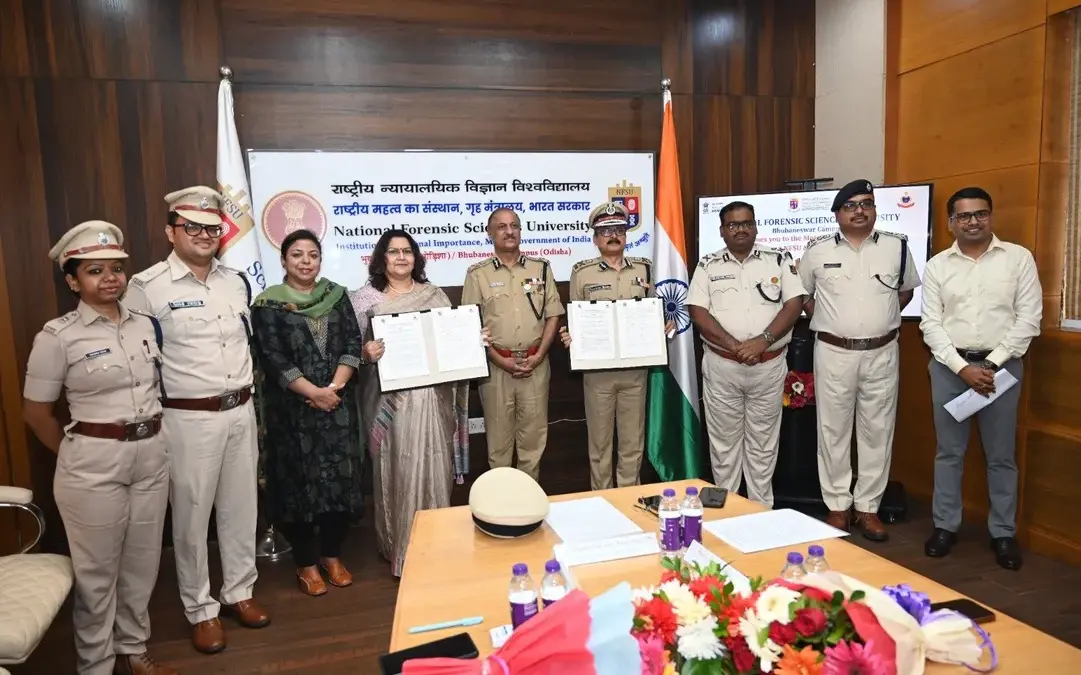
Bhubaneswar: In a major effort to modernise law enforcement and combat digital fraud, the CID-Crime Branch of Odisha Police signed a five-year Memorandum of Understanding (MoU) with the Bhubaneswar campus of the National Forensic Sciences University (NFSU) on Tuesday.
The partnership is designed to overhaul cybercrime investigation capabilities, elevate digital forensics expertise, and embed scientific methodology across policing operations in the state.
The agreement was formalised by Crime Branch DGP Vinaytosh Mishra and NFSU Campus Director Dr Purvi Pokhariyal in the presence of Odisha DGP Yogesh Bahadur Khurania, who later inaugurated a six-day training initiative titled “Cyber Crime Investigation and Digital Forensics” for police personnel, marking the immediate rollout of the alliance.
Describing the partnership as a historic milestone in the modernisation of Odisha Police, Khurania said the collaboration would lay a strong foundation for cyber policing in the state. He noted that crime patterns are evolving rapidly, with digital evidence now central to nearly every investigation. The surge in offences such as mule account fraud, online investment scams, and “digital arrest” cases has made scientific investigation and forensic analysis more critical under the new criminal laws. Proper seizure, preservation, and management of electronic evidence, he stressed, must become a core competency for all personnel.
Recent data underscore the urgency: cybercrime cases in the state jumped from 124 in 2014 to 2,803 in 2025, while financial losses from fraud rose sharply from Rs 8.97 crore in 2018 to Rs 154.5 crore in 2024.
Odisha has already taken concrete steps to counter the rising threat, establishing 20 new cybercrime and economic offence police stations and equipping stations statewide with modern hardware and software valued at around Rs 15 crore. The state has also moved to deploy specialised experts, with a central PSU tasked to provide 170 professionals in IT, cyber forensics, and financial analysis across cyber police stations.
However, Khurania stressed that technical tools are only as effective as the officers operating them.
Beyond classroom instruction, the agreement incorporates joint research programs, crime scene management, forensic infrastructure development, higher education pathways, and technical consultancy services.
Outlining the training roadmap, Crime Branch DGP detailed a structured rollout that will upskill 480 personnel across 34 police districts and the Crime Branch by January 2027. The programme consists of 16 batches of 30 participants each, spanning ranks from constable to Deputy Superintendent of Police (DSP). Each six-day module offers five days of academic and laboratory instruction at the NFSU campus, concluding with an intensive practical session at the state’s Cyber Complex.
Urging the initial cohort of trainees to take ownership of the material, DGP Khurania noted that true success lies not in earning certificates, but in collecting legally admissible evidence that holds up in court. He instructed participating officers to act as knowledge multipliers by cascading these technical skill sets down to their local district units upon completion.
The inauguration event was attended by key stakeholders, including Director of the State Forensic Science Laboratory (SFSL) Dr Santosh Bala, Inspector General (Crime) Dr Sarthak Sarangi, and programme coordinator Dr Bishwa Kallyan Dash, Associate Professor at NFSU.