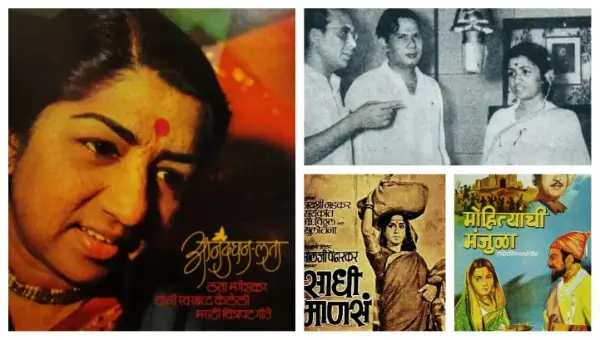
Long before she was remembered solely as the voice of generations, Lata Mangeshkar quietly explored another side of music—as a composer of Marathi film songs.
For millions of listeners, Lata Mangeshkar is inseparable from the idea of the playback singer. Her voice defined generations of Hindi film music, while her recordings in Marathi and several other Indian languages revealed an extraordinary range. Yet there was a lesser-known chapter in her career: Lata Mangeshkar was also a film music composer.And for a while, she did it without putting her own name on the music.
She called herself “Anandghan’, a Marathi expression meaning ‘cloud of joy’. Under that pseudonym, Mangeshkar composed the music for four Marathi films in the 1960s: Mohityanchi Manjula (1963), Maratha Tituka Melvava (1964), Sadhi Manasa (1965) and Tambadi Mati (1969). But the story actually began a little earlier.
Before Anandghan, there was Lata Mangeshkar
In 1950, Mangeshkar composed the music for the Marathi film Ram Ram Pahune, directed by Dinkar D Patil. This was not a pseudonymous venture: she worked under her own name. Among the songs she composed were the tamasha numbers Kashi Jadli Sang Tuzya Warti Mazi Preeti and Raya Galaat Khudkan Hasa. She also sang in the film and brought composer-singer C. Ramchandra into one of its songs.
Her subsequent decision to adopt “Anandghan” came in connection with filmmaker Bhalji Pendharkar and Mohityanchi Manjula.
According to an account attributed to Mangeshkar herself, Pendharkar was looking for a music director for the historical film. When Mangeshkar offered to take on the job, Pendharkar was concerned that the stature of her name could work against her if the music was poorly received. His solution was to keep the composer’s identity separate from Lata Mangeshkar.
Several names were considered. Mangeshkar rejected Pendharkar’s suggestion of “Jatashankar” and instead proposed “Anandghan”, inspired by her fondness for the composition Anandavan Bhuvani associated with Samarth Ramdas. The pseudonym proved remarkably effective.
A secret hidden in plain sight
As Anandghan, Mangeshkar created music that drew naturally on Marathi musical traditions, including folk idioms. Mohityanchi Manjula featured songs such as Nilya Aabhali and Bai Bai Manmoracha, while Maratha Tituka Melvava produced the much-loved Reshmachya Reghani, sung by her sister Asha Bhosle.
When “Anandghan” won an award
The breakthrough came with Sadhi Manasa (1965), again directed by Bhalji Pendharkar. The film’s music included some of Anandghan’s most enduring compositions, among them Airanichya Deva Tula, Malachya Malyamandhi, Rajachya Rangmahali and Nako Devraya Anta Aata. Airanichya Deva Tula, written by Jagdish Khebudkar, became particularly celebrated. The song is credited to Anandghan as composer and Lata Mangeshkar as singer; the recording also featured flute played by the then-young Hariprasad Chaurasia.
Her final score
Mangeshkar continued under the Anandghan name with Tambadi Mati in 1969. The film included compositions such as Ja Ja Ranichya Pakhara, Bhasma Vilepit and Mazhya Kapalacha Kunku. Her brother Hridaynath Mangeshkar also performed songs from the score. But Tambadi Mati would be her last film as a music director.
The reason was not a lack of musical ability or opportunity. Quite the opposite: composing demanded a kind of time that her extraordinary playback career simply did not allow. Mangeshkar later explained that composing involved repeated meetings with filmmakers and lyricists, rehearsals and recording sessions, while her singing schedule could involve several recordings in a single day. Eventually, she chose to concentrate on singing. There was even a point when she considered a composing partnership with her brother Hridaynath, imagining something along the lines of the composer-duo model. That idea, too, remained unrealised.
Why Anandghan still matters
It is tempting to treat Anandghan as a curious footnote in Lata Mangeshkar’s career. It deserves more than that. The Anandghan recordings demonstrate that Mangeshkar’s relationship with music went well beyond interpreting melodies written by other composers. She understood melody deeply enough to construct it herself, worked with Marathi folk idioms, composed for her siblings and for herself, and produced music that became part of the Marathi film-music canon.
Perhaps the most revealing part of the story is that she did not initially seek the spotlight for this work. “Anandghan” allowed the music to be heard without the enormous expectations attached to the name Lata Mangeshkar. Some of it was to support his younger brother Hridaynath Mangeshkar.
In retrospect, the irony is irresistible: one of India’s most recognisable musical identities spent part of her career hiding behind a name that meant ‘cloud of joy’. And perhaps that is the most fitting description of this forgotten chapter – not a different Lata Mangeshkar, but another dimension of the same musician.
At a glance: The Anandghan years
|
Film |
Year |
Composer credit |
|
Ram Ram Pahune |
1950 |
Lata Mangeshkar |
|
Mohityanchi Manjula |
1963 |
Anandghan |
|
Maratha Tituka Melvava |
1964 |
Anandghan |
|
Sadhi Manasa |
1965 |
Anandghan |
|
Tambadi Mati |
1969 |
Anandghan |
The chronology above is supported by accounts from Scroll, Lata Mangeshkar’s biographical archive, and contemporary retrospectives. The following are some YouTube links to Anandghan’s music:
- https://youtu.be/Gf8UVxwYG8k?si=HFNemYc_XHcK_Npv
- https://youtu.be/1Yxo97oBWSY?si=hDgLl3kbi1CCE2-u
- https://youtu.be/YkhE3wLaiAY?si=pvYHFzWZfDoRw1o2
- https://youtu.be/NxGhVo_Mhu0?si=FEw3adT_DM9GM38G
- https://youtu.be/MF8NZhZ3oCc?si=XPTLjjMmWn1Y8nI3
So the next time you hear Airanichya Deva Tula or Reshmachya Reghani, remember to listen for more than Lata Mangeshkar’s voice. Listen for the composer too, who once signed her music ‘Anandghan’.