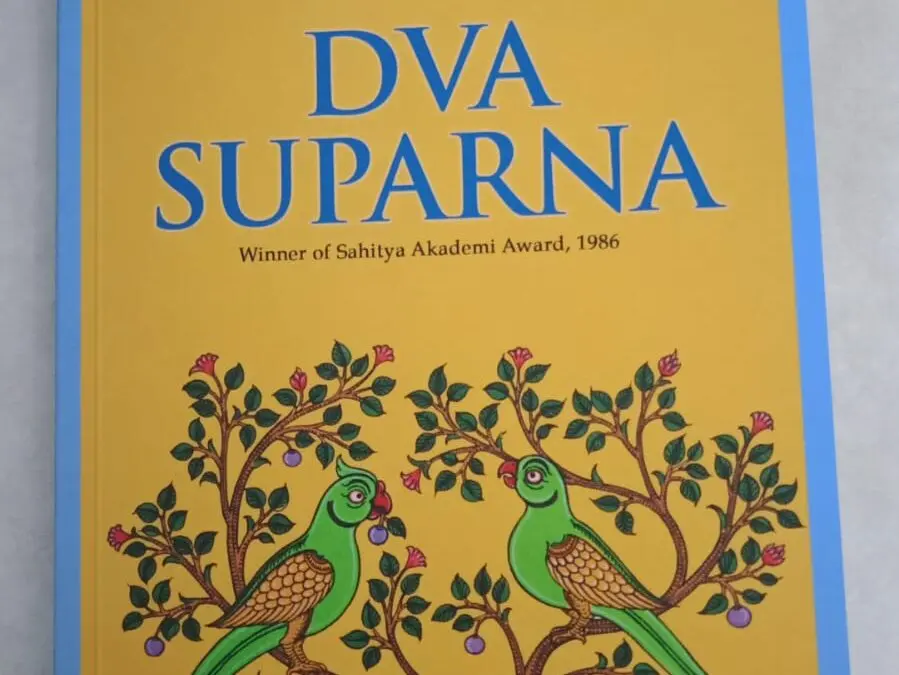
Dva Suparna, published in 1984, is the sixth poetry collection of Soubhagyakumar Misra, the renowned Odia poet who has authored 17 poetry collections.
Dva Suparna received the Sahitya Akademi Award in 1986 for being the salient Odia work of that year. It consists of 52 poems which in some way or other narrates the state of transition of the inner self.
In the recent release of the translated rendering of the work into English by renowned translator and poet Rabindra K Swain, the original work seems untarnished and seeks to find a new voice among global readership.
Dva Suparna, a mantra derived from Mundakopanishad, metaphorically explains two birds that symbolise the eternal relationship between the individual soul and the Supreme being. The allegory illustrates the journey from ignorance to spiritual liberation. The first poem of the collection ‘The White Bird, the Black Bird’ elaborates more on this notion when it states — If the sky were not as big as our old sky, only the white bird could fly, only the black bird could fly never both the white bird and the black bird at the same time.
It sums up that unless everything is not changing, not disappearing, the whol
e existence is that of being in nothingness. In a poem ‘Iran’ written in 1984, when Iran had transitioned from a Western-backed monarchy to an authoritarian Islamic theocracy, the ambience portrayed there resembles the happenings of present times. The poet, positioning himself as a war observer, spurts those lines — Each of those seventeen was blindfolded/ The rest of the work was to be undertaken by the firing squad/ It did not even take seventeen minutes/ If someone’s head hung forward, another’s blood paused for a while before spurting out.
Later in the poem he states — This play is not one of victory and defeat/ No bugle was blown, no flag of victory was unfurled… Only one hand shuddered a little/Does that hand belong to the poet?
In the allegorical poem ‘O Yes, Banshi’, the poet, while rustling past the abruptness of meeting a stranger or a friend, exclaims — Where were you all these days, where was I? Do you still dream of a Krauncha bird, hit by an arrow, falling before your eyes? I too dream of it, Banshi. This earth has no more the habit of being taken by surprise.
Edith Grossman, the inimitable translator of the works of Marquez and Cervantes, had once said about translation that “Fidelity is the highest aim, but a translation is not made with tracing paper. It’s an act of critical interpretation.” Hence, with the knowledge of the language from which the translation has been done by Rabindra K Swain, himself an accomplished poet, the work may seem to be an act of felicity, but in a real sense it’s most subtle and sinews of the transformative task that he has to undertake.
Somewhere again Grossman had emphasised auditory quality of the translation, the relation she defined as that of a playwright and an actor. On both counts it appears Swain has pulled off a remarkable feat.