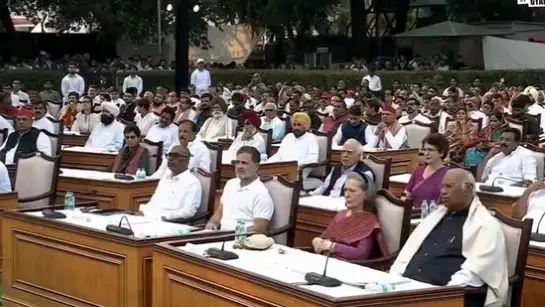
New Delhi: Congress president Mallikarjun Kharge demanded that Chief Election Commissioner (CEC) Gyanesh Kumar must be tried for treason, alleging that the Election Commission was facilitating vote theft.
Speaking at the INDIA bloc’s symbolic ‘public impeachment’ event held at Kharge’s Rajaji Marg residence in New Delhi, the Congress chief accused the CEC of acting on the instructions of Prime Minister Narendra Modi and Union Home Minister Amit Shah.
The Opposition parties decided to conduct the symbolic exercise came after their attempts to move a formal motion in Parliament, seeking the CEC’s removal, were rejected.
The proceedings began on the lawn, which was converted into Parliament hall, with former Lok Sabha Speaker and Congress leader Meira Kumar chairing the session.
#WATCH | Delhi | The INDIA bloc is holding a public impeachment program against CEC Gyanesh Kumar at the residence of Congress President Mallikarjun Kharge Former Lok Sabha Speaker Meira Kumar is presiding over the INDIA bloc’s public impeachment program (Video Source: AICC) https://t.co/y918b40KZG
— ANI (@ANI) October 31, 2026
#WATCH | Delhi: At the INDIA bloc’s symbolic public impeachment program against CEC Gyanesh Kumar, Former Lok Sabha Speaker and Congress leader Meira Kumar says, “…It has been decided that the INDIA bloc will convene a meeting to bring forward an impeachment motion to remove Gyanesh Kumar from his position. This impeachment motion will be moved in the Rajya Sabha by the Leader of the Opposition, Mallikarjun Kharge, who will subsequently deliver a statement…Ours is the largest democracy in the world. Nations across the globe, in Asia, Africa, and South America, look up to us and follow our model of democracy. Our democracy is driven by the power of elections, and at the heart of this electoral power lies the soul of the voter. The voter is the focal point of the entire electoral process. If even a single voter is denied the right to cast their vote, it strikes a blow to the very soul of our democracy. Preventing someone from voting inflicts harm upon our democracy.” (Video Source: AICC)
— ANI (@ANI) October 31, 2026
Kharge said 193 Opposition MPs had submitted notices in both Houses of Parliament seven months ago seeking Gyanesh’s removal. However, he alleged that the notices were rejected without being taken into consideration.
‘No personal grudge’
“We hold no personal grudge against the CEC. Our intention is for the Election Commission to function impartially, in line with the spirit of the Constitution, so that the common man’s trust in it remains intact. We must ensure that the voting rights of vulnerable sections, women, and the youth are not surreptitiously deleted from a computer by someone sitting in Delhi,” Kharge said.
He accused the Central government of attempting to retain power through various means.
“Since 2014, every possible conspiracy has been hatched to seize and retain power. They have stolen MPs, broken up political parties, toppled governments, and used electoral bonds, the ED, and the CBI, and now they are stealing votes,” Kharge alleged.
Claiming that there were hundreds of examples of vote theft, Kharge linked the alleged manipulation to the 2023 Chief Election Commissioner and Other Election Commissioners (Appointment, Conditions of Service and Term of Office) Act.
‘Hundreds of examples of vote theft’
He claimed that the legislation enabled Gyanesh to facilitate vote theft and criticised its passage in December 2023, when 145 Opposition MPs were suspended.
“We have hundreds of examples of such vote theft. Gyanesh Kumar is able to facilitate this theft due to the 2023 Chief Election Commissioner and Other Election Commissioners (Appointment, Conditions of Service and Term of Office) Act. This bill was passed in December 2023 after suspending 145 opposition MPs. It is shameful and a disgrace,” he said.
The law provided Election Commissioners with an unprecedented level of protection.
“This law grants the Election Commissioners a lifelong protective shield — a level of protection not even afforded to the President or the Chief Justice of India,” he said.
SIR motive questioned
Kharge also criticised the Election Commission’s decision to announce the Special Intensive Revision (SIR) of electoral rolls, alleging that the exercise was intended to remove voters opposed to the BJP.
“The ECI announced the SIR overnight. It was implemented across the entire country, effectively to delete the votes of those opposed to the BJP,” he alleged.
“The Modi government is using the pretext of outsiders and infiltrators to conceal its own failures. They allege that we are attempting to include infiltrators. That is not the case; we are simply advocating for the retention of genuine, legitimate voters. We are doing this to safeguard their rights,” Kharge said.
Resolution lists 6 charges against CEC
The INDIA bloc issued a resolution listing six charges against CEC Gyanesh.
First charge accused Gyanesh of being part of an alleged criminal conspiracy orchestrated by the BJP to manipulate national and state elections. It alleged that he had allowed the ruling party to access electoral rolls and add or delete voters at will to influence election outcomes.
Second charge held Gyanesh responsible for what the bloc described as a manipulated and destructive SIR exercise. The resolution alleged that 13.2 crore voters had been intentionally deleted from electoral rolls, depriving them of their constitutional right to vote. It also accused the Election Commission of carrying out the exercise in a partisan and opaque manner, in violation of the principles of natural justice.
Third charge accused the CEC of illegally amending Form 6 of the Registration of Electors Rules, 1960, without parliamentary oversight or knowledge. The resolution alleged that the amendment was aimed at preventing first-time voters from enrolling and exercising their right to vote.
Fourth charge alleged that Gyanesh had centralised control over electoral rolls within the Election Commission of India (ECI) through the use of ERONET/ECINET software. It claimed that this prevented local Electoral Registration Officers (EROs) from adding legitimate voters while facilitating deletions from the rolls.
Fifth charge accused Gyanesh of violating the law by excluding the other two Election Commissioners from decision-making. According to the resolution, seven associates in the ECI were involved in the alleged violation, which prompted the two excluded commissioners to record at least 14 objections.
Sixth charge accused Gyanesh of failing to function independently and uphold the Constitution. The resolution alleged that he had repeatedly targeted opposition parties, denied their leaders hearings and prevented them from raising their concerns before the Election Commission. It also accused him of remaining silent when opposition leaders were allegedly disqualified from contesting elections and assaulted outside the poll body’s office.