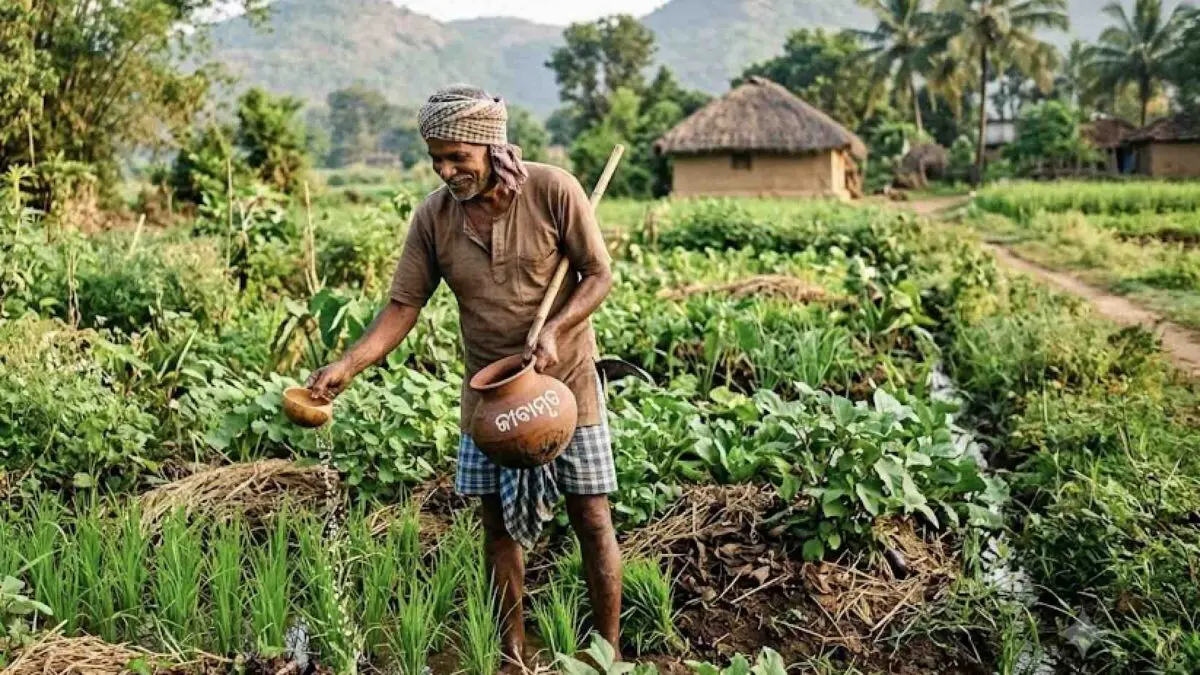
When the voice of nature resonates through the farmlands, the beauty of greenery enriches both the landscape and the environment. Across India, the call to return to nature-based agriculture is gaining momentum under the philosophy of “Back to Basics”.
Natural farming represents a revival of traditional wisdom that existed long before the advent of tractors, chemical fertilizers, and pesticides. In the context of climate change, soil degradation, and rising cultivation costs, integrating natural farming into Odisha’s development agenda has become increasingly important.
Agriculture and allied sectors form the backbone of Odisha’s economy. During 2023–24, agriculture contributed approximately 20.4 per cent to the State’s Gross Value Added and provided livelihoods to nearly 48.1 per cent of the population. The sector encompasses crops, livestock, forestry, and fisheries. According to recent estimates, Odisha has a net cultivated area of about 54.6 lakh hectares. Expanding natural farming practices across this vast agricultural landscape can contribute significantly to environmental conservation, soil health, and farmers’ welfare.
Natural farming is founded on the principle that nature is self-sustaining and possesses its own regenerative mechanisms. Its key components include Beejamrut (seed treatment), Jeevamrut (bio-fertilisation), mulching, soil aeration, and biological crop protection. Beejamrut is used for seed treatment to protect seeds from diseases and enhance germination, while Jeevamrut improves soil fertility by stimulating beneficial microbial activity.
One of the essential concepts of natural farming is maintaining the balance of air and moisture within the soil. The space between soil particles contains both air and water, creating a favuorable environment for beneficial microorganisms and healthy root growth. Mulching through crop residues, cover crops, and organic matter helps conserve moisture, regulate soil temperature, and improve soil structure.
Natural farming recognises that plants derive most of their nutritional requirements from air, water, sunlight, and naturally occurring biological processes. By promoting microbial activity and increasing organic matter content, the soil becomes more fertile and resilient. The enhanced population of microorganisms improves nutrient cycling, water retention, and overall soil productivity. Farmers can also prepare and use natural pest management formulations such as Nimastra, Agniastra, and Brahmastra to effectively manage pests and diseases without re
lying on synthetic chemicals.
In recent years, many young farmers and entrepreneurs have embraced natural farming as a viable and sustainable agricultural model. However, certification remains a crucial component in ensuring market recognition and consumer trust. Farmers often struggle to obtain premium prices for naturally grown produce due to the absence of proper identification and branding in the marketplace.
To address this challenge, the government has introduced certification mechanisms such as the Participatory Guarantee System (PGS), which provides recognition and credibility to natural farming practices. Through PGS Natural certification with the help of NCONF, Ghaziabad & RCONF, Bhubaneswar, farmers can officially validate their production methods and access specialized markets for natural and organic products. Certified farmers can also register on national organic portals and explore broader marketing opportunities. The initiative aims not only to promote natural farming but also to strengthen farmer collectives and improve market access across India.
The success of natural farming also depends upon preserving indigenous agricultural resources. Traditional seeds, livestock breeds, and local farming knowledge are gradually disappearing from rural landscapes. Future generations may never experience the rich agricultural heritage that once defined village life unless deliberate efforts are made to conserve and promote these valuable resources. Farmers must be encouraged to preserve indigenous seeds and share them within their communities, thereby strengthening local seed sovereignty and biodiversity conservation.
Farmer Producer Organisations (FPOs), Self-Help Groups, and community-based farmer collectives have a critical role to play in this transformation. Beyond awareness campaigns, they should establish demonstration plots that visibly showcase the benefits of Jeevamrut, Ghanajeevamrut, mulching, and other natural farming practices. In agriculture, practical demonstration is often more convincing than theoretical explanation. As the saying goes, “seeing is believing.”
These farmer groups can eventually evolve into stronger institutions through various government support schemes and market linkages. Panchayati Raj Institutions, especially Gram Panchayats, can take the lead in implementing pilot projects that gradually expand across districts and eventually throughout Odisha. Efforts should also be made to facilitate marketing through digital platforms such as ONDC, Jaivik Bharat Portal and other e-commerce channels, ensuring fair returns to farmers practicing sustainable agriculture.
Natural farming is not merely an alternative production system; it is a pathway towards ecological restoration, healthier food systems, and sustainable rural livelihoods. It harmonises agriculture with nature, reduces environmental degradation, and strengthens resilience against climate uncertainties. By embracing natural farming today, Odisha can build a greener, healthier, and more prosperous future for generations to come.
(Views expressed by the columnist are personal and do not necessarily reflect the opinion or policy of the news portal)