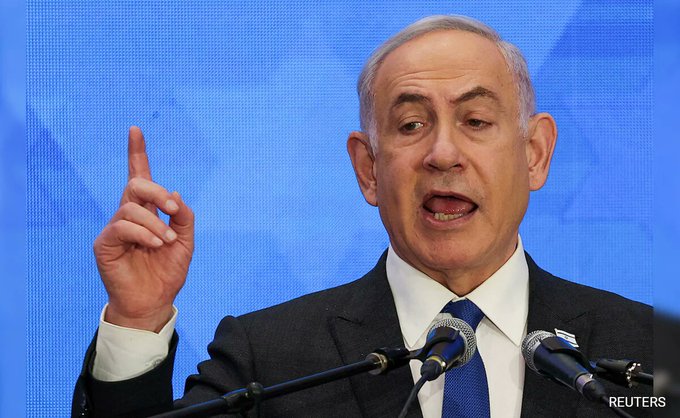
Jerusalem: Even as counting of votes is underway in Israel on Wednesday morning, Netanyahu’s bloc reportedly leads with 57 seats, while the opposition trails with 47 seats.
However, as per the Exit polls on Tuesday neither Prime Minister Benjamin Netanyahu’s bloc nor opposition leader Gadi Eisenkot’s camp had secured a majority in the 120-member Knesset.
Netanyahu has, however, declared a “decisive majority” for the right-wing bloc among the Zionist public. He, according to reports, had called for a “strong, right-wing government”.
The opposition leader had said voters had chosen “change.” He had also vowed to work with partners to “form a government that represents the entire society”.
Israel follows a proportional representation system in which voters elect political parties, which must then negotiate with other parties to form a coalition government with at least 61 seats in the 120-member Knesset. No single party has ever secured an outright parliamentary majority on its own.
The inconclusive election result comes at a time when Israel remains deeply divided over Benjamin Netanyahu’s leadership. The country is also still grappling with the consequences of the Hamas-led October 7, 2023, attack and the conflicts that have since destabilised the wider Middle East.
Israel Election Results: Four Possible Scenarios After the Vote
- Coalition Government
Following the election, political parties will begin negotiations to assemble a coalition with the support of at least 61 lawmakers. However, reaching an agreement may prove difficult given the sharp ideological differences between the parties. President Isaac Herzog will designate the candidate he believes has the best chance of forming a government, who may not necessarily be the leader of the party that wins the most seats.
- Minority Government
If neither political bloc can secure the required 61 seats, a candidate may attempt to form a minority government. Such a government would depend on obtaining support from other lawmakers on individual issues rather than relying on a stable parliamentary majority. In this scenario, Arab Israeli parties could emerge as influential players. Arab citizens constitute roughly one-fifth of Israel’s population, and many identify with the Palestinian community.
- National Unity Government
Despite Israel’s deep political polarisation, a national unity government remains a theoretical possibility. Such an arrangement could bring together political leaders from opposing camps and potentially produce a less hardline administration. One possibility discussed by Israeli commentators is an alliance in which Netanyahu parts ways with his far-right and ultra-Orthodox partners and joins forces with Gadi Eisenkot, who shares several of Netanyahu’s positions on national security. However, this arrangement would likely exclude Arab parties and would require significant political compromises.
- Political Deadlock and Fresh Elections
If the designated candidate fails to form a government, Israel could face another election. The country has experienced repeated electoral deadlocks in the past, holding four elections between April 2019 and March 2021 as political leaders struggled to establish a stable coalition. Under the usual procedure, the candidate appointed by the president has 28 days to form a government, with the possibility of a 14-day extension. If negotiations ultimately fail, the political stalemate could force Israelis back to the ballot box.