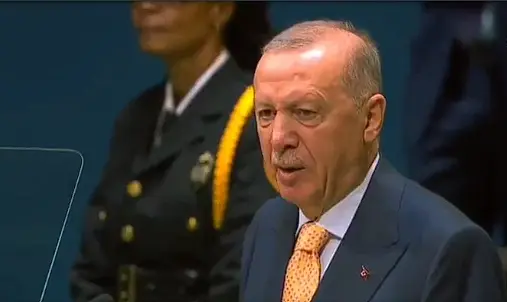
United Nations: Turkish President Recep Tayyip Erdogan once again referred to Kashmir during his address to the 81st United Nations General Assembly in New York, urging countries to resolve disputes in South Asia through talks.
With Pakistan Prime Minister Shehbaz Sharif present in the Assembly hall, Erdogan said disputes such as the Kashmir issue must be dealt with through negotiations and in accordance with the UN Charter and relevant resolutions.
“In South Asia, it is important that all disputes, including the Kashmir issue, be addressed through dialogue within the framework of the United Nations Charter and of relevant resolutions,” Erdogan said.
Kashmir has featured repeatedly in Erdogan’s addresses to the UN General Assembly. He spoke about the issue several times in recent years, including in 2019, following India’s decision to withdraw the special status of Jammu and Kashmir under Article 370, as reported by Firstpost.
The latest remarks came against the backdrop of persistent tensions between India and Pakistan. Erdogan has maintained strong relations with Islamabad and has repeatedly advocated what he calls a peaceful settlement of the Kashmir dispute.
Much of Erdogan’s speech was devoted to the conflict in Gaza, the Palestinian question and the need to restructure the UN Security Council. He appealed for stronger global action over the humanitarian situation in Gaza and asked countries that have yet to recognise Palestine to review their stance.
India’s Stand On Kashmir
India has consistently opposed attempts to place the Kashmir issue in an international forum and maintains that Jammu and Kashmir is an integral part of the country.
New Delhi has also reiterated that all outstanding matters with Pakistan must be settled peacefully and bilaterally, without the involvement of any third party.
Erdogan’s comments on Kashmir formed part of a broader address covering several international crises and geopolitical concerns. While criticising the existing composition of the UN Security Council, he demanded reforms, saying decisions affecting more than 190 countries should not be determined in effect by only five permanent members.