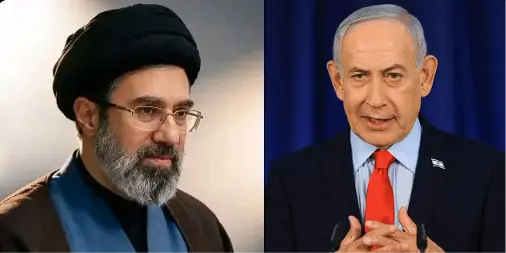
Tehran; Iran has issued its sternest warning yet to Washington and Tel Aviv, with Iran’s supreme leader declaring that any renewed assault would provoke retaliation without geographic limits. The statement comes as diplomatic channels struggle to prevent a return to full-scale war, AFP reported.
Iran’s Supreme Leader Mojtaba Khamenei told senior military officials that every threat, regardless of scale or nature, would be answered “immediately, forcefully and without regard to geography,” according to an official statement. It was described as his first reported gathering with the country’s military leadership since assuming office.
Khamenei has rarely been seen in public since taking power in March, after his father, Ayatollah Ali Khamenei, was killed in US-Israeli strikes. He also ordered commanders to expand Iran’s list of targets to include “all types of tangible and intangible assets belonging to the American-Zionist enemy.”
Iran has earlier warned that it may cut undersea cables in the Strait of Hormuz, raising concerns about damage to global communications and oil supplies.
US Elections May Decide Next Step
US President Donald Trump has suggested he could order new strikes on Iran after the US midterm elections next week. But Secretary of State Marco Rubio said no decision had been taken and that the US was still open to peace talks. “If there is a diplomatic solution, we would be open to it,” Rubio said.
Rubio also said the US could use force if needed. “We can achieve military objectives if we seek to,” he said, adding that Trump “hasn’t made a decision” on new strikes.
In Israel, Prime Minister Benjamin Netanyahu has called the situation a “historic, one-time opportunity” to remove Iran’s government. Israel voted on Tuesday, but Netanyahu’s group, although it won the most seats, has not yet formed a new government.
The results of the elections in both countries could affect whether the fighting resumes or whether talks move forward.
Oil Prices Cause Worry
Since the war started in February, Iran has limited shipping through the Strait of Hormuz. This important waterway normally carries about one-fifth of the world’s oil. The restrictions have pushed up fuel prices and made the war unpopular with many US voters before Tuesday’s elections.
Iranian state television reported that a ship moving through the strait hit a mine and caught fire. Earlier, Iran’s Revolutionary Guards said three oil tankers had been stopped after “incidents” or mine strikes.
If the opposition Democrats do well in the US elections, they could make it harder for Trump to carry out some of his policies.
Many people in Iran say they are tired of living with uncertainty. “Ordinary Iranians have been left in a state of limbo for the past year,” Fariba, a housewife in Tehran, told AFP.
Others said they were not afraid. “We do not fear another war. We have been at war for 48 years now,” said Ebrahim, a salesman in his forties, in Tehran.
Peace Efforts Continue
Attempts to stop a new war continued over the weekend. Qatari mediators arrived in Tehran on Friday, and US Vice President JD Vance sent a letter to Mohsen Rezaei, head of Iran’s Supreme National Security Council.
“I read the letter. I haven’t yet responded. Their tone has completely changed,” Rezaei said in a video shown on Iranian television. He called the change “a good sign,” but did not say what was in the letter.
Iranian Foreign Minister Abbas Araghchi said Iran was not planning direct talks with the US for now. “Currently, there are no plans for meetings with American officials,” he told Al Jazeera, according to IRNA. “Iran’s conditions are clear, and consultations regarding them are ongoing among mediators.”
Qatar and Pakistan are acting as mediators, but the talks have not yet led to a lasting agreement. The Wall Street Journal reported that Vance sent the letter at Trump’s direction to restart negotiations and prevent more US strikes.
Fears Of Bigger War
Iranian officials repeated their warnings on Saturday. Army spokesman Mohammad Akaraminia said any new fighting would make the war larger. “The flames of war will undoubtedly engulf a much wider geographical area,” he wrote on social media.
Araghchi also warned on X that Iran would no longer have any “red lines.”
The war began on February 28 after US and Israeli forces attacked Iran. Iran quickly responded by targeting American assets in several countries in the region.