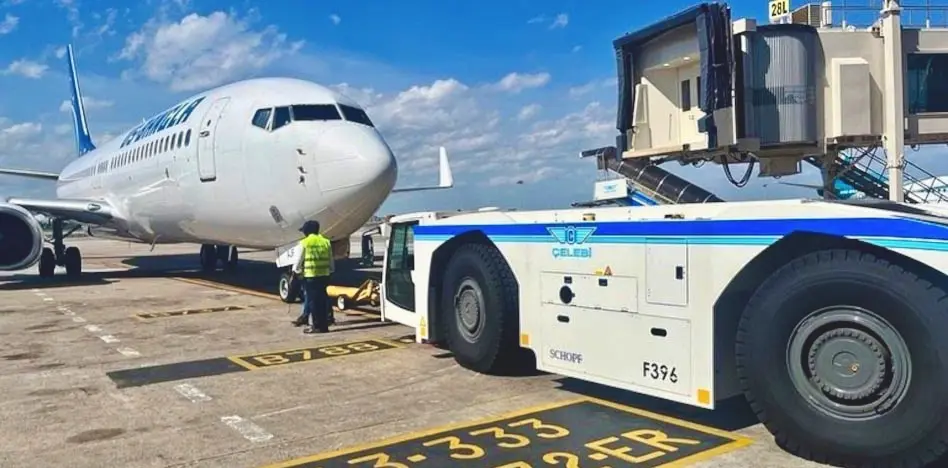
New Delhi: For the first time since India revoked the company’s security clearance in May 2025, Turkey’s Celebi Aviation has opened up on how it lost nearly $500 million in business value overnight, calling it as one of the most damaging setbacks in its history.
India’s decision abruptly ended nearly two decades of business operations that the company had painstakingly built in the country, Celebi chairperson Canan Celebioglu told Bloomberg.
The company lost access to all of its Indian operations immediately after authorities withdrew security clearances amid diplomatic tensions between New Delhi and Ankara following Operation Sindoor, Celebioglu said.
“All our equipment, everything we had, was seized and they removed us from there. They transferred our 10,000 employees to another company in a single day,” Bloomberg quoted her as saying.
The financial blow was massive and immediate, she claimed.
“They brought the value we had created, perhaps $400 million or $500 million, down to zero in a single day,” Celebioglu said.
The security clearances of Celebi’s Indian subsidiaries were revoked by India’s Bureau of Civil Aviation Security (BCAS) on May 15, 2025, shortly after India and Pakistan halted hostilities following Operation Sindoor.
This happened with Turkey openly backing Pakistan and supplying drones to Islamabad to target India.
Diplom
atic ties between New Delhi and Ankara fell to an all-time low and there is no restoration in sight. A few months ago, Turkey denied the use of its airspace for the transportation of Apache helicopters to India from the US. The delivery was delayed after transport aircraft were made to turn back and take another route.
Indian authorities cited national security concerns while cancelling its clearances, despite Celebi reportedly maintaining that it had no links with the Turkish government, as reported by Financial Express.
Celebi had established itself as one of India’s largest airport ground handling and cargo service operators by 2025. The company operated through Indian subsidiaries at nine major airports, including Indira Gandhi International Airport, Chhatrapati Shivaji Maharaj International Airport, Kempegowda International Airport and Rajiv Gandhi International Airport.
It has been reported that the company handled nearly 58,000 flights annually before the contracts were terminated and reassigned to other service providers.
The loss was not just financial but deeply emotional, given the company’s long investment in building operations in India, Celebioglu said.
“Put the monetary value aside. It was a place built stitch by stitch. We contributed to the development of the sector. We worked with authorities. We invested heavily. This shocked us. It truly saddened us,” she told Bloomberg.
Celebi challenged the decision to cancel clearances before the Delhi High Court, arguing that it was not given prior notice or an opportunity to respond.
The Court, however, dismissed the challenge in July 2025 after reviewing confidential government submissions, ruling in favour of the Centre and citing “compelling national security considerations.”
The government informed the Court that airport ground-handling firms occupy highly sensitive positions, granting them access to aircraft systems, cargo movement networks, passenger information and restricted airport zones and this was accepted.