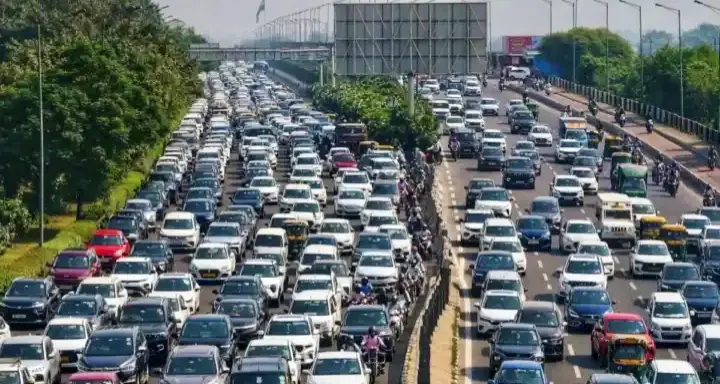
New Delhi/Gurugram: Sunday witnessed a massive traffic jam between Gurugram and Delhi that has nothing to do with the INDI Bloc rally at Ramlila Maidan.
The hold-up occurred as the Capital’s new restrictions on non-BS-VI vehicles came into force from November 1. This caused long queues of vehicles near the Sarhaul toll plaza on NH-48.
The congestion affected the Delhi-bound carriageway, service road and the flyover from Shankar Chowk. Commuters reported being stuck for more than two hours as traffic personnel stopped and checked vehicles entering Delhi, News18 reported.
Under the new rule, petrol and diesel vehicles registered outside Delhi that do not meet BS-VI emission standards are barred from entering the national capital between November 1, 2026 and January 31, 2027.
BS-III and BS-IV vehicles are among those covered by the restrictions, while BS-VI, CNG and electric vehicles are exempt.
Traffic police teams were deployed at the Gurugram-Delhi border to verify vehicles before allowing them to proceed. Vehicles found to be non-compliant were reportedly issued challans and sent back, adding to the queues at the busy crossing.
The restrictions are part of the Delhi government’s measures to tackle winter air pollution. The rules also cover light, medium and heavy goods vehicles, while vehicles merely passing through Delhi without the Capital as their destination have been advised to use the Eastern or Western Peripheral Expressways.
The first day of enforcement brought significant disruption for commuters. One of them said she was stuck for around two hours, including on the flyover from Shankar Chowk and later near the toll plaza.
A cab driver Vikas Kumar, travelling from Maruti Kunj, said he spent more than an hour in the traffic, while a Sector 54 resident also reported being delayed for nearly two hours.
The congestion also coincided with the ‘Dilli Chalo’ protest in Delhi. More than 100 buses carrying Congress workers from Haryana reached Gurugram for the rally. Congress workers led by party leader Raj Babbar briefly brought down barricades while marching, allowing some vehicles to pass before police restored them.
Additional personnel were later deployed to speed up checks and manage the queues. Traffic began easing around 3 pm after several hours of disruption.