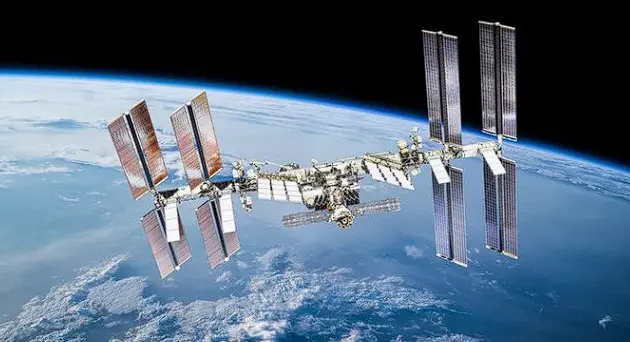
Washington DC: A worsening air leak aboard the International Space Station forced five crew members to take refuge in their docked spacecraft for about two hours on Friday while Russian specialists worked to repair a crack in the station’s Russian segment, NASA said.
At 9:04 a.m. ET, NASA mission control instructed four Crew‑12 astronauts — two Americans, one French astronaut and a Russian cosmonaut — plus another US crew member to board the SpaceX-built Crew Dragon craft attached to the station, agency spokesperson Bethany Stevens said.
The order was lifted roughly two hours later after NASA and Roscosmos assessed the leak rate and deemed it safe for the crew to return to the station.
The episodes add to months of exchanges between NASA and Russia’s Roscosmos over recurring small leaks in the Zvezda service module, a vital part of the orbiting laboratory. The two agencies have differed on both the causes and the best fixes for the problem.
Chris Cassidy, a former NASA chief astronaut who led Expedition 63 in 2020, said the leak’s discovery dates back several years. “It’s been troublesome for the last five or six years with engineers on both sides of the ocean figuring out plans to patch it up, but it’s been a pesky one,” Cassidy told CBC News.
Roscosmos reported detecting two separate leaks but stressed there was no immediate danger to the crew. NASA broadcasts a live external camera view from the station’s Harmony module.
Move To Address 2nd
breach
Officials said the first leak was sealed quickly and that efforts were under way to plug a second breach, with Roscosmos maintaining that the issue did not threaten the station’s systems. A senior NASA official, speaking anonymously, said the leak rate increased from about one pound of air per day to two pounds, effectively halving the time before alarms would be triggered.
“That’s double the leak rate. So if they were tracking a situation that might give them, say, a month of atmosphere until it trips alarm levels, now all of a sudden that month is 15 days,” Cassidy told CBC News.
Seven people currently live aboard the ISS, including the four-member Crew‑12 team — NASA astronauts Jessica Meir and Jack Hathaway, European Space Agency astronaut Sophie Adenot, and Roscosmos cosmonaut Andrey Fedyaev — who arrived in February. The station’s other crew, which launched in November, includes US astronaut Christopher Williams and Russian cosmonauts Sergey Kud‑Sverchkov and Sergei Mikayev.
Kud‑Sverchkov and Mikayev had planned to use a saw to access the area they believed contained the crack, the senior NASA official said. NASA objected to that approach, prompting mission control in Houston to command the crew into their spacecraft as a safety precaution.
‘Safe-Haven’ Seldom-Used Emergency
Cassidy described the “safe-haven” protocol as a serious, seldom-used emergency step that places crew members behind the hatch that leads directly to their escape vehicle. “They always want to put the crew in a place to be the most safe you can be and that means never putting a hatch between yourself and your escape vehicle,” he said.
After Roscosmos paused repair attempts, NASA rescinded the shelter-in-place order and allowed the astronauts to re-enter the station. “We look forward to working with Roscosmos on a collaborative approach to address the leaks,” a NASA spokesperson said earlier on X.
Although small leaks and debris threats have triggered similar precautions in recent years, the ISS has never required a full evacuation in its 27-year history, officials noted.