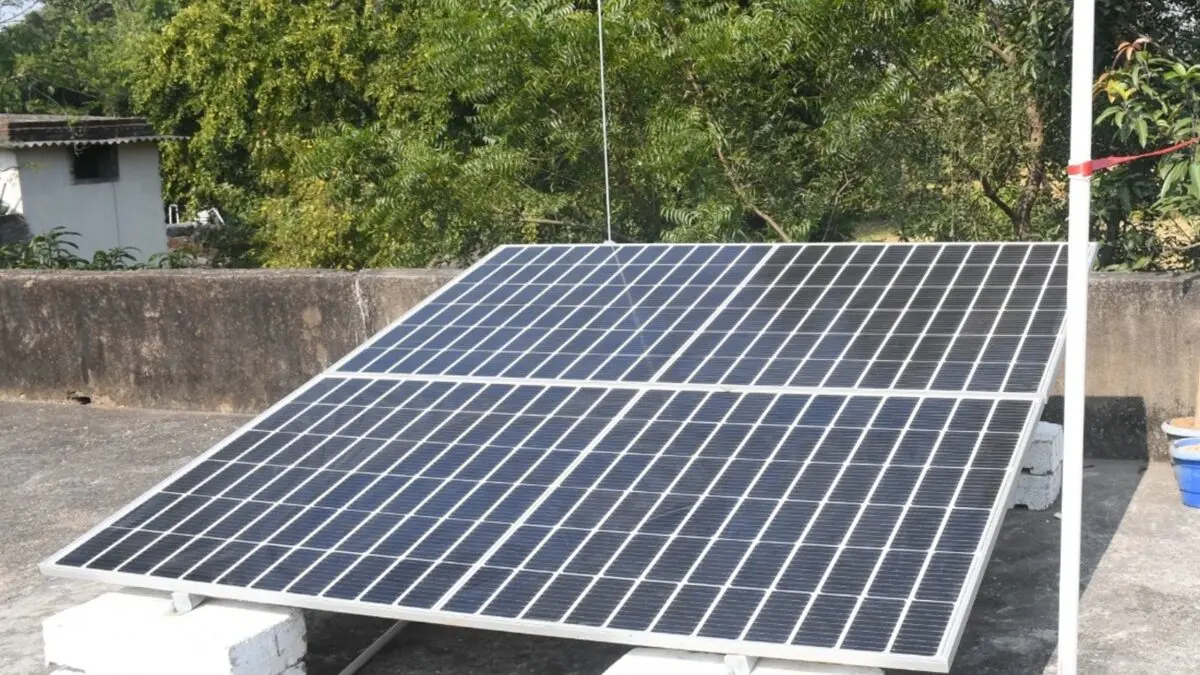
Bhubaneswar: Odisha has climbed from 13th to 7th place nationally in rooftop solar installations under the PM Surya Ghar: Muft Bijli Yojana, according to data from the Ministry of New and Renewable Energy portal.
The state has surpassed 1.5 lakh installations, reaching approximately 1.74 lakh rooftop solar systems, and has received 3,12,527 applications under the scheme.
Odisha has overtaken Madhya Pradesh and Assam in the rankings, establishing itself as a notable player in India’s push for decentralised clean energy. Recent months have seen rapid growth. Applications rose from 1,95,513 to 3,12,527 (about 60% increase), while installations jumped from 72,538 to roughly 1.74 lakh (more than 130% growth).
The conversion rate from applications to installations improved from 37.1% to 53.4%, pointing to smoother processes across approvals, installation, inspection, metering and commissioning.
A key factor has been Odisha’s additional financial support on top of the central subsidy. Eligible households can receive combined assistance of up to ₹1.38 lakh for a 3 kWp system, depending on capacity, consumer category and scheme rules. The state aims for 3 lakh installations by 2027, with the enhanced incentives helping expand access in urban, rural and semi-urban areas.
A release by Tata Power, attributed this sharp rise to a combination of enhanced state subsidies, efficient execution by the four discoms, TPCODL, TPWODL, TPNODL and TPSODL, and widespread community outreach. “They have facilitated the nearly 1.74 lakh installations: TPCODL 56,842, TPWODL 48,905, TPNODL 44,785 and TPSODL 23,881. Beyond traditional power distribution, the discoms have handled net metering, inspections, commissioning, vendor management and consumer support, while also promoting solarisation of government buildings and running awareness drives,” it said.
Consumer engagement efforts include the “Mo Chhata, Mo Sanchaya” campaign, which emphasises lower electricity bills and long-term savings. This is backed by Surya Ghar Gram Sabhas at the panchayat level involving local leaders and residents. TPCODL has also deployed a “Solar Rath” mobile outreach initiative, particularly under the Utility-Led Aggregation model, to take information directly to communities.
It further stated that the Solar Didi programme, run by the Tata Power Skill Development Institute, trains women in installation and maintenance so they can act as local ambassadors for clean energy. “Progress is spread across districts. Baleshwar leads with 16,069 installations, followed by Ganjam (15,301), Khordha (14,236) and Cuttack (13,343). These four districts together account for about 143 MWp of capacity. Statewide, Odisha now has 410 MWp of rooftop solar capacity.”
Gajanan Kale, Chief of Odisha Distribution Business at Tata Power, said: “Odisha’s rise from 13th to 7th position nationally and the achievement of more than 1.5 lakh rooftop solar installations are a strong testament to the growing confidence of consumers in clean energy. The attractive subsidy support provided by the Government of Odisha, combined with the Central assistance under PM Surya Ghar, has created a compelling proposition for households. We are focused on ensuring that this demand translates into installations through strong last-mile execution, consumer facilitation, net-metering support, vendor coordination and grassroots engagement. Through initiatives such as ‘Mo Chhata, Mo Sanchaya’, Surya Ghar Gram Sabhas, ULA-based outreach and Solar Didi, we are working to make rooftop solar simpler, more accessible and more relevant to households across Odisha.”