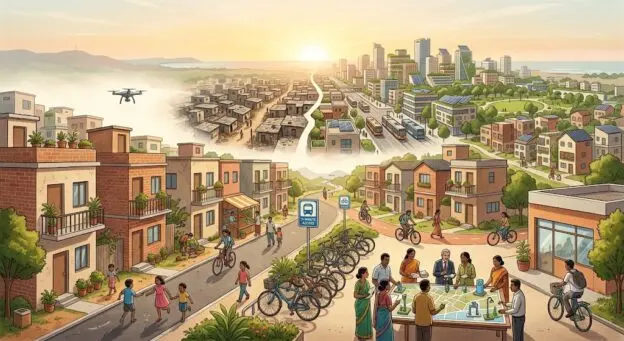
By 2050, approximately two-thirds of the world’s population will live in urban areas, bringing a distinct set of challenges and opportunities for urban development. These challenges of rapid urbanisation include growing vulnerability to climate change, spatial inequalities, pressures of migration and conflict, and difficulties in promoting inclusive prosperity and economic development. Access to shelter and a healthy habitat not only ensures the safety and security of the urban poor but also enhances productivity (Habitat for Humanity, 2020).
By 2030, UN-Habitat estimates that 3 billion people, about 40 per cent of the world’s population, will need access to adequate housing. This translates into a demand for 96,000 new affordable and accessible housing units every day. Additionally, an estimated 100 million people worldwide are homeless, and one in four people live in conditions that harm their health, safety and prosperity.
In recent decades, the landscape of cities has changed significantly due to rapid urban population growth. A major feature of fast-growing cities is urban sprawl, which drives the occupation of large areas of land and is usually accompanied by serious problems, including inefficient land use, high car dependency, low density and high segregation of uses. Coupled with land-use speculation, current models of city growth result in fragmented and inefficient urban spaces in which the advantages of city living are lost.
To address these global and national challenges locally, the first Monday of October is being observed as World Habitat Day since 1986, following a United Nations resolution of 1985. This year, it falls on October 5 and the theme is adequate housing. When we speak of housing, it must support inclusive, safe, resilient and sustainable cities and human settlements. In short, we need more urgent action and greater investment to improve the quality of life in cities and towns.
With continuing urbanisation, one of the key challenges facing cities today is the provision of safe habitats and adequate housing at scale. Odisha is no exception.
The housing shortage in Odisha was estimated at 0.41 million in 2012 and re-estimated at 0.3 million as of 2018. Housing forms an indispensable part of human dignity. “Adequate housing” encompasses more than four walls and a roof. It is a fundamental right and a cornerstone of an adequate standard of living; it includes security of tenure, access to basic services, affordability, habitability, accessibility, cultural adequacy and a convenient location. This helps prevent and address urban challenges such as unaffordability, displacement and the growth of informal settlements by fostering equity, social inclusion, access to opportunities and an improved quality of life in rapidly evolving cities.
The Odisha Urban Housing Mission (AWAAS) focuses on affordable homes and slum transformation for economically weaker sections. Recognising the crucial role played by slum dwellers in building and sustaining cities, the Odisha government decided to empower these indispensable yet impoverished residents by granting them in-situ land rights through landmark legislation. The government further launched the JAGA Mission with the ambitious aim of transforming slums into liveable habitats through a combination of land rights and a comprehensive improvement process. This approach uses participatory mapping and community mobilisation involving grassroots organisations and associations of slum dwellers, together with technological interventions such as high-resolution mapping using drones, remote sensing and geographic information systems.
Given its geographical scale—covering around 3,000 slums across all cities and towns and benefiting 1.8 million slum dwellers, the JAGA Mission has become the world’s largest slum land-titling and improvement programme. The goal is to achieve comprehensive slum improvement and upgradation by providing necessary physical infrastructure and amenities, such as piped water supply, pucca roads, street lighting, sanitation, drainage, household electricity, community centres and open spaces. The Odisha Land Rights to Slum Dwellers Act, together with the JAGA Mission, is unique not only in what it has set out to achieve but also in how it does so.
Encouragingly, the state recognises that urbanisation is crucial for economic growth as it enhances productivity.
Odisha’s level of urbanisation stood at 17 per cent in the 2011 Census, significantly below the national average of 31 per cent. This gap provides an ample opportunity to urbanise in a planned and sustainable manner, with a focus on liveability and inclusivity.
Odisha, therefore, envisions its cities and towns as dynamic socio-economic hubs that can uplift more than four crore residents, support the goal of reaching a USD 1.5 trillion economy by 2047, and help achieve various Sustainable Development Goals ahead of schedule.
This vision means future cities should adopt a different type of urban structure and space—one in which city life thrives and the most common problems of current urbanisation are addressed. It means refining existing sustainable urban planning theories to build a new and sustainable relationship between urban dwellers and urban space, and to increase the value of urban land. The approach is based on the features of sustainable neighbourhoods: compact, integrated and connected.
Cities such as Bhubaneswar may usefully explore the idea of a 15-minute city. This is an urban planning concept that makes everyday life easier—where everyone, regardless of age, income or ability, can meet their daily needs within a short distance of home if they choose, and where neighbourhoods are better connected to one another and to the wider world. It is about saving time and increasing choice for everyone, not only the most well-off, with destinations reachable by a 15-minute walk or bicycle ride.
Odisha Vision 2036 & 2047 recognises urbanisation as a cornerstone of progress, bridging the state’s rich heritage with modern infrastructure to drive innovation and improve quality of life. By fostering inclusive growth, it can empower communities, create jobs and unlock opportunities for a resilient future. With coverage of approximately 1.8 million people, the JAGA Mission is one of the largest initiatives in India to reduce the vulnerability of the urban poor. It has received international acclaim and was awarded the prestigious World Habitat Award in 2019.
(Views expressed by the columnist are personal and do not necessarily reflect the opinion or policy of the news portal)