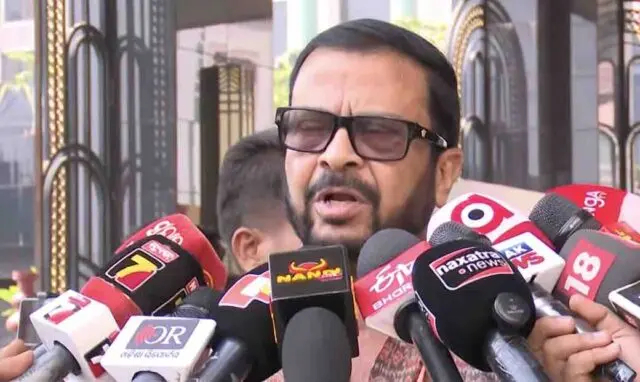
Bhubaneswar: Odisha Revenue and Disaster Management Minister Suresh Pujari on Monday launched a sharp critique of the Congress and the Biju Janata Dal for boycotting an orientation programme for newly elected and sitting legislators inaugurated by Vice-President C P Radhakrishnan, alleging that their absence amounted to disrespect for the constitutional office and undermined the dignity of the state legislature.
The one-day training session, organised ahead of the Odisha Assembly’s eighth session beginning November 18, was held in Bhubaneswar to familiarise members of the 17th Legislative Assembly with parliamentary procedures, House rules, Question Hour, Zero Hour, the budget process, committee systems and legislative responsibilities.
The event was also attended by Odisha Governor Braj Mohan Ram, Chief Minister Mohan Majhi, Assembly Speaker Surama Padhy and Deputy Speaker Bhawani Shankar Bhoi.
Addressing the gathering, the Vice-President emphasised that while political victories are secured at the ballot box, lasting respect from the public is earned strictly through dedicated service. He called upon state legislators to uphold constitutional values, maintain the dignity of the House and place public welfare above political differences. “Differences of opinion are natural in a democracy,” he observed, “but they should never become a barrier to effective decision-making or hinder broader commitments to the public and the Constitution.” The Legislative Assembly, he said, must function primarily as a dynamic forum for constructive debates and practical public solutions, with every question, law and policy exerting a direct influence on people’s lives. He also encouraged the use of modern technology, including artificial intelligence and digital systems, to make the legislature more efficient, transparent and accessible, and urged lawmakers to work towards the goals of Viksit Odisha 2036—coinciding with the centenary of the state’s formation as a separate province—and Viksit Bharat 2047 through inclusive development.
The absence of Congress and BJD legislators, however, triggered a political exchange, with the ruling BJP questioning the opposition’s decision to stay away from an event graced by the Vice-President. Pujari said the decision reflected a politically motivated approach and alleged that the two parties appeared to believe their legislators already knew everything and had nothing more to learn. Drawing on his own experience as a multi-term lawmaker, the minister stressed that parliamentary procedures, rules and regulations require continuous learning for public representatives at all levels. “Whoever does not want to attend may stay away. But I need learning. They seem to have already received training on how to create disturbances in the Assembly, prevent others from speaking and avoid debates and discussions. They do not need training, knowledge or reading. May God bless them,” he remarked, adding that skipping an event attended by the country’s Vice-President sets an unfortunate precedent for democratic institutions.
He further noted that governance and parliamentary democracy require both a responsible ruling party and a constructive opposition.
Pujari, however, appreciated the participation of suspended legislators from both opposition parties who attended despite their suspension. Among those present were suspended BJD MLAs Souvik Biswal, Devi Ranjan Tripathy and Arvind Mohapatra, as well as MLA Naba Mallik. Suspended Congress MLA from Cuttack-Barabati, Sofia Firdous, was also present.
Speaking after the session, Sofia clarified that the Congress had not communicated any boycott decision to her, adding that she attended purely to learn and maintained that all legislators should participate in such constructive workshops.
On November 15, senior BJD leader and MLA Arun Sahoo had raised questions regarding the timing and necessity of orientation programmes for legislators, asserting that real legislative training comes from active participation inside the House rather than introductory workshops. “An MLA’s primary job is law-making, participating in budget discussions, and raising public issues. When sessions are abruptly cut short or business is wrapped up without debate, public representation suffers,” Sahu noted, while mentioning the Mines and Minerals (Development and Regulation) Amendment Bill, 2026, which was passed by Parliament without debate amidst strong opposition protests.
He further criticised the shrinking operational calendar of the Assembly, noting that while assemblies should ideally function for around 60 days a year to address public concerns, sessions are frequently restricted to far fewer days under the pretext of having “no business”. He questioned how a state like Odisha could run out of legislative business so quickly during scheduled sittings.
The BJD MLA remarked that while letters for such programmes are often addressed to individual legislators, participation ultimately reflects a broader political and parliamentary outlook. He, however, emphasised that true parliamentary democracy thrives when opposition and ruling benches engage in meaningful debate, rather than relying solely on ceremonial training modules. “I will review the agenda first and decide for myself whether attending the session will be worthwhile,” he added.