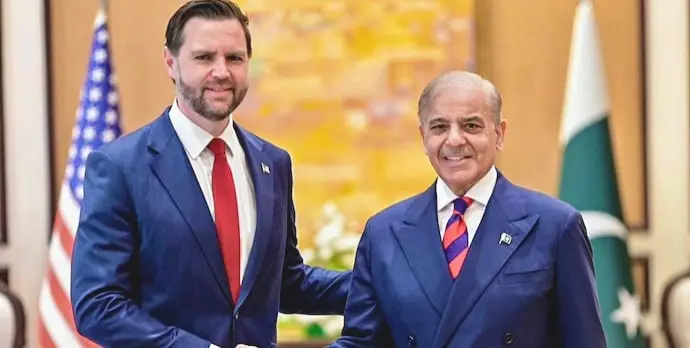
Washington, DC: Pakistan was left red-faced after US vice president J D Vance claimed that the delay in releasing details of the MoU with Iran was partly due to press freedom standards in Pakistan.
While US president Donald Trump announced the interim peace deal on June 15, the official text of the MoU was released two days later. Pakistan helped broker the deal along with Qatar.
Speaking in the podcast ‘Interesting Times with Ross Douthat’, Vance explained that Washington took time to release the details due to concerns over transparency.
“We actually wanted to get it out. I think part of the misalignment here is that in the Pakistani and Qatari systems, they don’t quite have the First Amendment and freedom of the press,” the US vice president said.
The US Constitution, through the First Amendment, prohibits the government from making laws that infringe on free speech, freedom of the press and religion. No such constitutional safeguards exist in Pakistan.
“And so, there isn’t this expectation (in Pakistan) that the text is going to be out there for the American people to actually interrogate and look at and analyse and understand for themselves. But it will be out,” Vance further said.
The full text of the agreement between the US and Iran to end the war was eventually released on Wednesday following an outcry and criticism from Democrats, as reported by India Today.
The US was withholding the MoU details because the agreement may have involved significant concessions to Iran to bring an end to the conflict, w
hich triggered a global oil crisis due to Tehran’s chokehold on the Strait of Hormuz, critics had speculated.
This remark by Vance has brought into the spotlight the steep decline in free speech and press freedom in Pakistan, which ranks 153 out of 180 countries in the World Press Freedom Index.
Pakistan has long been recognised as one of the most challenging countries for journalists. The recent 27th Constitutional Amendment, passed in November 2025, further impedes press freedom by stripping the Supreme Court of its authority to independently review fundamental rights.
Pakistan, which has been touting the MoU as a major diplomatic achievement, was embarassed earlier this week with prime minister Shehbaz Sharif announcing that a formal signing ceremony would be held in Switzerland on June 19.
Trump and Iranian president Masoud Pezeshkian signed the MoU digitally on Thursday, leaving egg on Pakistan’s face. The Iranian Foreign Ministry had also clarified that no signing ceremony would be held in Switzerland.
Sharif quietly removed the Switzerland signing paragraph from his post. He also cancelled his visit to Switzerland.
Vance also touched upon key sticking points of the deal. Iran has agreed to dilute its enriched uranium in exchange for broad economic relief, as part of the 14-point MoU.
The US vice president called this a major win for the Trump administration. “The (Barack) Obama-Iran deal allowed them to generate a stockpile of enriched uranium. Our deal ensures that the stockpile is destroyed and eliminated. That’s a big difference,” he said.
He was referring to the Joint Comprehensive Plan of Action (JCPOA) negotiated by Obama with Iran in 2015. Trump withdrew from the JCPOA in 2018.
The US’s commitment to create a $300 billion reconstruction plan for Iran has also been a major political flashpoint. However, Vance clarified that “not a cent” of American money would go to Iran.
“Not a cent of American money goes to Iran. There could be economic benefits for Iran paid for by investment from other countries, but only if they fundamentally transform their country. We have transformed their country. Isn’t that good for America?” he said.