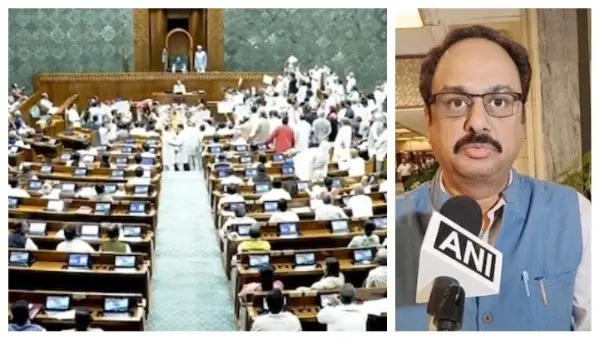
New Delhi/Bhubaneswar: As the high-stakes Monsoon Session of Parliament gets underway on Monday, a clear battle line is emerging between the ruling National Democratic Alliance (NDA) and a combative Opposition bloc. However, breaking away from the unified resistance of the main Opposition front, the Biju Janata Dal (BJD) has adopted a calculated stance, promising institutional cooperation while aggressively pushing an localised agenda for Odisha.
Ahead of the 25-day session, Prime Minister Narendra Modi addressed the media at the Parliament complex, setting a tone of economic confidence and democratic accountability. Striking a poetic note, the Prime Minister linked the seasonal rains to legislative progress. “Be it the monsoon or the monsoon session—if both are proactive, they prove to be highly productive. And when both are productive, it leads to the welfare of the nation and the well-being of all living beings,” he noted.
In what appeared to be a direct message to a confrontational Opposition planning to grill the government on multiple issues, the Prime Minister added a firm reminder: “Where there are facts and logic, there is no room for a storm.”
He urged lawmakers to choose grounded debates over political frenzy, highlighting India’s robust economic growth and recent development milestones driven by India’s youth power.
The Centre is set to bring key bills, including the one that makes insulting the national song ‘Vande Mataram’ a criminal offence, during this session, which on Day 1 was adjourned till noon amid heavy sloganeering by Opposition.
The BJD’s Balancing Act
While major Opposition parties gear up for immediate logjams over key bills, the BJD is chart-mapping a distinct path.
Following an all-party meeting convened by the NDA, Leader of the BJD parliamentary party Manas Mangaraj clarified that the party intends to work within standard constitutional boundaries. “In accordance with the constitutional and parliamentary procedures, the BJD will cooperate in the smooth functioning of the House,” Mangaraj noted.
However, this cooperation comes with strict conditions. Mangaraj made it clear that the BJD will “forcefully raise issues relating to the rights and interests of the people of Odisha.”
Regional Friction Takes Center Stage
The BJD’s stance highlights growing tension between the regional outfit and the BJP-led state government in Odisha. The party has demanded separate parliamentary discussions on a host of issues directly impacting their home state. The party has formally sought a Rajya Sabha discussion over errors in new school textbooks distributed in Odisha under the New Education Policy, which it claimed put the education of over 40 lakh students at risk. He alleged that the state government had treated the matter very casually despite its seriousness.
Mangaraj alleged that since the BJP took power in Odisha, local development has stalled because Member of Parliament Local Area Development (MPLAD) funds earmarked for BJD lawmakers have been systematically withheld. Beyond structural funding, the BJD has submitted demands to discuss severe agrarian issues and a allegedly deteriorating law and order situation across Odisha.
Other issues to be raised by BJD during the session include the prevailing war situation in South Asia, the rise in prices of essential commodities and the problems faced by vehicle owners due to ethanol blending.
On the national front, the BJD plans to join discussions regarding the economic impact of rising essential commodity prices, the geopolitical shifts in South Asia, and the technical issues squeezing vehicle owners due to the implementation of ethanol-blended fuel.