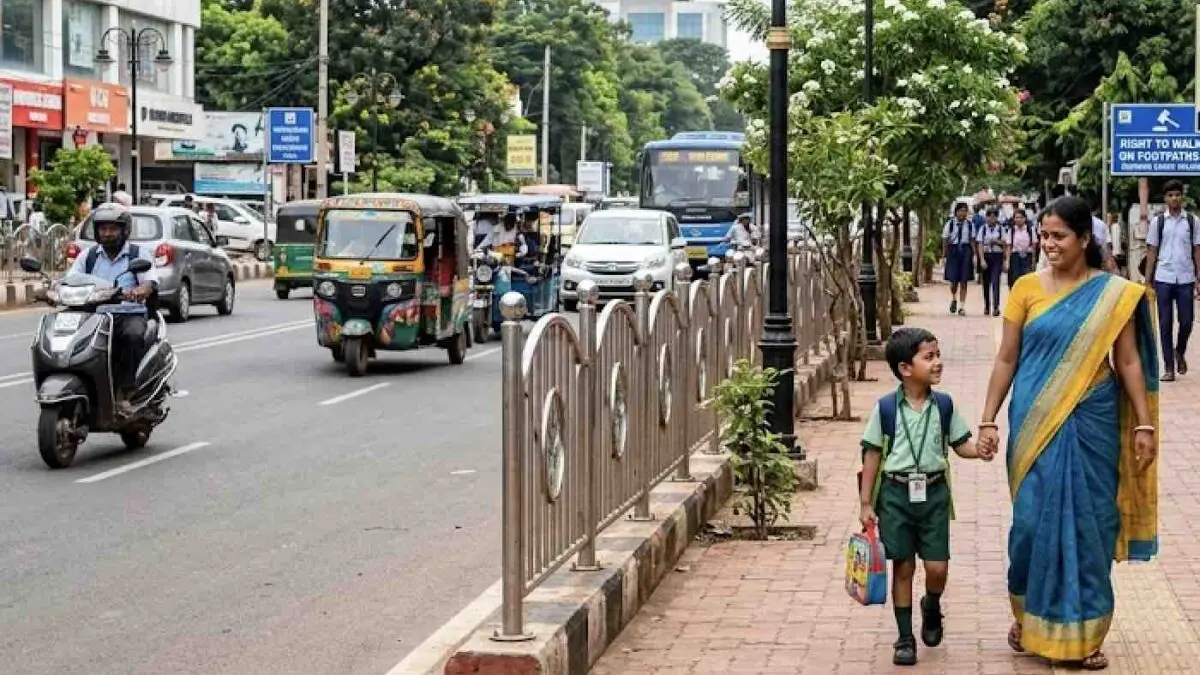
In my school days, my parents, teachers, and society taught me to always walk on the left side of the road. Back then, I was barely aware of the term ‘footpath’. It was only during my university years that I understood the importance of proper footpaths and zebra crossings in cities. Yet, we rarely saw them implemented well. Out of fear of being hit from behind, I often chose to walk on the right side of the road, facing the oncoming traffic, believing it was safer to see vehicles approaching.
As both a cyclist and a pedestrian, I still feel like I am praying to the gods and goddesses every day for a safe passage. When I went abroad on a fellowship for higher studies, I realised how transformative well-designed pedestrian footpaths and cycling tracks can be. Often running parallel to major roads or separated by physical barriers such as street gardens, canals, or barricades, they demonstrate that pedestrian and cycling infrastructure are not separate elements but two sides of the same coin.
The situation in India may soon change for the better. Pedestrian paths matter because they are fundamental to urban safety, public health, and equitable mobility. They provide essential physical separation from moving traffic, prevent severe accidents, reduce emissions, and allow vulnerable groups — especially children, the elderly, and persons with disabilities — to navigate cities safely.
The Supreme Court of India has now declared that the right to walk safely on demarcated footpaths is a Fundamental Right under Articles 19(1)(d) (freedom of movement) and 21 (right to life) of the Constitution. The ruling establishes that pedestrian safety must take priority over motorised vehicles and mandates local authorities to provide and maintain safe, obstruction-free walkways.
Justice P S Narasimha, in the judgment, said: “If a road exists, there must be a duty to ensure that a footpath is demarcated and maintained for walkers. This is an enforceable duty. The fundamental right to walk on demarcated footpaths shall override the privilege of a motorised vehicle.”
In contrast, the Supreme Court ruled on February 10, 2025, that dedicated cycle tracks are not a top priority, noting that states are still struggling to provide basic amenities like housing, making separate cycling infrastructure a secondary concern.
From an urban planner’s perspective, however, cycling and pedestrian infrastructure cannot be viewed in isolation. Despite investing thousands of crores in road infrastructure over the years, no Indian city has emerged as a true model for safe footpaths and cycle tracks. This is largely because planners, engineers, politicians, and bureaucrats often fail to consider pedestrians and cyclists in their decision-making. Many of them travel in government-provided vehicles with VVIP privileges, making it easy to overlook the daily struggles of those on foot or on two wheels.
Twenty-five years ago, after returning from abroad, I began advocating with the government for dedicated space for pedestrians and cyclists. Around fifteen years ago, I saw a ray of hope when the government agreed to build a 20-km dedicated cycling and pedestrian corridor along the road connecting Bhubaneswar Airport with Nandankanan Zoo — touted as India’s first such facility. It was a proud moment. Sadly, the corridor was cons
tructed over the city’s rainwater drainage system. Within a year, a flash flood exposed the flawed design: construction debris had blocked the drains, and the paths had to be cut open like “dissection tables” to let water flow. The incident shattered public trust. Over time, those spaces were gradually encroached upon by car parking, hawkers, and street vendors.
Since then, Bhubaneswar has made several attempts to develop proper footpaths, sometimes combined with cycling lanes. Two models worth replicating with suitable modifications are Patel Marg, where footpath and cycling have been integrated, and Smart Janpath, primarily for footpaths. These give the city a genuine opportunity to become a model for other Indian cities.
Learning from the past, Bhubaneswar should now prioritise safe passages for pedestrians and cyclists. In some areas, shared spaces or ‘slow streets’ may be more practical. When streets are designed for people rather than just vehicles, cities become more functional, vibrant, and economically vibrant. Studies consistently show that safe, walkable neighbourhoods boost local commerce and increase property and rental values.
Walking and cycling are also the most accessible forms of physical exercise. Shifting short trips of less than 5–10 minutes from fossil-fuel or electric vehicles to active mobility can significantly reduce sedentary lifestyles, lower the risk of chronic diseases, and cut greenhouse gas emissions. Sidewalks, vending zones, plazas, and pedestrian-cyclist-only areas also serve as shared community spaces that foster social interaction and a stronger sense of belonging. These will encourage social interaction and foster a sense of belonging, making the city feel welcoming while meeting the objectives of Patha Utsav.
However, effective planning requires keeping pedestrians and cyclists in mind from the outset through clear footpaths, protected cycle tracks, proper crosswalks, and reduced vehicle speeds, especially in narrow old-town streets. The benefits are clear: a sharp reduction in traffic fatalities and truly equitable mobility for children, the elderly, and persons with disabilities.
The Tragic Backdrop
This landmark judgment came in response to the death of a five-year-old boy, who was crushed by a truck while walking to his neighbourhood school with his father. The court emphasised that the Constitution guarantees every citizen the right “to move freely throughout the territory of India”, describing safe walking on wide footpaths as one of the simplest yet most fundamental human activities, inextricably linked to the right to life.
The case echoes a powerful movement in the Netherlands. In 1972, following a tragic spike in road deaths when over 3,000 people, including more than 400 children, were killed in 1971 alone, journalist Vic Langenhoff, whose own child had been killed in a car accident, wrote a series of articles with the dramatic headline ‘Stop de Kindermoord’ (Stop the Child Murder). The grassroots movement that followed, with parents, children, and activists staging protests, sit-ins, and street play days, forced the Dutch government to fundamentally shift its urban planning from car-centric to people-centric. Today, the Netherlands is world-renowned for its safe, vibrant pedestrian and cycling culture.
The young father who lovingly prepared his five-year-old son and left home at 9 am to walk him to school could never have imagined it would be their last walk together.
May this tragedy be the last of its kind. Let Indian cities draw inspiration from the Dutch ‘Stop de Kindermoord’ movement and undertake a similar transformation, moving decisively from car-centric planning to pedestrian, and cycling-friendly cities. This could well become the foundation for a nationwide culture of safe, people-first streets across India.
(Views expressed by the columnist are personal and do not necessarily reflect the opinion or policy of the news portal)