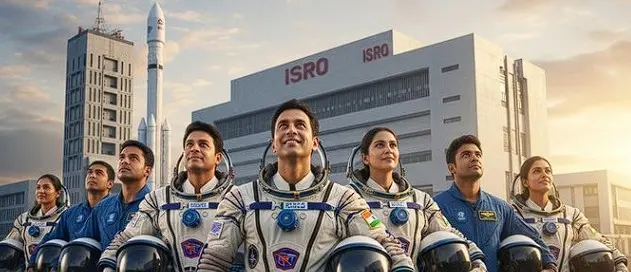
Bengaluru: The Indian Space Research Organisation (ISRO) is taking a major step in its human spaceflight strategy by welcoming civilians into its astronaut ranks, moving away from an exclusive focus on military test pilots to support a robust, enduring space initiative.
ISRO’s astronaut selection and management committee has endorsed a mixed second batch featuring both military personnel and civilians, as reported by The Times Of India.
Mixed Military-Civilian Batch
The planned group totals 10 astronauts, with six mission pilots from military aviation and four specialists from science, technology, engineering, and mathematics (STEM) disciplines.
This differs sharply from the Gaganyaan programme’s first batch, made up solely of Indian Air Force test pilots like Air Commodore Prashanth Nair and Group Captains Shubhanshu Shukla, Ajit Krishnan, and Angad Prathap.
Military selections will now extend to combat helicopter pilots, enhancing the team’s hands-on experience.
Future Plans & Hurdles
Civilian integration underscores ISRO’s forward-looking goals. After validating technologies in initial Gaganyaan flights, the agency aims for ongoing orbital activities, such as routine crewed launches, experiments, and roles in the Bharatiya Antariksh Station.
Civilians won’t debut on missions soon; they’re projected for crews from the fourth Gaganyaan flight, following established international protocols that prioritise military flyers until protocols solidify.
Tied to rising mission rates — potentially two yearly, with 2-year astronaut rotations — a complete training cycle spans about 4.5 years.
Crew sizes may grow to three from the seventh mission, thanks to crew module enhancements, while later batches like the third could feature eight civilians and two pilots. The committee proposes a 40-person cadre for sustained operations, partnerships and replacements.
Significant obstacles remain, notably the lack of a permanent astronaut training facility—ISRO currently depends on a makeshift arrangement—and delays in key technology like the Environment Control and Life Support System (ECLSS).
Yet, this civilian push represents a landmark shift, positioning more Indians to carry the nation’s flag into space.
Despite the hurdles, however, the inclusion of civilians signals a historic step towards empowering a wider array of Indians to bear the national banner beyond Earth’s bounds.