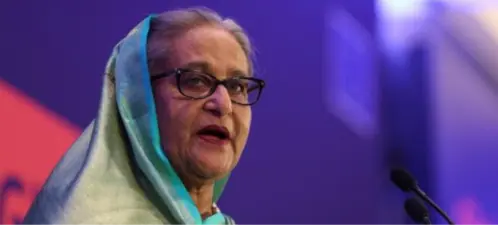
Dhaka: Bangladesh has dismissed suggestions that India may be seeking conditions before allowing former prime minister Sheikh Hasina to return home. A senior adviser to Prime Minister Tarique Rahman said no foreign government could decide the terms of her return and that Dhaka would not accept demands it considered unfair.
Information Adviser Zahed Ur Rahman made the remarks on Tuesday after a BBC Bangla report said India had indicated two requirements for facilitating Hasina’s extradition. He said Bangladesh had made a formal request for her return under the extradition treaty and that any case against her would be handled according to Bangladeshi law.
“Neither India nor any other country can dictate terms on this,” Zahed said at a media briefing in Dhaka when asked about a BBC Bangla report claiming that India had indicated two conditions for facilitating Hasina’s return.
“Bangladesh is now an independent, sovereign state standing on firm legal ground and it will reject any unjust terms,” he said.
Despite his strong statement, Zahed said he did not expect India to impose conditions on Hasina’s return. He maintained that Bangladesh’s legal system would govern the proceedings once she was back in the country.
“The (Bangladesh) government has formally requested her return in light of the extradition treaty. Her trial will be conducted under the prevailing laws of Bangladesh,” he said.
He also said Bangladesh had remained independent and sovereign since August 5, 2024, and that unfair pressure or conditions could not extract anything from the country, as reported by The New Indian Express.
What India Reportedly Wants
Hasina has been in India since August 2024, when a student-led uprising removed her government from power. The BBC Bangla report, which cited unnamed Indian officials, claimed that New Delhi wanted the Bangladesh Army to take direct custody of Hasina.
The report said this could be done through a military flight to Delhi or at a land border crossing. India was also reported to have sought judicial safeguards, including assurances that Hasina could appeal her death sentence and be given a fresh trial.
Bangladesh State Minister for Foreign Affairs Shama Obaid Islam had already rejected the reported conditions on Monday, saying no such discussions had taken place between Dhaka and New Delhi. India’s Ministry of External Affairs spokesperson Randhir Jaiswal said on Friday that Hasina’s extradition was a legal matter and would be handled accordingly.
“India desires a positive, constructive and forward-looking relationship with Bangladesh,” he said.
Legal Process & Return Plans
Bangladesh’s International Crimes Tribunal convicted Hasina in November 2025 of crimes against humanity over her government’s crackdown on protesters during the July–August 2024 uprising. Tried in absentia, she was sentenced to death on one charge and life imprisonment on another. Hasina has rejected both the charges and the proceedings.
Law Minister M Asaduzzaman said on Saturday that Dhaka had completed all legal steps needed to secure
Hasina’s return from India. He said the next decision rested with New Delhi.
“We have completed everything required from our side as part of the legal process. What they (India) will do is up to them,” he told reporters.
Asked whether Hasina could appeal her death sentence, Asaduzzaman said the Supreme Court’s Appellate Division had no legal provision to condone delays in filing appeals in crimes against humanity cases.
Hasina has said since July that she intends to return to Bangladesh voluntarily in December and face legal proceedings, despite saying her life could be at risk. Dhaka, however, has insisted that her return must be arranged under the bilateral extradition treaty.
Last week, Hasina asked Bangladesh’s High Commission in New Delhi for a new passport and national identity card. Through her lawyer, she emailed the Acting High Commissioner and requested that the documents be issued.reuters+1
Hasina, daughter of Bangladesh’s founding leader Sheikh Mujibur Rahman, ruled the country for 15 years before being removed from power. Her Awami League government was accused of human-rights abuses and suppressing dissent.
After her ouster, the Muhammad Yunus-led interim government disbanded the Awami League, which had led Bangladesh’s 1971 Liberation War against Pakistan. The current BNP government has supported the ban.